
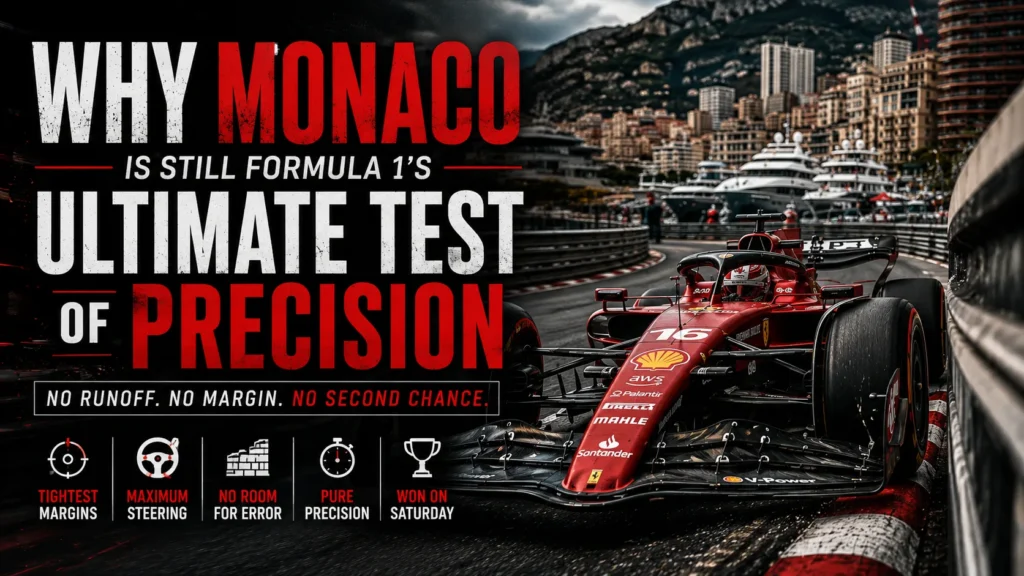
Emerging from the darkness of the tunnel at 290 km/h, the transition into the piercing Mediterranean light takes less than a tenth of a second. For that microscopic pocket of time, a Formula 1 driver is flying blind. The eyes strain to adjust while the carbon-fiber chassis beneath them violently tracks the crests of the public asphalt.
Ahead lies the heavy braking zone for the Nouvelle Chicane. It is a sequence where the guardrails sit close enough to clip a car’s wing mirrors. There are no expansive asphalt run-off areas here, nor any deep gravel traps to cushion an over-ambitious entry. There is only the unyielding steel of the Armco barriers.
To extract lap time from a modern Grand Prix car here is to flirt continuously with structural disaster. The steering wheel undergoes a rapid, high-frequency ballet of millimetric corrections. Turn in a fraction of a millisecond too early, and the inside front tire catches the barrier, snapping a carbon suspension wishbone. Turn in too late, and the rear step-out sends the car spinning into the opposite wall.
This remains the weekend reality of the Monaco Grand Prix—a recurring exercise in controlled chaos that defies modern circuit design standards. As top-tier racing machinery has evolved into long-wheelbase, heavy hybrid platforms generating immense downforce, the street layout of Monte Carlo has remained largely frozen in time. The cars grew; the streets did not.
The physical and psychological pressure of executing a flawless lap during Monaco qualifying is unique in modern motorsport. It demands an absolute commitment that pushes both driver and machine to the brink of mechanical survival. Three-time World Champion Nelson Piquet famously summarized the sheer spatial absurdity of the challenge with enduring clarity:
Yet, despite decades of escalating safety parameters and extensive track reconfigurations elsewhere, the Monaco F1 circuit remains a crucial fixture on the calendar. It stands as an atmospheric, technically brutal anachronism. It is an arena where raw engine horsepower and aerodynamic efficiency are stripped of their supremacy, revealing a deeper competitive truth. Monaco is not Formula 1’s fastest circuit—it is Formula 1’s most unforgiving test of precision.

SECTION 1 — THE HISTORICAL PARADOX: WHY MONACO SURVIVES
To understand why international motorsport continues to return to these narrow, high-camber public roads requires stepping back into the sport’s foundational mythology. Long before the advent of purpose-built racing facilities with acres of painted runoff, Grand Prix racing was an elite exhibition carved directly out of the public domain.
The genesis of street racing in Monte Carlo dates back to 1929, when Antony Noghès, president of the Automobile Club de Monaco, successfully organized an independent race within the principality’s tightly packed borders. The inaugural event linked the distinct districts of La Condamine, Monte Carlo, and the harbor front into a seamless 3.337-kilometer ribbon of tarmac.

As chronicled in the Monaco GP history archives on Formula1.com, the event quickly transcended its status as a regional race to become the spiritual epicenter of international racing culture. Alongside the Indianapolis 500 and the 24 Hours of Le Mans, it formed the legendary Triple Crown of Motorsport—the ultimate benchmark of a driver’s versatility and bravery.
While other classic venues like Spa-Francorchamps and Monza were systematically widened and re-profiled to accommodate skyrocketing cornering speeds, Monaco resisted major structural overhauls. This survival across nearly a century of competition is an anomaly driven by specific factors:
Cultural Prestige: A victory on these streets carries a historical weight that modern, rubber-stamped Tilke-dromes cannot replicate.
Unrivaled Environment: The proximity of the harbor, historic architecture, and the intense pressure of the paddock creates an environment where every error is magnified on a global stage.
The Pure Driver Benchmark: The grid continues to view Monaco as the ultimate validation of raw, unshielded driving talent.
According to FIA historical circuit references, the core layout has seen only minor geometry changes since its inclusion in the inaugural 1950 Formula 1 World Championship. The safety barriers have evolved from simple straw bales to sophisticated steel armco, and the track surface is meticulously resurfaced with high-performance asphalt every spring.
However, the fundamental geometry of Sainte Devote, Massenet, and the Grand Hotel Hairpin remains structurally identical to the streets navigated by Juan Manuel Fangio. In an era dominated by calculated simulator loops, Monaco survives because it represents the last frontier of pure human capability operating against an uncompromising physical environment.
SECTION 2 — THE PSYCHOLOGICAL CRUCIBLE: WHY DRIVERS FEAR MONACO
The psychological toll of navigating Monaco is a compounding weight that begins the moment a driver leaves the pit lane in Free Practice 1. On a standard modern circuit, a driver can hunt for the limit through a process of trial and error. Running wide over a exit kerb carries little structural consequence. In Monaco, that process is completely inverted. The limit must be approached from the outside, millimeter by millimeter, with the absolute certainty that the first mistake will terminate the session.
The track offers exactly zero recovery margin. If a driver experiences a minor snap of oversteer at the exit of Casino Square, there is no space to unwind the steering wheel. The car will instantly strike the concrete barrier. This complete absence of run-off creates an atmosphere of claustrophobia, narrowing the driver’s field of vision to a pinpoint.
Every section of the circuit demands a distinct brand of psychological commitment. The Monaco tunnel F1 section forces drivers to manage severe sensory overload. The engine note echoes off the curved concrete walls, amplifying the auditory sensation of speed, while the sudden drop in aerodynamic downforce caused by the enclosed space makes the car feel loose at nearly 300 km/h.
Entering the high-speed Swimming Pool chicane requires blind faith in the car’s aerodynamic platform. Drivers throw the car into a quick left-right flick at over 210 km/h, intentionally clipping the inside kerbs while their peripheral vision registers the guardrails passing mere centimeters from their helmets.
The history of the race is defined by these psychological breaking points. Even the greatest masters of the sport have succumbed to Monaco’s relentless mental pressure. Ayrton Senna’s legendary qualifying performance in 1988 saw him eclipse teammate Alain Prost by an extraordinary 1.427 seconds—a lap Senna described as a transcendental experience where he was driving purely by instinct. Yet, during the Grand Prix itself, a momentary lapse in concentration while holding a massive lead sent him into the barriers at Portier, a stark reminder that Monaco punishes the slightest hesitation.
In the modern era, drivers face this exact same psychological tightrope. Whether it is Max Verstappen brushing the barriers three times in a single sector to snatch a pole position, or Charles Leclerc fighting to conquer his hometown streets, success requires a flawless blend of calculated aggression and absolute millimetric control.
GRAPH 1 — Monaco Qualifying Speed Trace Overlay
Visual Interface Reference: High-Speed Sector Comparison

What the Telemetry Reveals
A granular evaluation of Monaco Formula 1 telemetry from recent qualifying battles underscores the commitment required to extract lap time. When overlaying top-tier qualifying traces from the Tunnel through the Nouvelle Chicane, the engineering data highlights distinct driver approaches to high-speed deceleration.
Through the heart of the tunnel (1450m to 1750m), both drivers run at a flat 100% throttle commitment, their speeds climbing steadily past 285 km/h. The critical divergence occurs at the 1915-meter mark, just as the cars exit the tunnel and begin the steep descent toward the chicane.
Telemetry analysis suggests that late-braking commitment demands immense driver confidence; the driver is intentionally delaying their braking phase until well past the point where human instinct prompts deceleration. When the brake pressure is finally applied, the trace spikes instantly to maximum pressure, transitioning from 0 to 100% in a near-vertical line. The car undergoes massive longitudinal deceleration, shedding over 200 km/h in less than 60 meters.
The data indicates that while one driver may win the entry phase through late-braking bravery, an opponent often optimizes their braking stability to rotate the car earlier. This allows them to get back on the throttle quicker at the 2050-meter mark to claim a speed advantage on the exit. This subtle interplay between late-braking aggression and mid-corner rotation is the exact margin between starting on pole position or being buried in the midfield.
SECTION 3 — THE ENGINEERING NIGHTMARE: MAXIMUM DOWNFORCE SETUP
To design a competitive Formula 1 car for Monaco requires engineers to alter their standard aerodynamic templates. At high-speed tracks like Silverstone or Spa, engineering philosophy revolves around maximizing aerodynamic efficiency—minimizing parasitic drag on the straights while generating clean, stable downforce in high-speed sweeps. Monaco, by contrast, is an uncompromising hunt for maximum downforce, mechanical grip, and low-speed agility.
Because the longest straight on the circuit is merely a gentle curve along the harbor front, drag is completely irrelevant. Teams bolt on the most aggressive, deeply contoured front and rear wings in their aerodynamic arsenal, featuring hyper-steep angles of attack and massive Gurney flaps. The goal is simple: force the car into the asphalt at any cost, ensuring the tires are pressed firmly into the ground even at low speeds.

However, aerodynamic downforce scales exponentially with speed. At the ultra-low speeds that define the slower sectors of Monaco, aerodynamics alone cannot rotate the car. Thus, the setup burden shifts heavily toward mechanical grip and chassis compliance.
The Mechanical Constraints
1. Extreme Steering Lock
The most glaring engineering hurdle is the infamous Fairmont Hairpin. Taken at just 45 km/h, this 180 degree left-hander is the tightest corner in all of motorsport. A standard Formula 1 steering rack simply does not possess enough mechanical travel to navigate the bend.
To solve this, teams must manufacture bespoke front suspension wishbones and modified steering columns specifically for this race, allowing for an extreme Monaco steering precision rack clearance of 360 degree or more. Without these custom components, the car would physically nose into the outer barrier before completing the turn.
2. Suspension Softness and Compliance
Unlike the smooth surfaces of modern tracks, Monaco is a bumpy, high-camber public road replete with manhole covers and severe surface undulations. To keep the Pirelli tires in contact with this uneven terrain, teams run their suspension setups significantly softer than usual.
Anti-roll bars are softened, and the ride height is raised to prevent the floor from bottoming out over the bumps, which would stall the under-body Venturi tunnels and cause an instant loss of control. The suspension must act like a sponge, absorbing the harsh kerb strikes through the Swimming Pool chicane without upsetting the delicate balance of the aerodynamic platform. Learn more about how modern chassis adapt to varied road textures in our feature on F1 Mechanical Grip & Suspension Innovation.
3. Thermal Management and Low-Speed Traction
Managing brake and tire temperatures at low average speeds is a constant tightrope walk. Without long straights to feed high-velocity air into the cooling ducts, brakes can quickly exceed 1000 degree Celsius, leading to fluid boiling and pedal fade. Teams open up their cooling ducts to their absolute legal maximums, accepting the aerodynamic drag penalty in exchange for thermal survival.
Furthermore, because the circuit demands constant, violent acceleration from low speeds, the rear tires are subjected to immense thermal stress from wheelspin. A driver who cannot manage their traction out of Portier or Rascasse will quickly destroy their rear tires, sliding down the order as their mechanical grip evaporates.
GRAPH 2 — Steering Precision Through Swimming Pool
Visual Interface Reference: Steering Angle & Lateral G-Force Analysis

What the Telemetry Reveals
The data captured through the high-speed Swimming Pool chicane illustrates the blistering rate of change in steering input required to survive Monaco. As the car enters the first element of the chicane at 215 km/h, the steering trace shows a sharp spike to +/- 90 degree of left lock. Within a mere 0.3 seconds, the driver must completely reverse that input, slinging the wheel through center to -90 degree of right lock to avoid smashing the exterior concrete wall.
The onboard traces imply that this rapid steering oscillation subjects the driver to lateral forces transitioning violently from +3.5 G to -3.5 G. The data demonstrates that any slight hesitation in the steering rate of change immediately destabilizes the car’s slide phase.
Drivers must apply their throttle commitment coincident with the steering unwind, matching their acceleration to the millimeter as the rear tires claw for traction past the final guardrail. The data demonstrates that the absolute best drivers don’t just turn the wheel; they manipulate the weight transfer of the car to rotate the chassis using the throttle, threading the needle through a space barely wider than the car itself. For a deeper breakdown of steering wheel telemetry markers, see our comprehensive guide on How to Read F1 Onboard Telemetry Traces.
SECTION 4 — THE ULTIMATE PRIZE: WHY SATURDAY DECIDES MONACO
In modern Grand Prix racing, strategy is typically a dynamic game of chess played out across multiple tire compounds, fuel degradation curves, and overtaking deltas. At tracks like Spa or Austin, a faster car starting out of position can systematically slice through the field using the aid of Drag Reduction System (DRS) overtaking zones. In Monaco, that entire strategic paradigm collapses. Monaco is an arena where track position is absolute monarchy, meaning the entire weekend effectively condenses into a single, high-stakes hour: Monaco qualifying on Saturday.
The fundamental architecture of the circuit creates a nearly insurmountable Monaco overtaking problem. The extreme narrowness of the track, combined with the immense width of modern machinery, means that unless a leading driver commits a catastrophic error or suffers a mechanical failure, it is physically possible to defend a position while running several seconds off the ultimate pace. The turbulent “dirty air” cast off the rear of a modern F1 car stalls the front wing of any chasing vehicle, destroying its downforce and causing the front tires to overheat and slide the moment they get within one second of the car ahead.
This strategic rigidity has completely shifted the psychological focus of the weekend. Saturday afternoon in Monaco is widely considered the most intense, pressure-packed qualifying session on the global motorsport calendar. Drivers are forced to take monumental risks, skimming their tires against the walls in a bid to extract the final thousandths of a second from their machinery.
The historical data compiled from decades of racing in the Principality confirms a striking reality: pole position in Monaco is the closest thing to a guaranteed victory in all of sports.
GRAPH 3 — Pole Position Dominance Analysis
Visual Interface Reference: Grid Position vs Race Winner Historical Matrix (2004–2025)

What the Statistics Reveal
An analysis of Monaco Grand Prix results from 2004 through 2025 demonstrates the overwhelming mathematical importance of Saturday’s qualifying performance. Out of the 21 races contested in this window, 13 were won directly from Pole Position, representing an astonishing 61.9% conversion rate.
The rare instances where pole position was not converted into a victory almost exclusively involved extreme weather disruptions or colossal strategic blunders in the pit lane—such as Lewis Hamilton’s mistimed stop in 2015 or Daniel Ricciardo’s infamous missing tires in 2016.
The historical data highlights the strategic rigidity of the event. The vast majority of winners started no lower than the first two rows of the grid. Aside from a handful of P2 and P3 conversions, the timeline features an extraordinary, chaotic outlier in 2019, where Pierre Gasly was credited with a highly anomalous result amid a wild, multi-car collision and red flag restart sequence that scrambled the lower half of the top ten.
Furthermore, the Safety Car distribution chart dispels a common myth: while Monaco is high-risk, the race is rarely flipped completely upside down by random neutralizations. In 17 of those 21 analyzed races, the absence of chaotic safety car interventions allowed the pole sitter to dictate a slow, calculated pace from the front, controlling the race entirely through strategic positioning rather than outright speed. For more on historical qualifying trends across classic circuits, read our deep dive into The History and Evolution of F1 Qualifying Formats.
SECTION 5 — THE MODERN SCALE DILEMMA: STREETS VS. GOLIATH
As Formula 1 has entered its golden commercial era, marked by exploding global popularity, cutting-edge hybrid powertrains, and massive global entertainment spectacles, Monaco has found itself facing an existential crisis. The sport has evolved into a multi-billion dollar engineering war where cars are built to dominate expansive, modern facilities like Silverstone, Qatar, or Abu Dhabi. Consequently, modern grand prix cars have quite literally outgrown the Principality.
The physical expansion of the cars is staggering. In 1988, Ayrton Senna’s iconic McLaren MP4/4 featured a nimble, lightweight chassis with a total width of 1,780 mm and a wheelbase of 2,600 mm. These compact dimensions left ample open asphalt on either side of the car, allowing drivers to explore alternative racing lines, launch lunges up the inside of braking zones, and react to slides with loose, organic car control.
By contrast, the 2026 technical regulations define a grid of massive weapons. A modern F1 car stretches a full 2,000 mm wide and carries a wheelbase of 3,200 mm—an expansive footprint driven by the integration of large hybrid battery packs, extensive crash-safety structures, and complex underbody Venturi floors.
While the cars have grown wider by 220 mm and longer by a massive 600 mm, the historical boundaries of the Monaco circuit remain entirely unyielding. The average usable track width in critical sections like the run up Beau Rivage or the entry to Massenet stays locked at approximately 7.0 meters.

This structural squeeze has triggered intense debates regarding Monaco’s long-term future on the F1 calendar. Media outlets like Reuters have frequently highlighted growing concerns among senior FIA officials and team principals regarding the lack of visual spectacle during Sunday’s Grand Prix. When modern cars are lined up nose-to-tail, they resemble a high-speed train, unable to break out of single-file formation without catastrophic risk.
To combat this, the FIA has explored radical strategic interventions, including debating the implementation of a mandatory two-stop tire rule specifically for Monaco to force tactical variance in the pits. Yet, despite the ongoing criticism that the race has become a processional Sunday drive, the sport’s purists argue that altering the track or dropping it entirely would destroy the ultimate psychological test of the sport. Monaco isn’t broken; it is simply the last remaining place on Earth where the car cannot rescue the driver from a failure of precision. To understand the broader trajectory of car dimensions over the decades, explore our long-form analysis on The Scale Problem: The Real Reason Modern F1 Cars Are So Large.
GRAPH 4 — Monaco Car Size Evolution
Visual Interface Reference: Spatial Footprint Comparison (1988 vs 2026)

What the Visual Data Reveals
When you look at the physical evolution of the machinery side-by-side, the geometric crisis becomes instantly clear. In 1988, the McLaren MP4/4 was highly compact, featuring a wide track width relative to its body shell. This design allowed the car to rotate cleanly on its center axis, darting into tight corners with razor-sharp mechanical agility.
The 2026 machine is a massive, uniform rectangle. The car width and track width are maximized out to a flat 2,000 mm boundary from front to back. Coupled with a +17.6% increase in wheelbase length, the modern car requires a significantly larger physical radius just to complete a turn.
On a 7.0-meter-wide road, two 1988 cars running side-by-side consumed just 3.56 meters of asphalt, leaving nearly half the track open for racing room. Two modern 2026 cars side-by-side consume a whopping 4.0 meters, leaving a microscopic buffer zone on these high-camber, barrier-lined streets. This graphical reality underscores why modern qualifiers must be perfect: they are threading a giant needle through a medieval corridor.
SECTION 6 — TRACK MATRIX: DOWNFORCE & MECHANICAL GRIP MAP
The true essence of the Circuit de Monaco cannot be captured by looking at a standard two-dimensional track map. To understand it from the perspective of a race engineer requires analyzing the track as a shifting landscape of changing loads, friction coefficients, and mechanical demands. It is a continuous loop where every single corner requires a completely different technical compromise.

The Anatomy of the Circuit
1. Sainte Devote (Turn 1)
The race begins with a violent braking zone into a ninety-degree right-hander. Taken at 110 km/h in third gear, drivers must launch the car over a severe bump on entry while avoiding the pit lane exit wall on the left. The inside apex kerb must be clipped perfectly to position the car for the uphill climb.
2. Beau Rivage to Massenet
A long, sweeping uphill climb where the car is subjected to continuous lateral compression. Drivers must hug the left-hand guardrail to open up the entry to Massenet, a blind, cresting left-hander taken at 150 km/h. The road here drops away sharply at the apex, causing the car to go light and threaten a snap-spin into the barriers.
3. Casino Square
A classic, high-stakes corner taken in fourth gear at 160 km/h. The car must be placed within centimeters of the interior wall on the left before drifting out to brush the outer metal barrier on exit. The track surface here is notorious for its low grip, as decades of everyday public traffic have left the asphalt polished and slick.
4. Mirabeau down to the Grand Hotel Hairpin
The circuit transitions into a steep downhill drop. Drivers fight a constant front-end lock-up into Mirabeau before entering the slowest corner in Formula 1: the iconic Grand Hotel Hairpin. Here, speeds drop to an agonizing 45 km/h. Drivers cross their arms completely on the steering wheel, utilizing every single degree of custom steering lock while trying to prevent the rear anti-stall system from kicking in.
5. Portier to the Tunnel
Portier is a low-speed right-hand pocket that demands immaculate throttle application. It is one of the most critical corners on the track because it dictates the driver’s exit speed into the long, curving tunnel section. Clip the inside wall here, and the car is instantly stranded at the most remote part of the circuit.
6. Nouvelle Chicane to Tabac
Following the high-speed blast through the tunnel and the heavy braking zone of the chicane, the track flows into Tabac—a terrifying, fourth-gear left-hander taken at 195 km/h. Tabac rewards absolute confidence; the entry is blind, and the car must be slung past the armco with zero hesitation.
7. The Swimming Pool to Rascasse
The lap concludes with the ultra-high-speed chicane, followed immediately by a slow, technical entry into Rascasse and Anthony Noghès. Rascasse requires the driver to deliberately hook the front-left tire into a painted pocket of asphalt, pivoting the heavy rear end around a tight ninety-degree bend before launching down the pit straight.
What the Telemetry Reveals
This engineering breakdown maps out why Monaco cannot be conquered through raw engine horsepower or pure aerodynamic efficiency alone. A race engineer’s data charts look at Monaco as a test of transient car behavior—how cleanly the chassis transitions from heavy braking to rapid directional changes while running at low speeds.
The heatmap of a successful lap shows that the driver is almost never operating in a steady state. They are constantly manipulating the brake pressure and steering angle simultaneously, overlapping their inputs to hunt for tiny fractions of mechanical grip.
The downforce dependency zones are highly concentrated in the high-speed sweeps of Massenet and Tabac, but through the middle sector, success is dictated entirely by mechanical compliance. The data shows that the fastest cars are those that allow the driver to get back on the throttle early without triggering rear wheelspin, using a smooth, progressive application that protects the delicate rear Pirelli tires across a grueling 78-lap stint. For a historical perspective on how engineering configurations handled the dangerous eras of the sport, explore our archival feature on The Unforgiving Track Safety Reconfigurations of the 1970s and 80s.
SECTION 7 — WHY MONACO STILL MATTERS
As Formula 1 marches confidently into the future, expanding into sprawling global markets and constructing immaculate, hyper-engineered facilities designed for maximum corporate luxury, the Monaco Grand Prix stands as a defiant sentinel of a bygone era. It is easy for modern critics to point at the lack of overtaking maneuvers on Sunday afternoon and dismiss the event as an antiquated parade, a relic of motorsport’s infancy that has outlived its sporting usefulness.
But to look at Monaco solely through the lens of overtaking statistics is to fundamentally misunderstand the soul of Formula 1.

Monaco does not exist to produce artificial entertainment. It exists to provide the ultimate validation of human precision. On a modern circuit wrapped in vast tarmac run-off zones, a driver can operate at 99% of their capability, knowing that if they push past the limit into the final 1%, the penalty is merely a deleted lap time or a gentle slide across painted lines. The modern environment buffers the driver from the real-world consequences of their own limitations.
Monaco strips away that safety net completely. It forces a driver to look down the barrel of a concrete barrier at 200 km/h and make a choice. It demands that they operate at 99.9% of the absolute limit of physical possibility for 78 consecutive laps, under intense physical exhaustion, with the absolute certainty that a mistake measured in single millimeters will instantly destroy their race.
This is the psychological brilliance of Monaco. It creates a state of athletic tension that cannot be replicated anywhere else on earth. When you watch a driver hooked up on a pole-position lap on Saturday afternoon—their front wings shaving the paint off the armco, the chassis bottoming out in a shower of brilliant titanium sparks, their hands moving with the frantic, calculated speed of a surgeon—you are witnessing the purest expression of human talent in all of sport.
The machine is no longer driving the man; the man has completely mastered the machine, bending its massive hybrid power to his will inside a concrete corridor built for horses and carts.
Ultimately, Monaco survives because it is the sport’s greatest equalizer. It is a living, breathing link to the dangerous, romantic roots of grand prix racing, a place where driver mythology is written not in telemetry rooms or wind tunnels, but on the cold, hard steel of the guardrails. It remains the ultimate test of human precision—a beautiful, terrifying reminder that before you can beat the competition, you must first survive the walls.
| Track Section | Peak Speed | Key Engineering Variable | Driver Psychological Trait |
| Sainte Devote | 110 km/h | Front-Inside Suspension Compliance | Instant reaction to entry bumps |
| Massenet | 150 km/h | Underbody Ground Effect Stability | Complete faith in blind aerodynamics |
| Fairmont Hairpin | 45 km/h | Bespoke Steering Rack Clearance (+/- 360 degree) | Extreme patience and input modulation |
| The Tunnel | 290 km/h | Thermal Brake Duct Venting | Courage under extreme sensory overload |
| Tabac | 195 km/h | High-Speed Downforce Latency | Millimetric corner-entry precision |
| Swimming Pool | 215 km/h | Low-Speed Mechanical Grip Pivot | Reflexive trust during rapid weight transfers |


