
How Formula 1’s most disciplined empire lost certainty — and began rebuilding it through engineering, psychology, and reinvention.
The Silence After Dominance
The ambient lighting inside the Mercedes-AMG Petronas Formula One Team headquarters in Brackley does not flicker; it hums with a cold, invariant intensity. Underneath these clean white LEDs, the silence carries a specific, heavy weight. For nearly a decade, this facility operated with the rhythmic, rhythmic cadence of an empire that had solved the computational equation of motorsport. Victory was not an elusive variable; it was an industrial output.
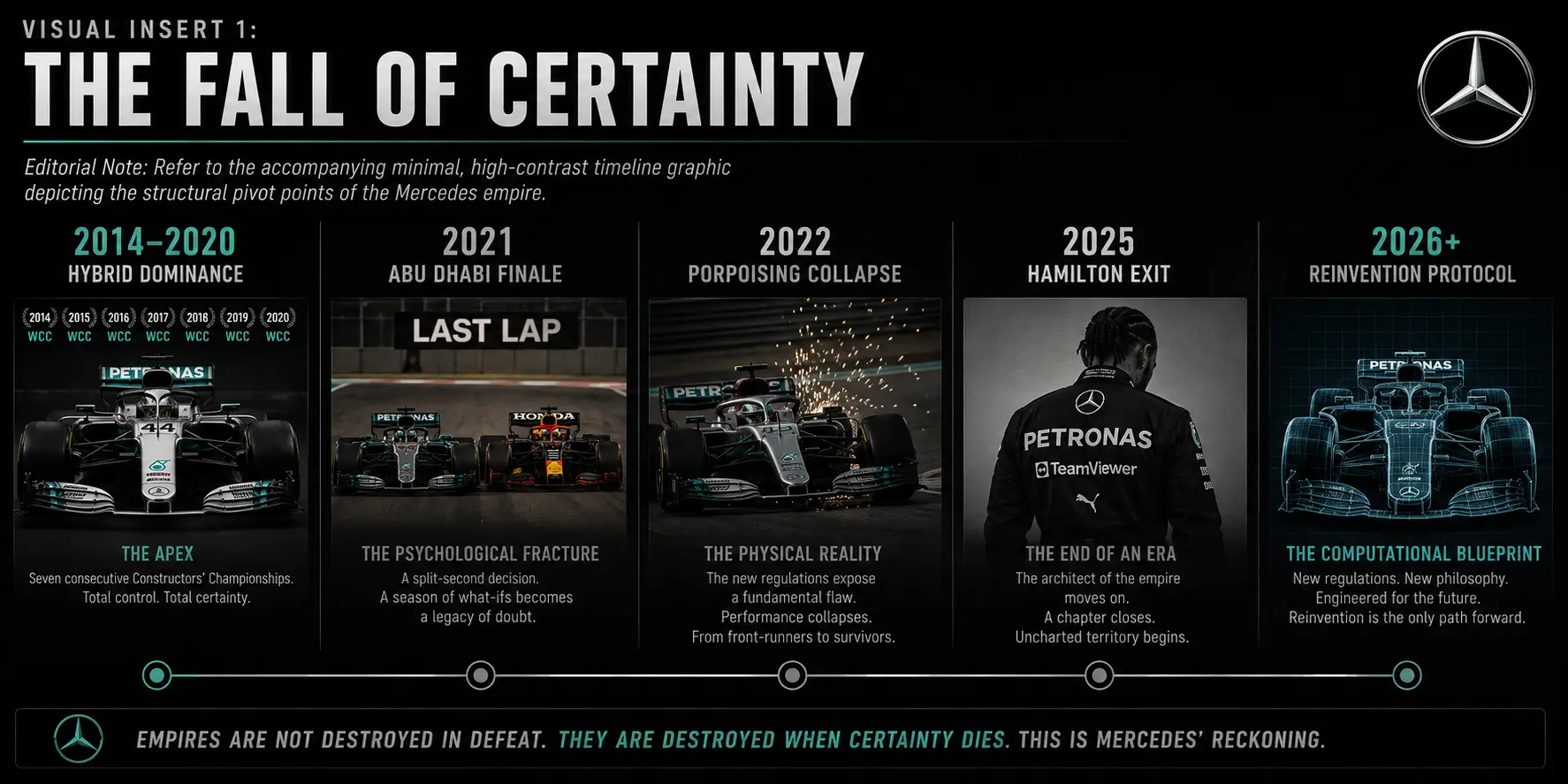
Between 2014 and 2021, the team established a baseline of competitive inevitability that reshaped the sport’s modern era. Then, the parameters changed, and the silence changed with it.
The departure of Lewis Hamilton marked a profound structural severance. When the seven-time world champion elected to conclude his historic partnership with the Silver Arrows, he left behind a design office forced to look directly into its own foundational philosophy. The historic dynasty, forged through a relentless decade of dominance, had given way to an unfamiliar operational reality: the loss of absolute predictability.
In the design offices of Brackley and the high-performance powertrain cells of Brixworth, engineers no longer dissect past titles with nostalgic longing. Instead, they analyze the mechanics of their collapse like telemetry. The initial shockwave of losing an iconic driver has crystallized into a cold, clinical determination. The panic that might dismantle a lesser organization has been systematically rejected. In its place stands a collective realization: the Mercedes F1 2026 program is no longer trying to recreate the past. It is attempting to redefine what dominance means in Formula 1.
1. How Mercedes Built Formula 1’s Most Clinical Dynasty
To understand the depth of the current Mercedes Formula 1 rebuild, one must first dismantle the mechanics of its initial ascendancy. The hybrid era, introduced in 2014, was conquered not merely through peak thermal efficiency at Brixworth, but through an uncompromising philosophy of total vehicle system integration. While rivals often designed machinery around isolated aerodynamic concepts or raw internal combustion targets, Mercedes operated as a singular, unified nervous system.
The Mercedes dominance explained itself through structural and aerodynamic predictability. The engineering department consistently delivered a chassis-engine package that established an exceptionally stable rear platform. This characteristic was critical for managing the highly sensitive thermal degradation loops of Pirelli’s spec tires. Under the regulatory framework of the early hybrid years, the team mastered the art of minimizing upper-body drag while generating highly consistent downforce across a wide spectrum of track conditions.
A primary cornerstone of this engineering triumph was the split-turbocharger layout pioneered by Mercedes High Performance Powertrains (HPP). By placing the compressor at the front of the engine and the turbine at the back, connected by a shaft running through the “V” of the internal combustion engine, Mercedes achieved revolutionary packaging advantages. This layout did not just reduce turbo lag; it allowed Brackley to design a much tighter rear bodywork envelope, significantly cleaning up the airflow to the rear wing and diffuser assembly.
This symbiotic relationship between engine and chassis departments established a baseline of operational perfection. The car’s performance envelope was intentionally wide, reducing the vulnerability to changing wind directions, track surface variations, and sudden ambient temperature shifts. It was a philosophy centered entirely on mitigation: reducing variables to eliminate engineering risk.

What the telemetry reveals
When evaluating high-speed telemetry from the peak iterations of the Mercedes aerodynamic philosophy, the data profiles exhibit an unparalleled geometric cleanliness. Where rival machineries frequently require sharp, micro-steering corrections at high-speed corner entry—indicating a volatile aero balance shifting across the car’s center of gravity—the Mercedes traces show an unbroken, linear arc.
The brake modulation and throttle confidence traces are equally telling. At the apex of high-speed sweeps, the driver input does not stagger or step. It transitions cleanly from brake release to immediate, aggressive throttle application. The rear end of the car remained locked to the asphalt, allowing the driver to commit to the throttle early without triggering a sudden aerodynamic detachment over the rear wing. Performance was generated through structural compliance and confidence, rather than volatile peaks of absolute downforce.
Operationally, this predictability was sustained by highly efficient simulator correlation. What was calculated in the digital matrix of Brackley matched the physical asphalt of the world’s race tracks with high fidelity. This feedback loop allowed the team to arrive at every grand prix weekend with an optimized baseline setup, turning Friday practice sessions into clinical validation exercises rather than desperate, reactionary troubleshooting missions.
Backed by highly disciplined pit-stop execution and a horizontal leadership structure championed by Toto Wolff, Mercedes converted the volatile sport of grand prix racing into a highly managed, low-risk manufacturing process. The team did not rely on trackside improvisation; they relied on structural validation.
2. When Ground Effect Broke Mercedes
In 2022, the mathematical model that had governed Brackley’s success suffered a catastrophic miscorrelation. The reintroduction of ground-effect aerodynamics flipped the fundamental laws of vehicle performance. Downforce was no longer primarily generated by complex upper-body wing profiles and vortex-generating barges; instead, it was dictated by the unseen fluid dynamics of venturi tunnels running beneath the car’s floor.
Believing their internal simulation models to be absolute, Mercedes embarked on a radical architectural path: the “zero-pod” philosophy. Formula1.com’s technical analysis of the W13 highlighted an incredibly narrow sidepod profile, aimed at maximizing the exposed floor area to feed the underbody tunnels. However, as noted in investigative assessments by Motorsport.com, exposing such a vast expanse of floor introduced structural flex vulnerabilities that the digital wind tunnels had failed to predict.
The car did not just underperform; it physically rejected its own design parameters. The phenomenon of Mercedes porpoising—a high-frequency aerodynamic stalling that caused the car to bounce violently on its suspension at terminal straight-line speeds—shattered the team’s engineering certainty.

The Zero-Pod concept was not a dead end — it was a necessary first step. Risk builds knowledge; knowledge builds performance.
The technical failure of the W13 lay in the extreme sensitivity of its underbody geometry. In a static wind tunnel with a uniform rolling road, the zero-pod car generated immense downforce metrics. But the wind tunnel could not fully replicate the dynamic, transient twisting of a carbon-fiber floor subjected to real-world track variations, curbing, and sudden track undulations.
When the car reached its terminal velocity on straightaways, the immense low pressure beneath the car sucked the floor panels too close to the asphalt. This physical deflection sealed the Venturi tunnels completely, causing an instantaneous aerodynamic stall. With the downforce suddenly vanished, the suspension compressed and released violently, initiating a cyclical bouncing effect that occurred multiple times per second.
Publicly available speed traces from circuits like Baku in 2022 clearly demonstrate this instability. Instead of a smooth, continuous acceleration profile toward the braking zone, the speed traces indicate subtle, high-frequency stuttering as the tires repeatedly lost optimal contact with the track surface. This mechanical bouncing destroyed braking stability and corner-entry confidence.
As technical director James Allison would later clarify in structural debriefs reported by Autosport and F1.com, the team had fallen into an intellectual trap. They had chased theoretical maximum performance peaks at the expense of real-world operational resilience.
The massive ride-height compromise required to protect the floor from fracturing on the tarmac meant running the car far outside its optimal performance window. For an institution built on absolute precision, operating in this grey zone of unpredictability caused profound frustration for Lewis Hamilton and the entire engineering core. It was an uncomfortable, prolonged lesson in the limitations of digital simulation.
3. The Hamilton Departure and the End of an Era
The structural fracture of the early ground-effect years eventually extracted its greatest institutional toll. Lewis Hamilton’s decision to execute a release clause and depart for Scuderia Ferrari was not a sudden impulse; it was a clinical assessment of a legendary partnership that had exhausted its creative momentum. For Mercedes, the departure was an uncoupling from its golden era, forcing an accelerated transition in leadership and responsibility.
The vacuum left by Hamilton altered the psychological landscape of the garage. Yet, within the clinical framework of Mercedes, this disruption was converted into an engineering objective. George Russell, who had spent years auditing the team’s methodology as a Williams junior before stepping into the primary race seat, instantly inherited the mantle of technical continuity.
The transition forced the team to look at driver input data through an entirely objective lens. Publicly available throttle and braking traces from transitional grand prix weekends reveal distinct philosophical differences in how drivers adapt to an unstable platform:
Platform Stabilization: Traces associated with Hamilton often showed a highly progressive, cautious approach to throttle application during corner exit, attempting to feel for the exact moment the rear axle stabilized before committing 100% of the torque. He fought to bring the car back into an envelope of classic balance.
Dynamic Adaptation: Russell’s traces frequently revealed a more reactive approach, featuring sharp, aggressive steering corrections and sudden throttle steps. Russell accepted the car’s volatile nature, using rapid inputs to force the chassis to rotate, overriding the aerodynamic instability through physical reflex.
| Driver | Corner Entry Strategy | Mid-Corner Manipulation | Traction Application |
| Lewis Hamilton | Extended trail-braking; searches for clean front-axle indexing. | Smooth, continuous steering arc; highly sensitive to rear-end sliding. | Deliberate, modulated throttle pick-up; mitigates snap oversteer. |
| George Russell | Sharp, definitive initial brake release; forces rapid pitch transfer. | Micro-corrections; willing to manage high slip angles at the apex. | Aggressive, direct throttle steps; relies on rapid reflex management. |
This divergence in driving style highlights the institutional shift currently underway. As Mercedes prepares for its future, including the highly anticipated integration of young talent like Kimi Antonelli, the engineering core is tasked with developing a platform that accommodates both the hyper-reflexive aggression of a new generation and the precise consistency required to sustain a championship campaign. The focus has moved entirely away from driver nostalgia toward pure technical adaptability.
4. The Toto Wolff Philosophy
At the center of this rebuilding process is Toto Wolff. As detailed in extensive profiles by the Financial Times and The New Yorker, Wolff’s leadership methodology is rooted in a highly analytical approach to human psychology and corporate structure. He has consistently rejected the blame-culture that frequently destroys underperforming Formula 1 teams, opting instead to preserve engineering transparency.
“Mercedes’ strength was never perfection — it was brutal self-awareness.”
Under Wolff’s guidance, the team treated the ground-effect failure not as an existential crisis, but as a massive data anomaly. If the system failed, it was because the parameters inputted into the system were incorrect, not because the organization had forgotten how to engineer a racing car. This distinction prevented the panic migrations of key staff that often compromise rival operations during a technical downturn.

Engineering Philosophy: We don’t guess performance. We engineer it. Data builds models. Models build understanding. Understanding builds performance. That is the Mercedes way.
The Mercedes Operating System relies on a clean, uninterrupted loop where physical track data validates virtual simulation models, thereby creating a predictable machine that maximizes driver confidence. When the ground-effect regulations decoupled correlation from predictability, Wolff did not dismantle the flowchart; he forced his engineering departments to audit the instruments measuring the data. By maintaining this structural discipline, Mercedes ensured that when the technical solutions were discovered, the team possessed the operational infrastructure to exploit them instantly.
This process required an internal overhaul of how uncertainty was quantified. The design office realized that chasing a single, monumental downforce peak in the wind tunnel was an inefficient metric if that peak could only be achieved at an unrideable ride height.
The entire development protocol was rewritten to prioritize the width of the performance envelope. New mathematical weightings were applied to simulation models, favoring concepts that delivered consistent, reliable downforce across a variety of pitch, roll, and yaw angles. The operating system evolved from a philosophy of absolute certainty to one of managed resilience.
5. Reengineering the Future
The modern era at Brackley is defined by an intensive technical correction. Recognizing that ideological rigidity had cost them years of development, the engineering team completely overhauled the mechanical and aerodynamic foundations of the car. This structural turnaround forms the core of the ongoing Mercedes Formula 1 rebuild.
The recovery began with a total redesign of the front and rear suspension geometry. Mercedes moved away from configurations that prioritized pure wind-tunnel packaging to layouts that mechanically controlled the car’s pitch and dive properties under braking and acceleration.
By implementing severe anti-dive characteristics at the front axle and anti-squat configurations at the rear, the engineers stabilized the physical platform mechanically. This prevented the floor from slamming into the ground during heavy braking phases, providing a consistent platform for the aerodynamicists to exploit.
With the mechanical foundation stabilized, the team completely scrapped the remnants of the zero-pod philosophy. The team adopted a highly sophisticated downwash sidepod architecture, designed to manage the turbulent wake generated by the front wheels while directing high-velocity airflow precisely into the rear coke-bottle region and upper surface of the diffuser.
THE STRUCTURAL OVERHAUL
Dynamic Comparison of Mercedes Fluid Concepts

Analysis of public speed-trap and GPS data across multiple aerodynamic iterations shows a significant shift in how the car generates its lap time. In the initial ground-effect years, the car suffered from high drag profiles on straightaways due to the massive wing levels required to compensate for a stalled floor.
The modern configuration shows a much cleaner straight-line trajectory, combined with highly consistent minimum corner speeds across both low- and high-speed turns. The airflow structures are no longer operating on the absolute knife-edge of stalling; instead, the downwash sidepods and complex floor edges generate controlled vortices that seal the underbody tunnels mechanically, preserving downforce levels even during high-speed pitching phases.

As the sport enters the highly anticipated 2026 power unit and aerodynamic regulation overhaul, Mercedes finds itself in a uniquely advantageous position. The historical data available on Mercedes-AMG F1’s official technical channels confirms that Brixworth has historically excelled when faced with sweeping powertrain re-architectures.
The upcoming regulatory framework dictates a near 50/50 electrical-to-thermal power split, alongside the complete removal of the complex Motor Generator Unit–Heat (MGU-H). This shifts the engineering burden entirely onto energy recovery efficiency via the Motor Generator Unit–Kinetic (MGU-K), sustainable fuel combustion, and advanced thermal management algorithms.
The development teams at Brixworth have spent years optimizing electrical energy deployment loops, a core competency that became a decisive factor during their initial hybrid dominance. While the true competitive order of the next era remains unwritten, the structural alignment between Brackley’s stabilized chassis philosophy and Brixworth’s powertrain capability indicates an organization that has successfully re-aligned its engineering compass.
6. The Search for the Next Era
The search for the next dominant era is not a quest to reclaim what was lost; it is an exercise in building an entirely new identity. The modern Formula 1 landscape does not permit the decades-long hegemony of the past. Cost caps, aerodynamic testing restrictions, and a highly competitive midfield have compressed the field, ensuring that any technical advantage is measured in hundredths of a second rather than full grid positions.
Mercedes understands this shift. The Mercedes AMG Petronas analysis reveals a team that has transformed from an unstoppable machine into an extraordinarily resilient organism. The upcoming era will be defined by how effectively George Russell’s analytical approach and Kimi Antonelli’s raw, uninhibited pace can leverage a technical platform designed around flexibility rather than ideological stubbornness.
The silver garages are quiet once more as the late-night shifts conclude in Brackley. The cold white LEDs cast crisp, sharp shadows over components destined for the dynos and test beds of the next grand prix project. The air is still filled with the scent of carbon composite and machined titanium, carrying the quiet pressure of an empire that has traded its past certainty for a sharper, more dangerous hunger.
The dynasty of the past is a matter of record. The future, however, belongs to the engineers who learned how to stand firm when the ground beneath them collapsed. Mercedes’ future success will not be determined by whether the Zero-Pod concept succeeded or failed; it will be determined by whether the organization’s engineering operating system can adapt faster than its rivals under Formula 1’s next major regulatory cycle.


