
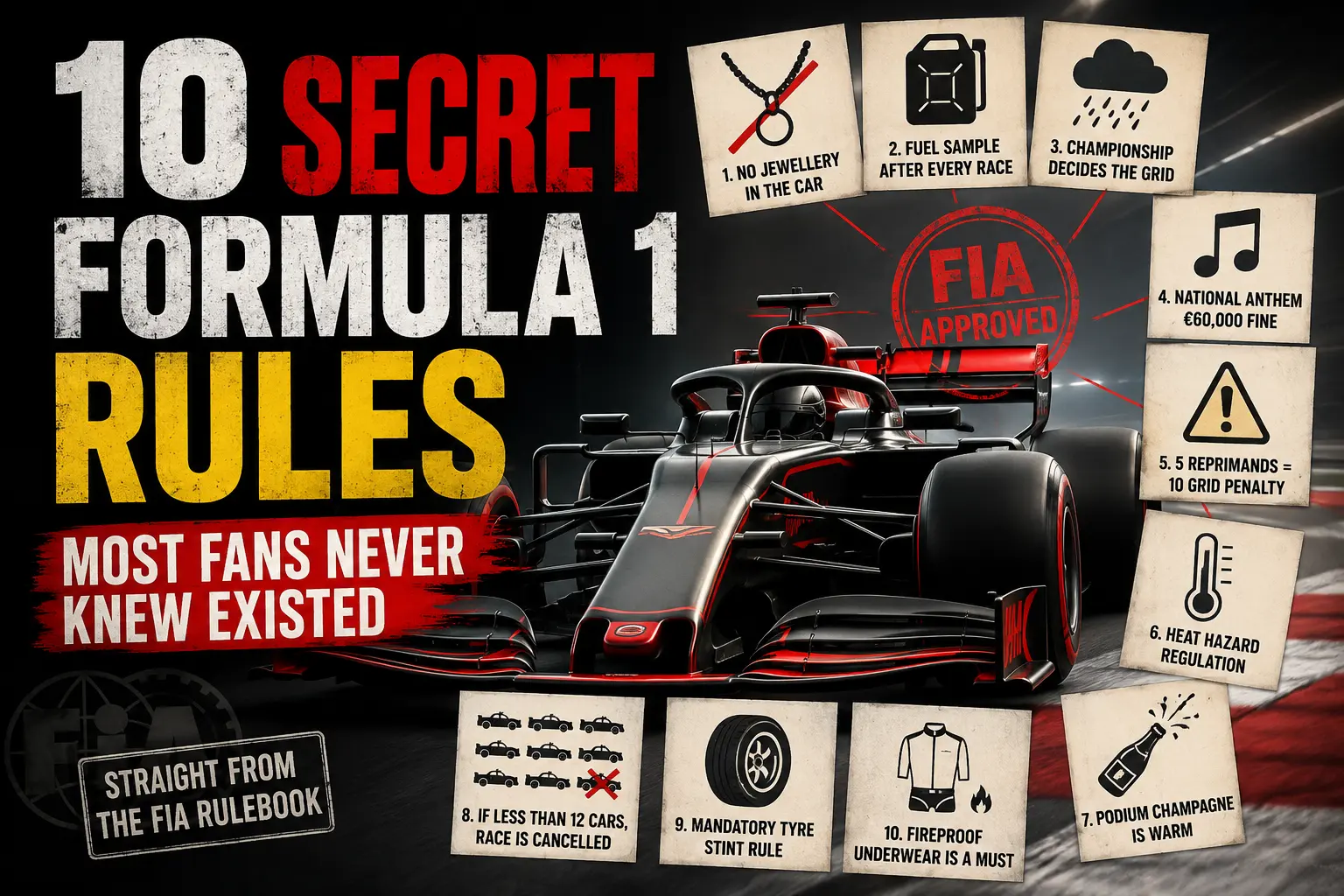
Formula 1 is known for lightning-fast pit stops, high-speed wheel-to-wheel drama, and global superstars. But beneath the glamour lies one of the most exhaustive, complex, and downright bizarre rulebooks in modern sports. The FIA (Formula 1’s governing body) regulates everything from the aerodynamic curvature of the wings to the exact temperature of the podium celebrations.
These aren’t internet rumors or paddock myths—they are genuine regulations written into the official rulebook that have directly shaped real Grand Prix results. If you are a casual viewer or a new fan who arrived via Drive to Survive, get ready to look at the grid in a whole new way. Here are ten secret F1 rules you probably never knew existed.
1. Jewellery Is Banned Inside the Car
What is the Rule?
According to official FIA safety regulations, drivers are strictly prohibited from wearing any rings, neck chains, or body piercings (including nose rings and studs) while inside their cars during a session. This rule applies the moment a driver buckles into the cockpit.
Why Does This Rule Exist?
The ban is entirely about driver safety, specifically regarding fire protection and medical interventions. In the event of an intense cockpit fire, metal jewellery can heat up rapidly and cause severe skin burns, or it could snag and tear the skin if emergency crews need to pull a driver out of the car quickly.
Famous Example
This regulation became a massive talking point during the 2022 season when the FIA began strictly enforcing it, leading to a high-profile standoff with Lewis Hamilton, who was known for his signature nose stud and earrings. Hamilton was initially given a multi-race grace period to comply with the rule before facing potential fines or penalties.
2. The FIA Takes a Fuel Sample from Every Car After the Race
What is the Rule?
At the end of every Grand Prix, teams must ensure their cars finish with at least 1 liter of fuel remaining in the tank. This fuel isn’t for driving; it is legally reserved for the FIA technical delegates to extract and inspect.
Why Does This Rule Exist?
This maintains sporting integrity and fairness. The FIA analyzes the sample to verify that the chemical composition perfectly matches the legal fuel blend declared by the team before the race weekend, ensuring no one is using illegal additives for an unfair horsepower boost.
Famous Example
At the 2021 Hungarian Grand Prix, Sebastian Vettel drove a brilliant race to finish second on the podium. However, his Aston Martin team was unable to pump the mandatory 1-liter sample out of his car after the checkered flag, resulting in an automatic disqualification from the race.
3. If Qualifying Can't Happen, the Championship Standings Decide the Grid
What is the Rule?
If extreme circumstances mean a qualifying session cannot take place at all over a race weekend, the starting grid for the Grand Prix is determined by the current Drivers’ Championship standings at that specific point in the season.
Why Does This Rule Exist?
This acts as a logistical fail-safe. If torrential rain, structural damage, or unsafe track conditions permanently cancel qualifying, F1 needs a fair, objective way to set the grid without delaying the live race broadcast.
Famous Example
The guideline was formally updated in the regulations following an extreme weather scare at the 2024 São Paulo Grand Prix where qualifying was severely delayed.
Fun Fact: If this nightmare scenario happens at the very first race of the year when there are no championship standings yet, the stewards have the absolute discretion to decide the starting order themselves.
4. Missing the National Anthem Costs You €60,000
What is the Rule?
Formula 1 drivers are legally required to be present, in full uniform, and in position on the grid for the host country’s national anthem ceremony before every Grand Prix. Arriving even a few seconds late triggers a staggering standard fine of €60,000.
Why Does This Rule Exist?
This is a matter of sporting decorum, commercial discipline, and respect for the host nation. Because the pre-race ceremonies are broadcast live to millions of people worldwide, the FIA demands that all twenty drivers act as professional ambassadors.
Famous Example
At the 2025 Japanese Grand Prix, Carlos Sainz arrived moments after the national anthem had already commenced due to a sudden stomach issue. While a formal doctor’s note verified his medical condition and convinced the stewards to reduce the penalty to €20,000, the fine still stood because being sick is not a full exemption under the rules.
5. Get 5 Reprimands in a Season and You Drop 10 Places on the Grid
What is the Rule?
The FIA issues “reprimands” as formal warnings for minor offenses. While a single reprimand carries no immediate sporting penalty, accumulating five reprimands within a single season triggers an automatic, mandatory 10-place grid penalty for the driver’s next race.
Why Does This Rule Exist?
It serves as a behavioral deterrent. It ensures that drivers face real consequences if they consistently break minor rules, preventing them from treating warnings casually.
Famous Example
Sebastian Vettel famously received a non-sporting reprimand in 2021 for wearing a “Same Love” t-shirt during the national anthem ceremony. Even though it wasn’t an on-track driving violation, it still legally counted toward a driver’s season total.
6. Drivers Must Wear Fireproof Underwear
What is the Rule?
Drivers cannot just wear comfortable everyday clothes under their racing suits. FIA regulations mandate that every driver must wear fire-resistant long underwear, socks, gloves, and a balaclava beneath their primary race suit—all strictly certified to official safety standards.
Why Does This Rule Exist?
F1 cockpits are surrounded by fuel and high-voltage hybrid batteries. If a major crash occurs and a fire breaks out, these specialized layers provide critical extra seconds of thermal protection against severe burns while the driver escapes the vehicle.
Famous Example
The FIA actively monitors this, and officials can inspect compliance at any point during a race weekend. Going without the approved fireproof undergarments results in a steep fine or worse.
7. The Podium Champagne is Warm. On Purpose.
What is the Rule?
Those iconic, giant bottles of sparkling wine sprayed by the top three drivers on the podium are never chilled in a refrigerator before the ceremony. Instead, they are intentionally kept and delivered at room temperature.
Why Does This Rule Exist?
This rule exists purely for the visual spectacle of the television broadcast. Cold sparkling wine doesn’t spray well because the liquid holds onto its gas; warm bottles build up far higher internal pressure, creating a massive, dramatic explosion of bubbles when uncorked.
Famous Example
If you watch closely during any post-race celebration, you’ll see the massive physical distance the spray travels. This trick is a staple of podium logistics designed entirely for the entertainment of fans.
8. If the Race Can't Start With 12 Cars, It Gets Cancelled
What is the Rule?
To officially hold a Grand Prix, the FIA requires a minimum of 12 cars to be present on the starting grid. If a series of massive multi-car accidents, mechanical failures, or sudden team disqualifications reduce the grid below 12 cars before the lights go out, the race cannot legally proceed.
Why Does This Rule Exist?
This protects the sporting value and integrity of a World Championship event. A race with fewer than 12 cars lacks sufficient competitive substance for global fans, broadcasters, and sponsors.
Famous Example
This regulation is so obscure that it has never actually been triggered in modern F1 history—the closest being the infamous 2005 US Grand Prix where only 6 cars raced, but because 20 cars technically started the formation lap, the rule wasn’t violated.
9. The Heat Hazard Regulation
What is the Rule?
If the official weather service predicts that the heat index will exceed 31°C at any point during a Sprint or Grand Prix, the FIA officially declares a “Heat Hazard”. Once declared, teams are legally obligated to fit an advanced “Driver Cooling System” to the cars.
Why Does This Rule Exist?
This is a direct response to driver health and safety. Cockpits can act like ovens, and excessive cabin heat poses a severe risk of heat exhaustion, dehydration, and blurred vision at 200 mph.
Famous Example
The FIA began researching and ultimately introduced this protocol following the brutal 2023 Qatar Grand Prix, where extreme track temperatures caused several drivers to throw up in their helmets or require urgent post-race medical attention. The protocol was recently activated at the hot Austrian Grand Prix weekend.
Fun Fact: While the internal cooling pump must be fitted to the car, drivers can choose not to wear the liquid-cooled vest itself; however, the team must then add a 0.5kg weight ballast to the cockpit to keep things perfectly fair.
10. Mandatory Maximum Tyre Stint Limits
What is the Rule?
While teams usually have total freedom over how long they run a set of Pirelli tyres, the FIA reserves the right to impose a strict, legally binding maximum number of laps that any single set of tyres can perform during the race.
Why Does This Rule Exist?
This rule acts as a safety intervention. If a specific track feature—like aggressive, sharp curbs—causes unforeseen structural degradation to the tyres, the FIA steps in to prevent dangerous high-speed blowouts.
Famous Example
This rule dictated the entire strategy of the 2023 Qatar Grand Prix. Due to safety concerns regarding the circuit’s “pyramid” curbs separating the tyre tread, the FIA mandated that no tire could be used for more than 18 laps. This forced every single team into an unprecedented, mandatory three-stop race strategy.
Conclusion
Formula 1 is far more than just fast cars, roaring engines, and famous drivers. Behind every thrilling overtake and podium celebration is a massive, highly specific rulebook that quietly dictates the boundaries of the sport. The next time you sit down to watch a Grand Prix, look beyond the racetrack—understanding these hidden regulations reveals an entirely new, fascinating layer of strategy and survival that makes F1 the pinnacle of motorsport.


