
In Formula 1, every single millimeter of a car is a closely guarded secret. Aerodynamic surfaces are the product of thousands of hours in a wind tunnel, underneath the digital scrutiny of Computational Fluid Dynamics (CFD) servers, and at a cost of millions of dollars. Teams go to extraordinary lengths to obscure their designs, deploying mechanics to form human walls in front of garage openings and wrapping bodywork in intricate camouflage patterns during shakedowns.
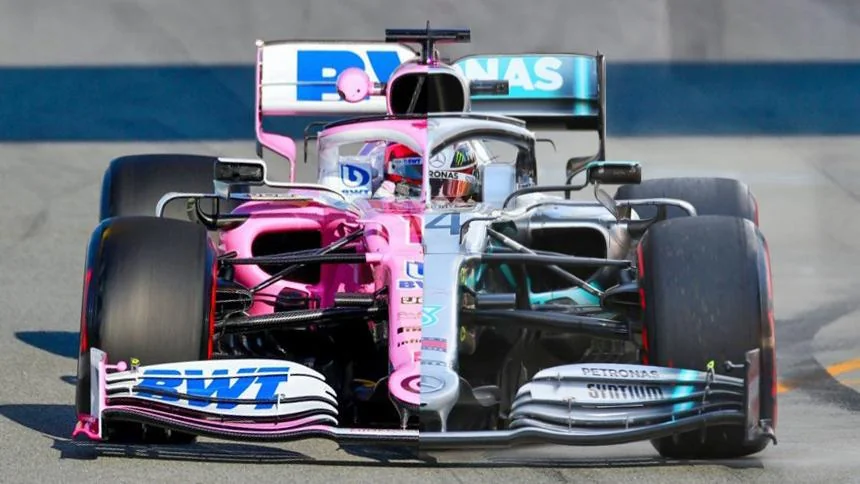
Yet, when the sheet was pulled off the Racing Point RP20 at the pre-season test in Barcelona, the entire pit lane fell silent. Standing before them was a car that did not merely look inspired by another; it appeared to be a millimeter-perfect, pink-painted replica of the Mercedes-AMG F1 W10 EQ Power+—the machine that had crushed the world championship the previous season.
To some inside the paddock, it was a masterful display of engineering efficiency, an underdog team finding a loophole to leap toward the front of the grid. To others, it was industrial espionage disguised as innovation, a direct threat to the core identity of Formula 1 as a constructor-led sport. The Federation Internationale de l’Automobile (FIA) would eventually find itself arbitrating a case where both interpretations held weight.
This saga was never just about a pink car. It became an ideological battleground over a fundamental question that has challenged the sport since its inception: Can a Formula 1 team legally copy another competitor’s car? To understand the answer, one must look beyond the bodywork and step into a high-stakes world where creative interpretation meets the letter of the law.
Chapter 1: Formula 1 Has Always Copied Success
To view the “Pink Mercedes” as an isolated incident is to misunderstand the history of grand prix racing. Formula 1 has never been an open-source science project, nor has it been a gallery of purely isolated artistic expressions. It operates on a principle of convergent engineering. When one team uncovers a physical truth about airflow, vehicle dynamics, or combustion efficiency, the laws of physics dictate that every other team must eventually head in that same direction or face competitive extinction.
Consider the revolution of the ground-effect “wing car” pioneered by Colin Chapman’s Team Lotus in the late 1970s. Once the paddock realized that underbody venturi tunnels could pull a car down to the tarmac with unprecedented force, every single drawing board in England and Italy was scraped clean. Within two seasons, the entire grid had transformed into variations of the Lotus concept.
The same pattern repeated when Tyrrell introduced the high-nose concept in 1990, and when Red Bull perfected the blown diffuser under Adrian Newey in the early 2010s. Iteration and adoption are the twin engines of grid evolution.

However, historical copying relied heavily on adaptation. A team would observe an opponent’s front wing layout, deduce the vortex structures it was trying to generate, and then sketch their own version tailored to their car’s specific wheelbase, weight distribution, and engine packaging. You could not simply bolt a Ferrari sidepod onto a Williams and expect it to work; the underlying mechanical architectures were too fundamentally distinct.
The true shift of the modern era was not that teams were looking at each other’s ideas—it was the precision with which they could extract, process, and replicate them. As digital tools grew more sophisticated, the boundary between being inspired by a competitor and mechanically duplicating them began to blur, setting up a inevitable collision between classic design philosophies and twenty-first-century technology.
Chapter 2: The Birth of the Pink Mercedes
The story of the RP20 began not in a design office, but in a state of financial desperation. The team known as Racing Point had spent years overachieving under the banner of Force India. Operating on a fraction of the budget of corporate titans like Ferrari or Mercedes, the Silverstone-based outfit specialized in building remarkably efficient mid-field cars. But by the summer of 2018, the financial walls collapsed, forcing the team into administration.
Enter a consortium led by Canadian billionaire Lawrence Stroll. The buyout saved hundreds of jobs and injected capital into an organization starved of resources, but money cannot instantly buy championships in Formula 1. It takes years to build wind tunnels, scale up composite manufacturing departments, and recruit top-tier aerodynamicists.
For the 2019 season, Racing Point raced the RP19—a car heavily compromised by the financial chaos of the previous year. It was slow, difficult to balance, and left the team languishing in seventh place in the Constructors’ Championship.
Technical Director Andy Green and his engineering team faced a stark choice for 2020, the final year before a massive sweep of technical regulations was scheduled to arrive (regulations that were ultimately delayed to 2022 due to the global pandemic). They could continue developing their traditional “high-rake” aero concept, which tilted the car forward to use the floor as a giant wing, or they could pivot completely.
Racing Point had long purchased its engines and gearboxes from Mercedes. The Mercedes gearbox casing was designed explicitly for a “low-rake” aerodynamic philosophy, meaning the car ran flat and close to the ground. For years, Racing Point had fought against this mechanical DNA, trying to force a low-rake Mercedes rear end into a high-rake car concept.
In late 2019, Green decided to stop fighting the architecture. The team abandoned their development path and committed to an unprecedented strategy: they would use every legal tool at their disposal to replicate the aerodynamic philosophy of the 2019 world-championship-winning Mercedes W10.
When the RP20 hit the track at Circuit de Barcelona-Catalunya in February 2020, it didn’t just mimic the Mercedes philosophy; it mirrored its physical form. The tightly packaged sidepods, the slender nose cape, and the complex floor details looked identical to the Silver Arrow. The paddock went into a frenzy. Red Bull Racing personnel were spotted leaning over pit lane railings with cameras, while Renault executives held hurried meetings with legal counsel. The “Pink Mercedes” was born, and the fuse on an explosive political bomb had been lit.

Chapter 3: Reverse Engineering: The Most Misunderstood Skill in Formula 1
To the casual observer, what Racing Point did looked like tracing a drawing. Critics accused the team of using leaked computer-aided design (CAD) files or obtaining data through illicit means under the table from Mercedes. But the reality within modern engineering is far more complex. Replicating a modern Formula 1 car from the outside look is an incredibly difficult technical feat in its own right.
Racing Point achieved their design through a highly advanced process of digital reverse engineering. Because they had no legal access to Mercedes’ internal aerodynamic surface data, they had to rebuild the car’s exterior geometry using trackside photography. This wasn’t done with standard consumer cameras, but with high-resolution, long-lens photography taken from precise angles during race weekends.
The core technology behind this is photogrammetry—the science of extracting 3D coordinates from 2D photographic data. By taking dozens of photos of a stationary Mercedes W10 in the pit lane or paddock and processing them through advanced software, engineers can map out the exact surface curvatures of an opponent’s bodywork.
The workflow from trackside observation to a physical racing component requires a rigorous sequence of engineering gates:
This process highlights why simple imitation is impossible. If a surface profile is off by a single millimeter, the delicate airflow structures—such as the vital “Y250 vortex” shed by the front wing—will break down completely, causing the floor to stall and stripping the car of vital downforce.
Racing Point didn’t just copy a shape; their engineers had to deeply understand why every curve on the Mercedes W10 existed. They had to validate those shapes within their own simulations and ensure that their wind tunnel data matched the real-world performance of the car. It was an elite-level engineering effort, but it skirted the edge of a crucial regulatory boundary.
Chapter 4: The Rule Nobody Understood
To understand how Racing Point believed this approach was entirely legal, one must dive into the dense lexicon of the FIA’s Sporting and Technical Regulations. At the heart of the debate was a shifting classification of components designed to balance financial sustainability with constructor integrity.
The regulations divided a Formula 1 car’s components into distinct legal categories:
Listed Parts: These are the components that a team must hold the exclusive intellectual property rights to. They must design and manufacture these parts themselves, or outsource the design to an independent third party that does not compete in Formula 1. Examples include the monocoque (chassis), survival cell, and all aerodynamic surfaces exposed to the airflow.
Transferable Components (Non-Listed Parts): These are parts that teams are legally allowed to purchase from a competitor. This framework allows smaller teams to buy expensive under-the-skin mechanical systems, saving millions in development costs.
| Component | Classification | Can be Purchased from Competitor? | Must be Designed by Team? |
| Engine (Power Unit) | Transferable Component | Yes | No |
| Gearbox Casing & Hydraulics | Transferable Component | Yes | No |
| Suspension Internal Elements | Transferable Component | Yes | No |
| Chassis / Monocoque | Listed Part | No | Yes |
| Front Wing Assembly | Listed Part | No | Yes |
| Rear Wing Assembly | Listed Part | No | Yes |
| Brake Ducts | Shifted Category (2019 to 2020) | No (from 2020 onward) | Yes (from 2020 onward) |
This structural breakdown created a fascinating design landscape. Racing Point was already legally buying its power units, gearboxes, and rear suspension assemblies directly from Mercedes. Because the rear suspension geometry dictates how air flows around the rear of the car, the team argued that it was completely logical to design a Mercedes-style aerodynamic body around those purchased Mercedes mechanical parts.
The critical issue arose because the regulatory categories are not static. The FIA regularly updates the definitions of what must be built by a constructor and what can be bought off the shelf. In the transition from 2019 to 2020, one specific assembly crossed the aisle from a transferable customer part to a strictly proprietary Listed Part: the brake ducts. This seemingly minor shift became the focal point of the entire controversy.
Chapter 5: The Brake Duct That Changed Everything
Brake ducts are highly misunderstood components. While their primary mechanical function is to channel cooling air to the carbon brake discs and calipers, their secondary role is purely aerodynamic. In modern Formula 1, brake ducts feature an array of intricate fins, turning vanes, and internal scoops designed to manage the turbulent air wake generated by the spinning tire. They are incredibly powerful aero devices.

During the 2019 season, when brake ducts were still classified as non-listed parts, Racing Point had legally obtained the full CAD design data for the Mercedes W10’s brake ducts from Mercedes. This was a normal commercial transaction permitted by the rules at the time. Racing Point intended to use this data to understand how Mercedes packaged their cooling networks around the suspension elements they were purchasing.
When the FIA announced that brake ducts would become Listed Parts for the 2020 season, it meant that every team now had to design them independently. For the front brake ducts, Racing Point had already taken the Mercedes design concepts and integrated them into their 2019 car, the RP19. They had run the parts on track, evaluated them, and used them as a foundation to develop their 2020 front ducts. The FIA viewed this as a legal evolutionary design path.
The rear brake ducts, however, were a completely different story. Racing Point’s 2019 car used a high-rake concept with proprietary rear suspension, meaning they could not use Mercedes’ low-rake rear brake duct data that year. The CAD files sat unused on their servers.
When Racing Point switched to a low-rake concept for the 2020 RP20, they opened those Mercedes W10 rear brake duct CAD files and used them to manufacture their physical 2020 parts.
This action created a profound legal paradox:
If a part transitions from “buyable” to “must design yourself,” can you use design data that you legally bought before the rule changed to build a brand new part after the rule changed?
The rival teams argued that because Racing Point had never physically run those rear brake ducts in 2019, they had bypassed the entire design process for a 2020 Listed Part. They hadn’t interpreted an idea; they had manufactured a component directly from an opponent’s digital blueprint, violating the fundamental requirement that constructors must design their Listed Parts from a clean sheet of paper.
Chapter 6: The Trial
The simmering tensions boiled over at the 2020 Styrian Grand Prix at the Red Bull Ring. Following the race, the Renault DP World F1 Team filed an official protest against the legality of the Racing Point RP20, specifically targeting the front and rear brake ducts. Renault repeated their protests at the subsequent Hungarian and British Grands Prix, forcing the FIA to impound the parts and launch a formal investigation.
The legal battle played out before a panel of FIA stewards, turning the paddock into a technical courtroom.
The Accusation (Renault, supported by Ferrari and McLaren)
Renault argued that Racing Point had effectively outsourced the design of a Listed Part to a competitor. They asserted that it was impossible to replicate the internal geometry and cooling channels of a brake duct through trackside photography alone, meaning Racing Point must have relied entirely on direct digital data transfers from Mercedes to manufacture a proprietary 2020 component.
The Defense (Racing Point)
Technical Director Andy Green fiercely defended the team’s engineering integrity, stating that their actions matched the wording of the regulations. The team argued that since the Mercedes CAD data was obtained legally in 2019 when it was permissible, there was no rule explicitly stating they had to forget or delete that data when the calendar turned to 2020. They maintained that the parts were designed and manufactured in-house at Silverstone, satisfying the literal definition of a constructor.
The Verdict
On August 7, 2020, the FIA Stewards delivered a monumental 14-page decision. They cleared Racing Point of any technical violation, confirming that the parts fully complied with the 2020 Technical Regulations. However, they found the team guilty of breaching the Sporting Regulations.
The stewards noted that by using Mercedes’ data to build a component that they had never previously developed themselves, Racing Point had gained an unfair sporting advantage. They had bypassed thousands of hours of research and development time that a constructor is required to invest.

The penalty was severe yet calculated: a deduction of 15 World Championship points from Racing Point’s Constructors’ tally (7.5 points per car) and a total fine of 400,000 Euros. Crucially, the FIA did not ban the rear brake ducts. The stewards recognized that forcing Racing Point to re-design the parts would be a futile exercise, as their engineers could not un-learn the knowledge they already possessed. The team was allowed to continue racing the car, sparking an immediate wave of fury across the pit lane.
Chapter 7: Why The Paddock Was Furious
The FIA’s ruling left almost no one satisfied. Racing Point felt penalized for reading the rules better than their peers, while their direct competitors felt the punishment was an insignificantly small wrist-slap for a massive breach of sporting fairness.
To understand the depth of the anger, one must analyze the positions of the key stakeholders in the paddock:

For independent constructors like McLaren and Renault, the RP20 represented a threat to their business models. These teams spent hundreds of millions of dollars to maintain massive design offices capable of engineering every component from scratch. If a customer team could bypass that massive financial layout by simply purchasing a rear end from a front-runner and reverse-engineering the rest, the value of being a true independent constructor collapsed.
McLaren CEO Zak Brown noted that this could turn Formula 1 into a “copycat championship,” where a handful of large manufacturer teams designed cars, and the rest of the grid simply replicated them as satellite operations.
Ferrari joined the protest out of a deeper philosophical concern. The Scuderia viewed themselves as the defenders of Formula 1’s historical identity as a pure engineering competition. If identity could be copied, the romantic allure of a unique racing car built in Maranello or Enstone would be replaced by an efficient corporate cloning process.
The anger intensified because the RP20 was fast. It was no longer just an intriguing technical case—it was actively taking podiums, points, and millions of dollars in prize money away from teams that had designed their own cars.
Chapter 8: Was The RP20 Actually Faster?
Stripping away the politics and legal jargon, the ultimate measure of any Formula 1 engineering project is the stopwatch. Did Racing Point’s radical reverse-engineering strategy actually deliver a major leap in competitive performance? The data shows it was one of the largest single-season performance gains in modern grand prix history.
In 2019, the team’s predecessor, the RP19, was an unpredictable mid-field car. Let’s look at the raw competitive turnaround across a 12-month delta:
2019 Constructors’ Standing: 7th place (73 points)
2020 Constructors’ Standing: 4th place (195 points—would have been 210 points without the 15-point deduction)
Qualifying Pace Improvement: The RP20 was consistently between 1.0 to 1.5 seconds per lap faster than its predecessor on identical circuits. At the 2020 Hungarian Grand Prix, the team locked out the second row of the grid, qualifying third and fourth behind only the factory Mercedes team.
The car proved to be exceptionally quick on traditional, aerodynamically demanding tracks. At the British Grand Prix at Silverstone, a track that demands high-speed stability and aerodynamic balance, the RP20 matched the single-lap pace of the front-running Red Bulls.
The crowning achievement came at the 2020 Sakhir Grand Prix. Sergio Perez, after being dropped to the back of the field on the opening lap following a collision, carved through the grid to take a sensational victory. It was the team’s first win under the Racing Point name and a powerful validation of the machine’s absolute performance.
The statistics showed that Racing Point had successfully unlocked the performance secrets of the Mercedes W10. They had bypassed years of painful trail-and-error development to leapfrog established factory teams like Renault and Ferrari. It proved that in the modern era, precise reverse-engineering could beat traditional independent design, forcing the sport’s governors to step in and reset the rules.
Chapter 9: The Legacy Of The Pink Mercedes
The legacy of the Pink Mercedes is written directly into the modern FIA rulebook. Following the resolution of the protests, the FIA realized that the regulations contained a massive loophole created by advanced digital technology. If left unchecked, the 2022 regulatory reset would have triggered an era where smaller teams used photogrammetry to clone the dominant team’s design within weeks.
To prevent this, the FIA completely rewrote the regulations governing Listed Parts for 2021 and beyond. The updated rules explicitly banned the use of advanced digital tools for reverse-engineering an opponent’s car:
“Teams may not use 3D cameras, photogrammetry, or stereoscopic scanning tools to copy the geometry of another competitor’s vehicle. Software designed to convert images into CAD data or point clouds is strictly prohibited.”
The rules also targeted the transfer of intellectual property between teams. The FIA made it an offense for a team to share design data about a part that was about to transition into a Listed Part category, closing the exact window of opportunity that Racing Point had used.

For Racing Point, the RP20 served as a bridge to a grander corporate future. In 2021, Lawrence Stroll rebranded the team as the Aston Martin Cognizant Formula One Team. The short-term performance boost and financial stabilization provided by the Pink Mercedes allowed the organization to recruit world-class talent, construct a state-of-the-art campus at Silverstone, and eventually secure a works partnership with Honda.
The strategy that defined the RP20 is now impossible to repeat. It stands as a unique engineering monument: a car that was too close to a copy to be universally embraced, yet too brilliantly engineered to be dismissed as a simple fake.
Conclusion
Formula 1 has always been a sport that celebrates the lonely genius—the designer who stares at a blank sheet of paper and uncovers a revolutionary concept that leaves the rest of the world behind. But innovation rarely exists in complete isolation. Every modern breakthrough is an evolution of an idea that came before it, shaped by the shared knowledge of an incredibly competitive paddock.
The Pink Mercedes forced the sport to confront a deep philosophical question that every engineering discipline eventually faces: When does learning from a competitor become copying? And where should the line be drawn?
If you draw the line too tightly, you destroy competitive balance, locking the grid into permanent hierarchies where the richest team holds an unbeatable advantage. If you draw the line too loosely, you destroy the core spirit of the sport, turning a historic championship of independent constructors into a standardized grid of corporate clones.
The RP20 didn’t just push the envelope of the rules; it fundamentally exposed how digital tools had evolved faster than the sport’s traditional definitions of design. It reminded the world that while engineering will always seek out the paths of maximum efficiency, the soul of Formula 1 relies on a delicate balance: the shared understanding that the glory of victory belongs not to the team that replicates a masterpiece, but to the team that risks everything to create one.
Editorial Acknowledgement
The idea for exploring this topic was inspired by a YouTube video discussing the 2020 Racing Point RP20 (“Pink Mercedes”) controversy. While that video sparked the initial curiosity, this article is the result of independent research based on official FIA regulations and stewards’ decisions, Formula1.com, Motorsport.com, Autosport, Racecar Engineering, and other authoritative technical sources. We thank the original creator for inspiring a deeper exploration of one of Formula 1’s most fascinating engineering and regulatory debates.
Original inspiration: They Copied an Entire F1 car by ActuallyVen


