
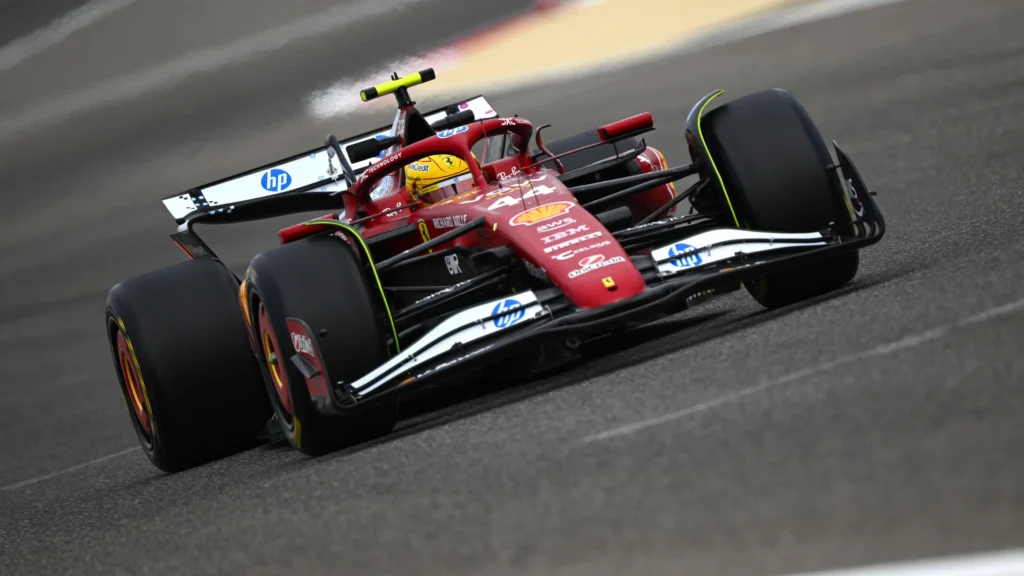
Picture a Formula 1 car approaching the 130R corner at the Suzuka International Racing Course. It is traveling at 310 km/h (192 mph). At this velocity, the car is covering 86 meters of asphalt every single second. It is moving so fast that it consumes nearly the length of a football field before the human brain can even process a visual mistake.
A human blink lasts roughly 300 milliseconds. If a Formula 1 driver blinks at the entry to 130R, their car will travel more than 25 meters in absolute darkness.
And yet, as the corner approaches, the driver does not touch the brake pedal. They simply turn the steering wheel. The car violently changes direction, subjecting the driver to up to 5G of lateral force. Blood is pulled aggressively from the brain toward the side of the skull, the neck strains against weights equivalent to a heavy barbell, and the car simply grips.
Why? Because Formula 1 cars are not simply “fast” in the way a supercar is fast. In a straight line, a heavily modified drag car will outrun an F1 car. But racing is not done in a straight line. Formula 1 exists in a completely different performance universe.
The Impossibility Test
To understand how alien Formula 1 performance truly is, consider what would happen if other celebrated vehicles attempted to replicate a modern F1 lap:
A Road Car at Copse (Silverstone): If a high-performance hypercar attempted to take the high-speed Copse corner flat-out, physics would ruthlessly intervene. The tires would instantly exceed their mechanical grip limit, the chassis would understeer violently, and the vehicle would be buried deep in the tire barriers.
A GT3 Race Car at 130R (Suzuka): A GT3 car possesses immense mechanical grip and aerodynamic balance, but it lacks the underfloor downforce of an F1 car. Attempting 130R flat-out would induce catastrophic aerodynamic stall; the rear end would break loose, resulting in a high-speed spin.
An IndyCar at Monaco: While an IndyCar is exceptionally fast—capable of over 370 km/h on an oval—it is physically larger, heavier, and designed for different aerodynamic profiles. Around the tight, low-speed streets of Monaco, it would lack the extreme front-end mechanical agility, the incredibly complex suspension compliance, and the explosive low-speed acceleration of a Formula 1 car.
What makes a Formula 1 car so fast is the relentless, agonizing refinement of aerodynamics, thermodynamics, material science, and data analysis. To understand it, you must stop looking at the car as a standard vehicle, and start looking at it as an integrated weapon of physics.
The Evolution of Speed
Formula 1 speed was not invented overnight. The performance we see today is the result of seventy-five years of engineers discovering what makes a car go faster, hitting the absolute limits of physics, and then inventing new ways to bend the rules.

The 75-Year Search For Speed
1950s → Power
1960s → Weight
1970s → Ground Effect
1980s → Turbo Power
1990s → Electronics
2000s → Aerodynamics
2010s → Hybrid Efficiency
2020s → Integrated Performance
- 1950s: The Era of Pure Power
The Problem: Cars were heavy, front-engined, and utilized rudimentary aerodynamics.
The Breakthrough: Pushing engine displacement and raw horsepower to the maximum.
The Consequence: Cars like the Alfa Romeo 158 relied entirely on brute force. Drivers fought the heavy, sliding cars through corners and blasted down the straights, limited strictly by the mechanical grip of their narrow tires.
- 1960s: The Lightweight Revolution
The Problem: Adding horsepower inherently added weight, creating a performance ceiling.
The Breakthrough: Colin Chapman and Lotus introduced the aluminum monocoque chassis, replacing heavy steel spaceframes.
The Consequence: Cars became mid-engined, vastly improving weight distribution and cornering agility. “Simplify, then add lightness” became the ultimate engineering mantra, proving that a lighter car is faster everywhere.
- 1970s: The Discovery of Ground Effect
The Problem: Mechanical grip and engine power had plateaued; cars could not corner any faster on standard tires.
The Breakthrough: Engineers realized the air under the car was a weapon. By shaping the underside of the car like an inverted airplane wing, cars like the Lotus 78 created a low-pressure vacuum.
The Consequence: Cornering speeds exploded. The car was literally sucked onto the track, birthing the era of extreme downforce.
- 1980s: The Turbo Power Explosion
The Problem: With ground effect heavily restricted by the FIA, teams needed a new way to overcome aerodynamic drag.
The Breakthrough: Forced induction.
The Consequence: The 1980s saw the rise of the turbocharged monsters. In qualifying trim, 1.5-liter engines from BMW and Honda produced in excess of 1,200 horsepower—so much power that engines literally melted after a few laps and had to be discarded.
- 2000s: The Era of Aerodynamic Optimization
The Problem: Engines were regulated to V10s and V8s, meaning teams had to find lap time in the air.
The Breakthrough: The wind tunnel and computational fluid dynamics (CFD) era.
The Consequence: Every millimeter of the car was sculpted. Bargeboards, winglets, and complex front wings directed airflow with surgical precision, resulting in the most aerodynamically complex cars in history.
- 2010s: The Hybrid Efficiency Revolution
The Problem: Global automotive relevance demanded an end to fuel-guzzling V8 engines.
The Breakthrough: The 1.6L V6 Turbo Hybrid Power Unit, capable of harvesting kinetic and heat energy.
The Consequence: Formula 1 cars became the most thermally efficient internal combustion machines on Earth, proving that energy recovery was just as vital as energy deployment.
- 2020s: Integrated Performance
The Problem: Complex “over-car” aerodynamics created turbulent wake, making it impossible for cars to follow each other closely.
The Breakthrough: The return of underfloor ground effect Venturi tunnels.
The Consequence: Modern cars now generate the majority of their downforce from the floor, creating the heaviest, yet fastest-cornering machines in the history of the sport.
The Biggest Secret: Formula 1 Creates Its Own Grip
If you take a standard road car and drive it faster into a corner, its tires will eventually lose adhesion, and the car will slide. Mechanical grip has a fixed, absolute limit. Formula 1 aerodynamics completely cheat this limit.
Instead of relying solely on the car’s physical mass to push the tires into the track, an F1 car uses the air passing over, under, and around it to push the car down. This is downforce. As McLaren Racing aerodynamicists have famously noted, if you drove a modern F1 car upside down in a tunnel at 200 km/h, it would generate enough aerodynamic downforce to stick to the ceiling.
At the heart of modern Formula 1 aerodynamics is the floor. Beneath the car are massive, sculpted Venturi tunnels. As air rushes into these tunnels, the space constricts, forcing the air to accelerate. According to Bernoulli’s principle, this rapid acceleration creates a massive drop in pressure underneath the chassis. The higher-pressure air above the car then crushes the vehicle down onto the track.
The Invisible Weight
At a standstill, an F1 car is remarkably light. At 300 km/h, it is remarkably heavy.
| State | Source of Grip | Downward Force Applied to Tyres |
| Standing Still | Gravity (Mass) | 798 kg (Minimum FIA Regulations) |
| At 250+ km/h | Gravity + Aerodynamics | 2,500+ kg |

At speed, a Formula 1 car experiences aerodynamic loads exceeding the weight of several large family cars. This “invisible weight” is what allows the car to corner at terrifying speeds.
How Drivers Learn To Trust Downforce
The first instinct of every human being in a fast-moving vehicle is self-preservation. When approaching a corner at 300 km/h, the brain screams at the driver to lift off the throttle. Formula 1 severely punishes that instinct.
Because downforce increases with the square of velocity, an F1 car generates exponentially more grip the faster it travels. If a driver nervously lifts off the throttle entering the legendary Eau Rouge at Spa or Copse at Silverstone, the car slows down. When the car slows down, the aerodynamic load vanishes. Without that load, the car loses grip and spins into the wall. To survive a high-speed corner, an F1 driver must completely suppress their survival instinct. They must trust that if they keep the throttle pinned flat to the floor, the invisible weight of the air will catch them.
The Four Postcards: Why Tyres Matter More Than Horsepower
You can have 1,000 horsepower and infinite downforce, but it means absolutely nothing if that energy cannot be transferred to the track. The entire multi-million-dollar engineering exercise of a Formula 1 car is ultimately filtered through four patches of rubber.
Each contact patch is roughly the size of a standard piece of printer paper. These four “postcards” are the only things connecting the car to the Earth.

Formula 1 tires, supplied exclusively by Pirelli Motorsport, are highly complex, viscoelastic polymer compounds designed to operate in a state of controlled degradation. To achieve maximum grip, the tires must be kept in a razor-thin thermal window, typically between 90°C and 110°C.
If the tires drop below 85°C, the rubber becomes glass-like, offering no molecular adhesion. If the tires exceed 115°C, the rubber essentially melts from the inside out, causing blistering.
Championships Won Through Rubber
Tires do not merely influence races; they decide World Championships. The greatest drivers in Formula 1 history are ultimately masters of thermal management.
Michael Schumacher’s Aggression: Schumacher and Ferrari mastered the art of the “sprint race” strategy in the early 2000s, utilizing perfectly optimized Bridgestone tires to run lighter, four-stop races where Schumacher pushed the rubber to its absolute thermal limit on every single lap.
Lewis Hamilton’s Preservation: Hamilton has repeatedly won races by manipulating his tire temperatures to extend stints far beyond what Pirelli engineers deemed possible—most famously winning the 2020 British Grand Prix on three fully inflated tires and one that had completely delaminated on the final lap.
Max Verstappen’s Slip Angle Mastery: Verstappen’s dominance is heavily rooted in his ability to maintain a microscopic “slip angle” through corners. By rotating the car perfectly without sliding the rear tires, he prevents the surface temperature from spiking, allowing his soft tires to outlast his rivals.
The Physics of Formula 1 Braking: The Most Violent Moment Of The Lap
If the acceleration of an F1 car is impressive, the deceleration is physically abusive. It is the area where a Formula 1 car distances itself furthest from any other machine on the planet.

At the end of the main straight at the Monza circuit, cars brake from roughly 350 km/h down to 80 km/h in under 3 seconds, covering just 120 meters. To achieve this, F1 uses pure carbon-carbon composite brake discs and pads. These brakes must be heated to over 400°C just to generate friction, and regularly exceed 1,000°C in heavy braking zones, glowing incandescently inside the wheel rim.
When an F1 driver stamps on the brake pedal, they generate up to 5G of longitudinal deceleration. A fighter pilot experiences extreme G-forces during complex aerial maneuvers, but those are sustained over long, sweeping arcs. A Formula 1 driver experiences a violent 5G impact against the seatbelts every 90 seconds, for two solid hours. Under this load, a driver’s head and helmet effectively weigh 35 kilograms. Blood rushes to the front of their face, and tears are compressed out of their tear ducts onto the visor.
Human Body vs Formula 1 Loads
| Activity | Typical G-Force | Direction of Load |
| Normal Walking | 1 G | Vertical |
| High-Performance Road Car Braking | 1.0 – 1.2 G | Longitudinal |
| Extreme Roller Coaster | 3.0 – 4.0 G | Vertical / Lateral |
| Fighter Jet Combat Maneuver | 7.0 – 9.0 G | Vertical |
| Formula 1 Braking & Cornering | 4.5 – 5.5 G | Longitudinal / Lateral |
Note: While fighter pilots endure higher peak G-forces, Formula 1 drivers endure extreme multi-directional G-forces constantly, without the aid of pressurized G-suits.
Why Formula 1 Cars Corner So Quickly
Lap time is rarely won on the straights. It is won in the corners. The sheer speed an F1 car can carry through an apex is the culmination of aerodynamics, tire science, and double-wishbone suspension geometry keeping the aerodynamic platform completely perfectly level.
The Corner That Defines Formula 1: Suzuka's 130R
To truly understand F1 cornering, look to the 130R corner in Japan. Named for its 130-meter radius, it is a corner that engineers obsess over, drivers fear, and fans revere.
Approaching at 310 km/h, the aerodynamic load on the car is immense. The suspension is compressed to its absolute limit, leaving virtually zero travel. The tires are deformed by the pressure, their sidewalls bulging under the immense strain. When the driver turns the wheel, the car must instantly translate forward momentum into lateral grip.
If the aerodynamics are unbalanced by a single degree, the car will understeer off the track. If the tires are three degrees too cold, the rear will step out. But when the integrated systems work perfectly, the car glues itself to the tarmac, slicing through the apex in a violent, breathtaking display of engineered perfection. 130R is the ultimate test of the Formula 1 ecosystem.
The Efficiency Revolution: Hybrid Power
The propulsion system sitting behind the driver is not merely an engine. It is a Power Unit (PU). Since 2014, F1 has utilized 1.6-liter V6 turbocharged hybrid systems. Despite their small displacement, these units produce over 1,000 horsepower.
But raw power isn’t the real achievement. The true marvel is thermal efficiency.
A standard internal combustion road car engine operates at roughly 30% thermal efficiency. This means 70% of the energy stored in the gasoline is completely wasted as heat, vibration, and noise. Most engines simply burn fuel and throw the resulting energy away.
Formula 1 harvests it.
According to Mercedes-AMG Petronas, a modern Formula 1 power unit achieves over 50% thermal efficiency. It converts more fuel into useful mechanical work than any production engine on Earth. It achieves this through a dual-recovery system. The MGU-K (Motor Generator Unit – Kinetic) recovers energy under braking. Simultaneously, the MGU-H (Motor Generator Unit – Heat) recovers wasted heat energy straight from the exhaust gases. This is a monument to human engineering: extracting maximum violence from minimal resources.
The Obsession With Weight and the Carbon Fibre Revolution
In the world of high-performance engineering, mass is the enemy. Weight increases inertia. It takes more power to accelerate, more braking force to stop, and more mechanical grip to change direction. According to Formula 1 data engineers, every 10 kilograms of extra weight costs a car roughly 0.3 seconds per lap.
The Carbon Fibre Revolution
This desperate obsession with weight led to one of the greatest leaps in motorsport history. In 1981, McLaren designer John Barnard introduced the MP4/1.

For decades, F1 cars were built using aluminum bathtubs. Barnard looked at the aerospace industry and decided to build a chassis out of carbon fibre composite. The grid laughed, assuming the brittle-looking plastic would shatter on impact. But the carbon fibre monocoque was radically lighter, infinitely stiffer, and vastly safer than aluminum.
When John Watson suffered a massive crash at Monza in the MP4/1 and walked away without a scratch, the laughter stopped. Within a few seasons, the entire sport copied McLaren. Today, practically the entire car—from the crash cell to the suspension wishbones—is baked in high-pressure autoclaves, proving that true performance comes from what you take away, not what you add.
The Digital Formula 1 Car: Physical Meets Virtual
If you want to know what truly makes an F1 car faster than any other racing machine, look away from the track and look at the computers. Modern Formula 1 cars effectively race twice: once on the circuit, and once inside a server.

A modern F1 car is covered in over 300 sensors. These sensors measure everything from suspension deflection to the core temperature of the brake pads. This data is beamed via microwave burst telemetry back to the garage, and simultaneously routed to a remote operations “Mission Control” room at the team’s factory, where dozens of engineers analyze live data.
Before a physical car ever arrives at a Grand Prix, it has already completed the race in the digital world. Teams use “digital twins” in state-of-the-art driver simulators, immense Wind Tunnels, and Computational Fluid Dynamics (CFD) supercomputers to find the perfect setup. Strategy software runs millions of Monte Carlo simulations, predicting tire wear and optimal pit stop windows before the red lights even go out. Formula 1 engineers can predict a race with staggering accuracy before a single drop of fuel is burned.
Formula 1 By The Numbers
To grasp the extreme nature of this sport, you must look at the numbers generated during a single lap:
310+ km/h: Velocity carried through high-speed corners like Suzuka’s 130R.
86 meters per second: Distance traveled at top speed.
5 Gs: Lateral loads experienced during cornering, and longitudinal loads during braking.
1000+ Horsepower: Generated by a 1.6-liter V6 hybrid power unit.
50%+ Thermal Efficiency: Making F1 engines the most efficient in the world.
300+ Sensors: Transmitting live data to the pit wall.
90°C – 110°C: The razor-thin operating temperature window for Pirelli tires.
2500+ kg: The aerodynamic downforce load pressing the car into the asphalt.
The Greatest Misconception in Motorsport
The greatest misconception among casual motorsport fans is the belief that Power = Speed. People assume Formula 1 cars are the fastest circuit racing machines on Earth simply because they have the biggest engines.
Formula 1 proves this entirely wrong.
A dragster has far more power. A hypercar has a higher top speed. But Formula 1 is the ultimate proof that true speed is an equation: Efficiency + Grip + Downforce + Data = Speed.
If you put a 2,000-horsepower engine in a Formula 1 car but removed the front and rear wings, the car would be undriveable. The tires would instantly spin into smoke, the brakes would lock, and the driver would crash at the first corner. Speed is not about how much power you can make; it is about how much power you can physically force the Earth to accept.
If Formula 1 Could Keep Only One Advantage
If the FIA rewrote the rulebook tomorrow and forced teams to strip away the hybrid power units, replace the exotic carbon fibre with steel, remove the telemetry sensors, and race on standard road tires—but allowed them to keep just one performance advantage—what would the engineers choose?
Aerodynamic Downforce.
Without downforce, an F1 car is just a powerful, lightweight dragster. Downforce is the ultimate performance multiplier. It is the invisible force that bends the laws of physics, allowing the tires to grip harder, the brakes to bite deeper, and the driver to attack corners at speeds that the human brain struggles to process. It is the foundation upon which every other piece of Formula 1 technology relies.
Conclusion
A Formula 1 car is not the result of one genius engineer, nor is it the product of a single brilliant invention.
It is the culmination of seventy-five years of relentless, obsessive experimentation. It is the result of thousands of failures, spectacular crashes, and countless breakthroughs layered meticulously on top of one another. From the lightweight aluminum tubs of the 1960s to the ground-effect vacuum floors of the 1970s; from the carbon fibre revolution of the 1980s to the hyper-efficient digital hybrids of today.
The Formula 1 car is humanity’s fastest answer to a simple, profound question: “How much performance can we extract before physics says no?”
Every season, the engineers arrive at the track, look at the absolute limits of the physical universe, and begin negotiating for just one more tenth of a second. That is what makes a Formula 1 car so fast.


