
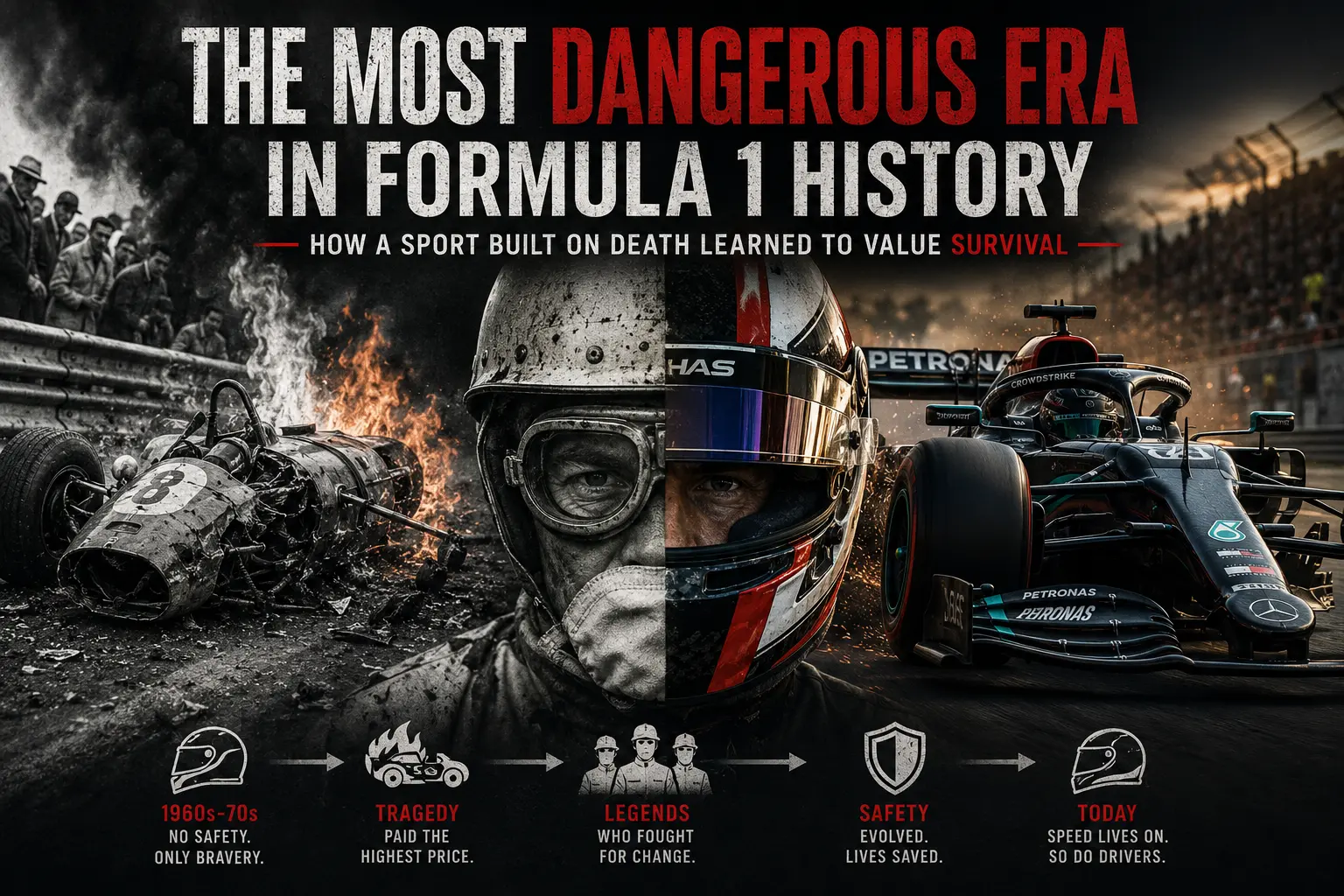
The air in the paddock did not just smell of high-octane aviation fuel and scorched rubber; it smelled of hot castor oil and underlying dread. To stand trackside in western Europe during the mid-twentieth century was to subject your senses to a brutal, beautiful assault. The scream of a V12 engine did not merely echo through the pine forests of the Ardennes or the Eifel mountains—it vibrated inside your chest cavity.
But beneath the glamour of champagne, leather gloves, and chrome lay an unwritten, terrifying reality. When a driver buckled into his cockpit, he was not just entering a race. He was stepping into an aluminum tube packed with hundreds of liters of volatile fuel, flanked by unyielding steel guardrails, and completely devoid of modern runoff areas. In The Most Dangerous Era in Formula 1 History, drivers did not ask if someone would die each season; they wondered who it would be.
For the first few decades of its existence, Formula 1 history was defined by a collective, almost pathological acceptance of mortality. Death was not treated as a systemic failure of engineering or track design; it was normalized as a line item in the budget of a Grand Prix season. The prevailing culture of the paddock dictated that speed demanded sacrifice, and safety was an afterthought that threatened the very essence of masculine bravery. Formula 1 once treated danger as proof of bravery.
To challenge the safety of a circuit was to confess a lack of nerve. Drivers wore thin linen helmets, short-sleeved shirts, and standard driving goggles. For a long time, many actively refused to wear seatbelts, operating under the grim calculus that it was statistically better to be thrown clear of a crashing vehicle than to be trapped inside its burning chassis. This was a world where drivers kept a black tie packed at the bottom of their kit bags—not for post-race galas, but because they knew they would likely be attending a peer’s funeral before the weekend was over.
SECTION 1 — WHY FORMULA 1 BECAME SO DANGEROUS
To understand why this dangerous Formula 1 era became so lethal, one must look at the violent asymmetric warfare between mechanical engineering and human survivability. Following the Second World War, automotive technology underwent a massive propulsion boom. Teams discovered the secrets of lightweight metallurgy, advanced combustion aerodynamics, and mid-engine layouts. Cars became exponentially lighter, sleeker, and faster with every passing month.
However, the science of stopping a human body in a crash did not keep pace. The sport’s technical evolution fundamentally outstripped its safety technology.

In the late 1960s, designers like Lotus’s visionary Colin Chapman pioneered the aluminum monocoque chassis—essentially a stressed-skin cigar tube that made cars structurally rigid and incredibly fast. But these thin aluminum skins offered virtually zero energy absorption. Even worse, the space surrounding the driver’s legs and torso was packed with flexible fuel bladders. In a high-speed impact, the chassis did not deform to protect the driver; it crumpled like a soda can, rupturing the fuel cells and instantly transforming the car into an inescapable furnace.
The introduction of inverted wings and raw aerodynamic downforce in the late 1960s compounded the old Formula 1 dangers. Suddenly, cornering speeds skyrocketed to dimensions the human body had never navigated. Yet, these early aerodynamic wings were designed through primitive trial-and-error, often constructed from fragile struts that could snap mid-corner at 180 mph. When a wing failed, the car lost all grip instantly, turning the driver into a helpless passenger aboard a ground-bound missile.
Compounding this structural vulnerability was a total lack of track infrastructure and medical response planning. Circuits like the original Spa-Francorchamps or the Nürburgring Nordschleife were not purpose-built racing facilities in the modern sense; they were sweeping networks of public country roads. Drivers blasted past telephone poles, stone farmhouses, uninsulated steel barriers, and dense forests at speeds exceeding 170 mph. If a car left the asphalt, there were no wide gravel traps or energy-absorbing barriers to cushion the blow. There were only trees, ditches, and stone walls.
If a driver crashed and caught fire, the medical response system was agonizingly primitive. Tracks relied on local volunteers and local fire departments. Marshals frequently lacked fire-retardant suits, and the medical center was often nothing more than a tent or a dirty room under the grandstand. A driver trapped in a burning car was entirely dependent on the bravery of his fellow competitors to pull him out of the flames.
SECTION 2 — THE 1960s AND 1970s: FORMULA 1’S DEADLIEST YEARS
As the sport entered the 1960s and 1970s, the human cost of this technological imbalance reached a crisis point. This span of years stands uncontested as the deadliest stretch in motorsport history. The sheer statistical probability of surviving a full career in Grand Prix racing during this period was terrifyingly low. If a driver raced continuously for five years during this window, they faced roughly a one-in-three chance of being killed in an accident.
The spaces where these tragedies unfolded became mythical battlegrounds, cloaked in fog, rain, and the persistent scent of spent fuel. The Nürburgring Nordschleife—a winding, 14.1-mile ribbon of asphalt cutting through Germany’s Eifel mountains—became known simply as “The Green Hell.” With more than 170 corners, dramatic elevation shifts, and cars regularly launching airborne over crests, it was a circuit where tracking an accident was nearly impossible. If a driver went missing in the dense fog or rain, it could take minutes for race control to even realize a crash had occurred, let alone dispatch an ambulance.

The atmosphere in the paddocks during these years was heavy with an unvoiced, emotional pressure. Drivers formed deep, intense friendships, yet they intentionally maintained a certain psychological distance, knowing that the man they shared a meal with on Friday night might be gone by Sunday evening.
The grim roll call of Formula 1 deaths grew longer with every passing summer. In 1970, the brilliant Jochen Rindt was killed during practice at Monza when his brake shaft failed, causing his car to violently strike an improperly installed guardrail. He was buried as the sport’s only posthumous World Champion. Drivers like Piers Courage, Jim Clark, and François Cevert—men of extraordinary intellect and sublime physical talent—were cut down in their prime.
The turning point for the public’s conscience arrived at the 1973 Dutch Grand Prix at Zandvoort. Young British driver Roger Williamson suffered a tire failure, flipping his March upside down and igniting the fuel tanks. The race was not red-flagged. On live international television, millions watched as fellow driver David Purley abandoned his own race, running across the track to desperately try and flip Williamson’s burning car by himself.
The track marshals, wearing basic cotton overalls and lacking proper training, stood by helplessly without adequate fire extinguishers. Purley was eventually dragged away, weeping in frustration, as Williamson asphyxiated in the cockpit. The absolute horror of that broadcast shattered any remaining romantic illusions about the sport’s danger. It was no longer a display of gladiatorial gallantry; it was public slaughter on live television.
SECTION 3 — JACKIE STEWART AND THE FIGHT FOR SAFETY
Out of this profound grief emerged a leader who was willing to endure the wrath of the establishment to save lives. That man was three-time World Champion Jackie Stewart F1.
Stewart’s obsession with safety was born from his own brush with death at Spa-Francorchamps in 1966. Driving in a torrential downpour, his Lotus spun at 160 mph, crashing into a telephone pole and coming to rest upside down in the outbuilding of a local spectator. Stewart was trapped in the cockpit, soaked to the skin in high-octane fuel that was burning his skin. There were no track marshals to rescue him, and no tools available to cut him free.
It was his teammates, Graham Hill and Bob Bondurant, who managed to borrow primitive wrenches from a nearby spectator’s toolkit to dismantle the steering wheel and pull Stewart from the wreckage. He was then placed on a canvas stretcher on a dirt floor in a makeshift medical room, surrounded by cigarette butts, until an ambulance finally arrived.
From that afternoon forward, Stewart launched an uncompromising, deeply unpopular F1 safety revolution. Working alongside the Grand Prix Drivers’ Association (GPDA), he began demanding changes that team bosses and race promoters considered sacrilege. He demanded:
Mandatory full-face helmets and fire-retardant racing suits.
Secure six-point harness systems inside every cockpit.
The widespread installation of continuous steel barriers around tracks.
Deployed medical recovery vehicles and dedicated trackside helicopters.
The establishment’s pushback was fierce and immediate. Track owners accused Stewart of trying to bankrupt them with infrastructure demands. The racing press labeled him a coward who was destroying the romantic thrill of motorsport. Even some of his fellow drivers mocked his efforts, believing that safety concerns undermined their status as fearless daredevils.
Stewart famously countered the macho criticism of his critics with an iconic line that perfectly summarized the hypocrisy of the era’s cultural landscape:
“Sex was safe and racing was dangerous.”
Stewart’s safety crusade was not an emotional plea; it was a calculated, political battle. When track organizers at Spa and the Nürburgring refused to modernize their facilities, Stewart organized driver boycotts, successfully forcing the cancellation of historic races. He understood that the only way to compel the sport to change was to hit promoters where it hurt most: their ticket sales and international prestige.
SECTION 4 — NIKI LAUDA AND THE NÜRBURGRING FIRE
If Jackie Stewart was the political architect of the safety movement, it was the Austrian phenom Niki Lauda whose near-fatal tragedy permanently broke the spell of old-school danger culture. By 1976, Lauda was the undisputed king of Formula 1—a cold, analytical, and devastatingly fast driver who approached racing with engineering-grade precision.
Prior to the 1976 German Grand Prix, Lauda looked at the weather forecast, looked at the inadequate layout of the 14-mile Nürburgring, and called for a driver vote to boycott the race. He argued that if a driver crashed anywhere on the massive track in treacherous conditions, the safety infrastructure was mathematically incapable of responding in time. The drivers voted down his proposal by a narrow margin. The race went ahead.
On lap two, as the field streaked through the fast left-hand sweep at Bergwerk, a rear suspension component on Lauda’s Ferrari failed. The car snapped violently to the right, smashed through an earthen bank, and erupted into a massive ball of fire before bouncing back into the center of the track.

The impact was so severe that it ripped Lauda’s helmet clean off his head, leaving his face completely exposed to the fierce flames. Trapped inside the burning wreckage, he was breathing in superheated toxic gases that scorched his lungs from the inside out.
Just as Lauda had predicted, there were no track marshals anywhere near the accident zone. His survival rested entirely on the heroism of his peers. Drivers Brett Lunger, Guy Edwards, Harald Ertl, and Arturo Merzario slid their cars to a halt and ran directly into the inferno. Merzario plunged his hands directly into the open flames to unbuckle Lauda’s melted harness, and together they dragged his limp body away from the burning monocoque.
The world watched in shock over the next few days as Lauda lay in a hospital bed, fighting for every breath. A priest was brought to his bedside to administer the last rites. His lungs were so heavily damaged that doctors used industrial pumps to vacuum the soot and fluid from his chest cavity.
Yet, in a display of psychological resilience that remains legendary across all professional sports, Lauda returned to the cockpit of his Ferrari just 42 days later at the Italian Grand Prix. His raw wounds were still weeping through his fireproof balaclava, and his vision was partially compromised by missing eyelids.
The Niki Lauda crash permanently altered the collective consciousness of the sport. It proved that even the most calculated, brilliant driver on earth could be brought to the edge of death by an archaic circuit. The old Nürburgring Nordschleife never hosted another Formula 1 race. The era of accepting catastrophic fires as part of a normal race weekend was dead.
SECTION 5 — WHEN FORMULA 1 FINALLY CHANGED
The shockwave of Lauda’s crash ushered in an era where safety was finally treated as a legitimate engineering discipline rather than an unwanted compromise. In 1978, the FIA appointed Professor Sid Watkins as the official Formula 1 Medical Delegate. “Prof,” as he was known, revolutionized trackside medicine by introducing a dedicated medical car that followed the grid on the opening lap of every race, ensuring an emergency equipment crew arrived within seconds of an accident.
Concurrently, the sport underwent a massive materials science transformation. In 1981, designer John Barnard unveiled the McLaren MP4/1, the first car to feature a monocoque chassis constructed entirely from carbon fiber composites instead of aluminum.

The motorsport community initially viewed carbon fiber with intense skepticism, fearing it would shatter like glass upon a heavy impact. Those fears were permanently put to rest at the 1981 Italian Grand Prix, where McLaren driver John Watson suffered a terrifying, high-speed crash at the fast Lesmo bends. The car struck the barriers at immense speed, tearing the heavy engine clean off the back of the chassis. In an older aluminum car, the driver’s legs would have been crushed; instead, Watson stood up from the intact carbon survival cell and walked away without a single scratch.
To understand how these transformations shifted the sport over a multi-decade timeline, modern researchers have turned to rigorous empirical analysis. As detailed in a 2024 academic study conducted by researcher Abdelghani Belgaid at the College of Computing, Mohammed VI Polytechnic University, the long-term impact of regulatory interventions from 1990 to 2023 can be systematically mapped. Belgaid notes that while governing bodies introduce regulations to actively preserve driver life, their absolute year-over-year correlation with reduced fatalities is often masked by delayed implementation timelines and the general statistical rarity of modern fatal incidents. The sport grew up; it traded raw bravado for cold, analytical survival metrics.
SECTION 6 — IMOLA 1994: THE WEEKEND THAT SHOOK FORMULA 1
By the early 1990s, an elite generation of drivers had entered the sport without ever witnessing a peer die on a Grand Prix weekend. It had been 12 long years since a driver death during a race weekend. A dangerous illusion of total safety had settled over the paddock. The cars felt indestructible, the survival cells unyielding.
That illusion shattered into pieces over three dark days in the spring of 1994 at the San Marino Grand Prix in Imola, Italy. It remains the most emotionally devastating weekend in modern Formula 1 history.
The nightmare began on Friday afternoon during qualifying, when a young Rubens Barrichello launched his Jordan over a curb at 140 mph, violently striking the catch fencing and knocking him unconscious. He escaped with a broken nose, a harbinger of the tragedy to come.
On Saturday, during the final qualifying session, Austrian driver Roland Ratzenberger suffered a front wing failure on his Simtek at 195 mph. Deprived of steering grip, his car hit the concrete wall at the Villeneuve corner almost head-on. The structural force broke his neck, killing him instantly. The paddock was paralyzed with grief; the monster they thought they had tamed had returned.
But the final, crushing blow landed on Sunday afternoon. The world’s greatest racing driver, three-time World Champion Ayrton Senna Imola 1994, led the race in his Williams. On lap seven, as he entered the ultra-fast, bumpy Tamburello corner at 190 mph, his car veered straight off the asphalt, striking an uninsulated concrete retaining wall.
The carbon fiber survival cell did its job perfectly; the chassis absorbed the impact energy, and Senna’s torso was intact. But a piece of the steel suspension assembly had snapped off on impact, penetrating his visor and inflicting fatal head injuries.
The global shockwave triggered by Senna’s death was unprecedented. The world had watched its most charismatic, poetic, and iconic athlete die on live television. The tragedy sparked an immediate, aggressive regulatory overhaul by the FIA. The Grand Prix Drivers’ Association was permanently resurrected, and the sport entered a phase of zero-tolerance safety engineering.
SECTION 7 — THE MODERN ERA: WHY TODAY’S F1 IS DIFFERENT
The modern landscape of Formula 1 stands as a living monument to the drivers who sacrificed their lives in the decades that came before. Today’s sport approaches safety not as a political debate, but as a continuous loop of data-driven optimization.
When analyzing how these safety structures interact with the competitive product on track, the statistical modeling compiled by Belgaid (2024) reveals a fascinating modern balancing act. Using Ordinary Least Squares linear regression to track performance variables, Belgaid’s model successfully explains 78.7% of the total variance in average overtakes per race. The empirical data shows a distinct trade-off: as safety mandates forced vehicles to become larger and safer, car weight increased significantly. Belgaid’s multiple linear regression calculates a highly significant negative coefficient of -0.111 for average car weight, verifying that as modern safety frames made cars heavier, natural overtaking opportunities became mathematically more difficult.

To counter this negative impact on the spectacle without reducing safety margins, the FIA introduced the Drag Reduction System (DRS) in 2011. Belgaid’s 2024 regression models identify DRS as the single most dominant positive predictor of passing maneuvers, showing a highly significant coefficient that counteracts the physical penalties of increased vehicle mass. Furthermore, time-series analysis confirms that technical regulations related to car dynamics take hold immediately within the same season they are introduced rather than showing delayed multi-year lags.
The visible manifestation of this modern, uncompromising safety approach includes:
The HANS Device: A carbon fiber collar that secures the driver’s head relative to their shoulders, completely eliminating the basilar skull fractures that took the lives of past drivers.
The Titanium Halo: Introduced in 2018, this cockpit protection canopy can withstand immense structural loads, shielding the driver’s head from loose debris and heavy external impacts.
Advanced Circuit Runoffs: Modern tracks feature expansive asphalt runoff zones and high-tech energy-absorbing barriers designed to swallow impact force seamlessly.
The real-world proof of this evolution unfolds whenever a contemporary accident looks like it belongs in the 1970s, yet yields a completely different human outcome. At the 2020 Bahrain Grand Prix, Romain Grosjean’s Haas struck a metal barrier at 137 mph, tearing the car completely in half and igniting a massive fuel fire. In The Most Dangerous Era in Formula 1 History, it would have been an instantly fatal accident. Instead, protected by the Halo canopy, his carbon survival cell, and his modern multi-layered fireproof gear, Grosjean emerged from the flames under his own power, suffering only minor burns to his hands.
CONCLUSION — “THE PRICE FORMULA 1 PAID FOR SPEED”
Formula 1’s modern safety standards were built through painful lessons. The pristine, clinical, and hyper-safe environments of today’s tracks exist because previous generations raced in conditions modern drivers would consider unimaginable.
The sport’s pursuit of speed eventually forced it to value survival. As verified by modern motorsport analytics compiled in Belgaid’s 2024 dataset, tracking historical variables shows that safety is not a stationary metric but an evolving discipline. The names etched into the history books—Clark, Rindt, Cevert, Williamson, Lauda, and Senna—are not simply entries in a record book. They are the structural foundation upon which every modern racing lap is built.
The roar of the engines remains just as thunderous today, and the human desire to dance on the ragged edge of physics will never change. But the dark shadow that once defined the paddock has been cleared away. Formula 1 finally learned how to honor the thrill of speed without demanding the ultimate sacrifice, turning a blood-soaked arena into the ultimate showcase of human and technological resilience.


