
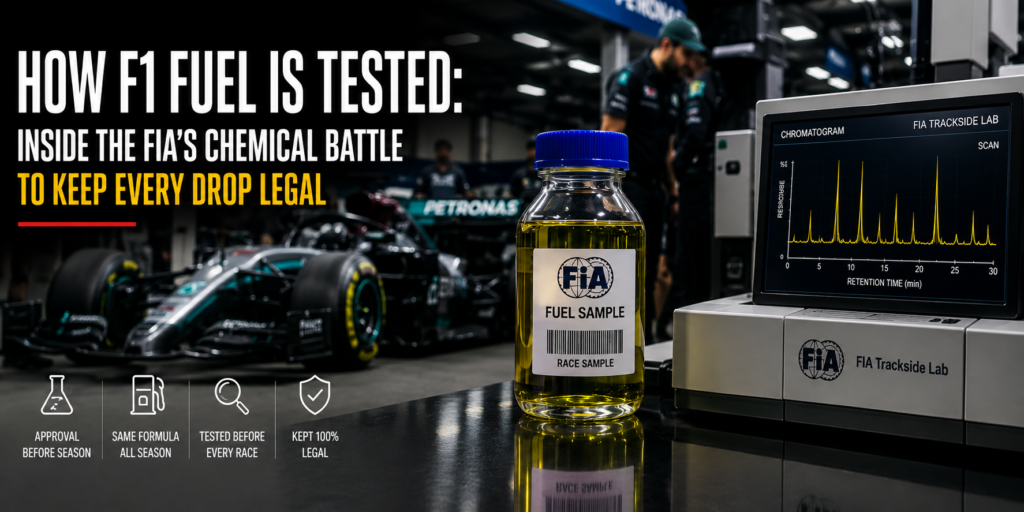
Imagine a Formula 1 car sitting in the pit lane. The mechanics swiftly clear the tyre blankets, the power unit fires into life with a concussive bark, and the car aggressively pulls out of the garage. As millions of fans watch the machine accelerate down the main straight, the focus is naturally drawn to the driver’s reflexes, the aggressive aerodynamics, and the sheer, violent speed of the vehicle.
But somewhere behind that apparently simple process of internal combustion lies a profound, heavily guarded question: How does the governing body actually know what is being burned inside that engine?
Fuel is one of the least visible, yet most tightly controlled performance variables in all of motorsport. It dictates heat transfer, thermal efficiency, and ultimate power output. If a team could secretly slip a heavily oxygenated, highly volatile chemical cocktail into their car on a Sunday afternoon, the performance advantage would be devastating.
So, how can the FIA detect if a supplier quietly alters a fuel formulation between the laboratory and the starting grid? The answer is found in an invisible, rigorous chain of chemical analysis, regulatory approval, and trackside monitoring designed to keep every single drop legal.
What Actually Is F1 Fuel?
To understand how Formula 1 fuel is monitored, it is necessary to first understand what it is. Formula 1 fuel is highly specialised racing fuel. While it shares a fundamental concept with ordinary road petrol—it is a liquid designed to ignite and release energy—it is engineered to a vastly different standard. It must comply with incredibly detailed FIA regulations that dictate everything from its physical density to its microscopic chemical composition.

In 2026, the sport utilizes Advanced Sustainable Fuels. In 2026, Formula 1 uses Advanced Sustainable Fuels, with the FIA requiring the fuel’s sustainable components to meet defined sustainability criteria. Instead, it is manufactured using sustainable feedstocks, such as municipal waste, non-food biomass, or carbon capture technology.
Regardless of its origin, the fuel is ultimately a complex matrix of chemical compounds. The
key components include:
• Hydrocarbons: The foundational molecules of fuel, constructed entirely of hydrogen
and carbon atoms.
• Oxygenates: Oxygenates are compounds containing oxygen that can alter
combustion and fuel properties. Depending on the formulation, they can influence
characteristics such as knock resistance and combustion efficiency.
• Aromatics: Ring-shaped hydrocarbon molecules that offer excellent energy density
and knock resistance, though they are strictly limited to prevent excessive soot
production.
• Olefins: Unsaturated hydrocarbons that can boost performance but are chemically
unstable over time.
Before exploring the chemistry of enforcement, we must establish why this liquid matters so
much.
Why Does Fuel Matter So Much to an F1 Power Unit?
At its most basic level, the relationship is straightforward: Fuel leads to combustion, which
creates energy, which delivers power.
However, in the highly refined world of Formula 1, the relationship is far more intricate: Fuel properties dictate combustion behaviour, which determines thermal efficiency, which ultimately governs power-unit performance.
Fuel development is not simply about finding a liquid that “burns hotter.” Burning too hot can destroy an engine through excessive heat transfer and thermal loading on the pistons and valves. Instead, fuel scientists are looking to optimize combustion characteristics. They want a fuel with a high energy density, excellent burn efficiency, and high knock resistance.
“Knock” is uncontrolled, explosive auto-ignition that can shatter internal engine components. A highly knock-resistant fuel provides engineers with the freedom to run more aggressive ignition timing and optimize the combustion calibration. Therefore, the fuel and the power unit must be designed in perfect thermodynamic harmony. Crucially, this development must happen entirely inside strict regulatory boundaries.
The 2026 Fuel Revolution
The 2026 technical regulations represent a watershed moment. The move to Advanced Sustainable Fuels marks a complete departure from fossil-derived fuel components. But the revolution is not merely about sustainability; it fundamentally changes how fuel is regulated in relation to the new power units.
The FIA is no longer simply asking, “How much fuel are you using?” They are increasingly concerned with, “How much chemical energy are you putting into the power unit?”
This is governed by the fuel’s Lower Heating Value (LHV). The LHV is a measurement of how much useable heat energy is released when a specific amount of fuel is burned. The FIA converts the fuel mass flow rates measured by the car’s Fuel Flow Meter into fuel energy flow rates using the energy density and the LHV of the fuel as measured by the FIA.
In the 2026 regulations, the absolute maximum fuel energy flow must not exceed 3,000 MJ/h (Megajoules per hour).
Furthermore, the regulations tightly control energy delivery across the entire rev range. At engine speeds below 10,500 rpm, the fuel energy flow must not exceed the strict mathematical limit of EF(MJ/h) = 0.27 N(rpm) + 165.
This 3,000 MJ/h limit physically caps the amount of raw chemical energy a team can pump into the combustion chamber. The engineering challenge is extracting maximum mechanical power from that strict energy allowance.
Who Actually Develops the Fuel?
The FIA writes the rules, but the fuel itself is developed by major global energy companies working in tight collaboration with F1 teams and power-unit manufacturers. The ecosystem operates like this:
FIA (Regulator) → Fuel Supplier (Chemist) → Team / Power-Unit Manufacturer (End User)
This collaborative process is visible across the grid:
• Shell and Ferrari: Shell executes a multi-year development programme to tailor its fuel precisely to the combustion chamber dynamics of the Ferrari power unit, navigating the complexities of sustainable feedstocks.
• Aramco and Aston Martin: Aramco has developed its ProForce+ programme to seamlessly integrate with the 2026 Honda power units used by Aston Martin.
• PETRONAS and Mercedes: PETRONAS leads the sustainable fuel development for Mercedes, focusing on thermal efficiency and synthetic formulation inside the new engine architecture.
• BP/Castrol and Audi: bp is working directly alongside Audi as they enter the sport in 2026, developing bespoke Advanced Sustainable Fuels for their entirely new power unit from the ground up.
These suppliers are fierce competitors. They pour vast resources into pursuing their own technical solutions, optimizing the molecular structure of their fuels to find fractional performance advantages while remaining inside a common FIA regulatory framework.
How a Fuel Becomes Legal for F1
Step 1 — Formulation
The supplier develops the fuel within the strict chemical and physical boundaries of the FIA regulations.
Step 2 — Compliance
The formulation’s documentation is checked against the regulatory requirements to ensure it meets all Advanced Sustainable Fuel criteria.
Step 3 — Samples
The supplier must provide the FIA with two separate five-litre samples of the fuel for physical and chemical testing.
Step 4 — FIA Laboratory Analysis
The FIA subjects the samples to deep chemical analysis to verify the supplier’s claims, check for prohibited substances, and establish the fuel’s exact properties.
Step 5 — Reference Fuel
Once approved, this specific chemical formulation becomes the approved reference fuel. It is the baseline standard against which all competition samples for that team will be compared.
Step 6 — Written Approval
A fuel cannot simply be used in competition without prior written FIA approval. This process distinguishes legal fuel development from illegal manipulation. Fuel suppliers can continue developing new technology in their laboratories, but they cannot introduce an unapproved formulation into a Grand Prix weekend.
What Does the FIA Actually Look For in the Fuel?
When the FIA analyzes those pre-approval samples, they break the liquid down into its
fundamental chemical components. They are looking at several critical categories:
Fuel Category | Chemical Definition & Regulatory Purpose |
Aromatics | Aromatics are ring-shaped hydrocarbon compounds with important effects on fuel properties. Their concentration is limited by the FIA regulations. |
Olefins & Diolefins | Unsaturated hydrocarbons. While they can alter combustion characteristics, they are chemically unstable and prone to oxidation. Strict limits ensure the fuel remains stable and safe. |
Oxygenates | Compounds containing oxygen atoms. They cool the intake charge and improve knock resistance. The FIA regulates them to prevent teams from creating highly volatile “rocket fuel” blends. |
Sulphur & Metals | Elements like sulphur, lead, and manganese. These are heavily restricted or outright banned due to environmental, health, and fairness concerns. |
Beyond molecular families, the FIA also measures physical properties such as oxidation stability (how quickly the fuel degrades when exposed to air), electrical conductivity, distillation characteristics (how the liquid vaporizes at different temperatures), and density.
The regulations do not simply list numbers; they enforce these limits to ensure that all Advanced Sustainable Fuels remain safe, environmentally relevant, and strictly within the performance envelope intended by the sport.
Gas Chromatography: The FIA’s Chemical Detector
To verify exactly what is in the fuel, the FIA utilizes an advanced analytical technique called
Gas Chromatography (GC), often paired with Mass Spectrometry (GCMS).
Imagine dropping a handful of mixed coins down a highly textured, vibrating ramp. The smallest, lightest coins will bounce down the ramp quickly. The largest, heaviest coins will take much longer to navigate the obstacles. By timing exactly when each coin reaches the bottom, you can figure out the exact composition of the handful of coins.
Gas chromatography operates on a similar principle, but at a microscopic level:
1. A fuel sample enters the heated GC instrument and is instantly vaporized.
2. The vapor is pushed by a carrier gas through a long, microscopic column coated with a specific chemical lining.
3. The different chemical compounds in the fuel interact with this lining differently, causing them to separate as they travel.
4. Different compounds interact differently with the column’s stationary phase and therefore travel through it at different rates.
5. As they exit, a detector records them, producing a graph of characteristic peaks.
The resulting chromatogram contains a characteristic pattern of peaks at different retention times, creating a detailed chemical profile of the fuel.
When paired with Mass Spectrometry (GCMS), the analysis goes a step further. Mass spectrometry analyzes the ions produced from the compounds and generates characteristic mass spectra that can help identify the exact chemical nature of the molecules exiting the chromatograph.
The Fuel “Fingerprint”
This chromatographic fingerprint is the absolute core of the FIA’s regulatory enforcement power.

When a fuel is approved, its gas chromatography pattern becomes the approved reference fingerprint. During a race weekend, when the FIA takes a sample from a car, they run it through their trackside GC equipment to generate a measured fingerprint.
The assessment is straightforward: Does the competition sample remain consistent with the approved reference fuel?
Conformity is determined according to the prescribed testing methods and permitted analytical tolerances. The FIA does not demand that every single molecule must remain mathematically identical to the billionth decimal place. The regulations account for legitimate, unavoidable variations.
For instance, F1 fuel is highly volatile. Simply transferring it into the car’s FT5-1999 rubber bladder and exposing it to ambient heat will cause some of the lightest molecules to evaporate. This evaporative loss slightly alters the ratio of compounds in the liquid. The regulations use normalized chromatographic peak areas when assessing conformity, with the rules accounting for changes consistent with evaporative loss.
What Happens at a Grand Prix?
Fuel monitoring is an active, ongoing process that continues throughout the competition.
When fuel is brought to a Grand Prix event, it must match the approved reference fuel. Throughout the weekend—after practice, after qualifying, or immediately following the race—FIA officials can demand a fuel sample from any car.
The team must ensure a 0.70-litre sample can be taken from the car at any time during the Competition. The FIA then takes this sample straight to their trackside laboratory. The trackside gas chromatograph can then produce a measured chromatographic profile for comparison with the approved reference. The software overlays the race sample’s fingerprint onto the pre-approved reference fingerprint to conduct a conformity check.
What If a Team’s Sample Doesn’t Match?
If a trackside sample’s fingerprint falls outside the permitted analytical tolerances, the process escalates carefully. The FIA does not act on a single anomalous trackside graph without verification.

If a sample appears not to conform, the FIA can undertake further analysis, including testing at an FIA-approved laboratory, before the matter proceeds through the relevant regulatory process. If the discrepancy persists, the sample is sent to an FIA-approved laboratory for deeper, more comprehensive analysis.
If the laboratory confirms that the race sample is fundamentally different from the approved reference fuel—meaning an unapproved formulation has been introduced into competition—a regulatory investigation is launched. Depending on the findings of the stewards, non-conformity can result in severe sporting and technical consequences, including disqualification from the event.
Can Fuel Suppliers Still Find Performance?
If the rules are so tight, and the fingerprint so closely monitored, does this mean fuel development is restricted?
Yes, but within the regulatory boundaries, vast amounts of performance can still be found. Suppliers compete relentlessly over what they can achieve inside those boundaries. .
The competition moves into the realm of extreme chemical optimization. Suppliers tweak the blend of permitted sustainable molecules to optimize combustion behaviour and thermal efficiency. They meticulously adjust the distillation characteristics so the fuel vaporizes perfectly when fired from a 350 barG injector into the cylinder, extracting the absolute maximum mechanical work from the regulated fuel-energy flow.
Because the hardware is tightly regulated, the fuel chemistry itself becomes a highly proprietary performance differentiator. Suppliers are engineering the most efficient, power dense, legal chemical matrix possible.
Why the FIA Doesn’t Need to Know Every Molecule in Real Time
The brilliance of the FIA’s regulatory system lies in its elegance. The FIA doesn’t actually need to know the exact, real-time chemical state of every single molecule being burned during lap 44 of a Grand Prix. Policing at that level of microscopic, real-time telemetry would be technologically impossible.
Instead, the reference-fuel approach allows the FIA to establish exactly what the approved fuel looks like in a controlled laboratory environment. They can then simply determine: Does the competition sample remain consistent with that approved baseline?
By establishing a strict baseline and enforcing it trackside with gas chromatography, the FIA creates a tight regulatory net without needing impossibly complex real-time chemical sensors inside the fuel tank.
The Future of F1 Fuel
As Formula 1 races into 2026, the focus has shifted entirely to Advanced Sustainable Fuels.
This is a laboratory for global transport. While an F1 power unit is incredibly specialized, the core challenge of creating high-efficiency, energy-dense, 100% sustainable liquid fuels has direct relevance to the wider world.
The strict fuel-energy efficiency limits force F1 teams and fuel suppliers to do more with less. They must extract maximum thermal efficiency from sustainable feedstocks. By providing a brutally competitive arena with strict boundaries, Formula 1 ensures that top-tier research is poured into sustainable combustion technology.
Conclusion — Reveal the Hidden Battle
The next time you watch a Formula 1 car launch off the starting grid, consider the invisible chain of custody behind it.
Before the driver even touches the accelerator pedal, that fuel went through a massive supplier development programme. It was constrained by FIA regulations, subjected to deep laboratory testing, and established against an approved reference fuel. Trackside, it faces random sampling, chemical analysis, and strict conformity checks.
The spectator sees the speed, the overtakes, and the checkered flag. But underneath the carbon fibre, operating perfectly within tight analytical tolerances, one of the most intense and sophisticated technical battles in modern Formula 1 is happening at a molecular level that spectators never see.


