
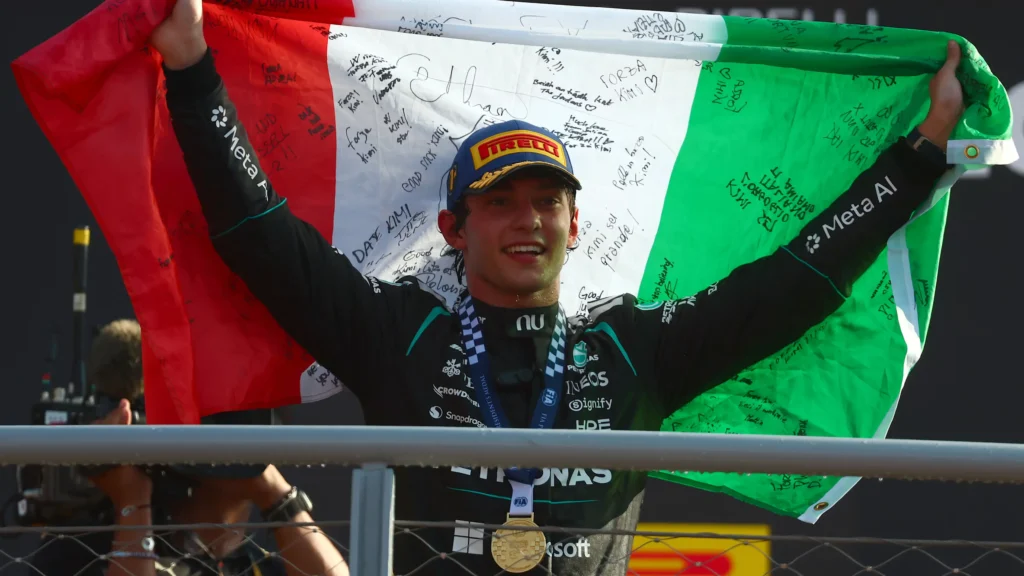
Nineteenth on the grid. First at the chequered flag.
In modern Formula 1, recovery drives are common, but outright victories from the back row of the grid are statistical anomalies. When Kimi Antonelli parked his Mercedes in parc fermé as the winner of the 2026 Italian Grand Prix, the immediate reaction was disbelief.
How does a driver start nineteenth at Monza, a circuit notorious for DRS trains, and end the afternoon as the race winner?
The answer was not one single miracle moment. Antonelli’s stunning victory was a complex web of circumstances and choices. It was a combination of Antonelli’s raw pace, clinical overtaking, and Mercedes’ calculated race preparation. It relied on shrewd tyre strategy, the timing of a Virtual Safety Car, and the differing tyre strategies between the Mercedes drivers. Ultimately, it came down to battery and energy deployment, George Russell’s tyre degradation, Antonelli’s flawless execution under immense pressure, and the unique opportunities created by the race itself.
Here is how the impossible became reality.
1 — THE GRID PENALTY THAT CHANGED EVERYTHING
To understand Antonelli’s Sunday, we must look at his Friday. The Italian arrived at his home race highly competitive, routinely placing at the top of the timing sheets. Yet, he started on the back row.
The penalty was a calculated sacrifice. Mercedes opted to fit Antonelli’s W17 with a new Internal Combustion Engine (ICE) and a fresh Energy Store, exceeding his seasonal allocation. Under FIA regulations, these component changes trigger an automatic grid drop.
Strategically, taking the penalty at Monza made sense. The circuit’s long straights offer genuine overtaking opportunities, making it one of the least punishing tracks on the calendar to start from the back.
However, a crucial distinction must be made: starting from the back did not mean Mercedes had a slow car. Antonelli’s P19 starting position was a regulatory consequence, while Mercedes’ underlying pace was arguably the strongest on the grid. They had a car capable of winning; it just happened to be starting at the rear.
2 — MERCEDES PREPARED FOR A RECOVERY DRIVE
Mercedes did not approach Sunday hoping for luck; they engineered a recovery plan from Friday morning. Knowing the engine penalty was inevitable, the team abandoned traditional qualifying preparation.
Instead of tuning the car for single-lap pace, Mercedes dedicated Free Practice 2 to long-run data, traffic running, and overtaking preparation. They sacrificed a small amount of cornering downforce to strip drag from the rear wing. This setup ensured Antonelli would have a potent top-speed advantage to make passes into Turn 1 (the Rettifilo chicane) and Turn 4 (the Variante della Roggia).
If we look closely at Mercedes’ pre-race communications, their intentions were clear. The team noted they were “focused entirely on Sunday’s raceability.” They knew Antonelli would be operating in dirty air—the turbulent wake left by cars ahead, which normally degrades tyres—and set the suspension geometry to protect the rear tyres from overheating during continuous overtaking attempts.
3 — THE FIRST 10 LAPS: HOW P19 BECAME THE FRONT
When the lights went out, Antonelli’s progression was systematic. He did not rush, but he did not waste time.
By Lap 3, he had cleared the backmarkers. By Lap 7, he was slicing through the midfield, picking off the Alpine and Haas cars with ease. Most of these overtakes were completed exactly where Mercedes had planned: utilizing the slipstream down the main straight and out-braking his rivals into Turn 1.
Monza is uniquely suited for this kind of recovery. The heavy braking zones at the end of long DRS (Drag Reduction System) straights allow a driver with a top-speed advantage to make decisive, low-risk moves.
But Antonelli’s rapid ascent through the field told us something critical about the Mercedes’ pace. Ordinarily, battling through ten cars in a dozen laps shreds a driver’s tyres. Antonelli, however, was maintaining lap times comparable to the leaders. The W17 was not just fast; it was remarkably kind to its rubber, allowing Antonelli to push aggressively without paying a thermal penalty.
4 — THE STRATEGIC TURNING POINT
The complexion of the race shifted dramatically during the Virtual Safety Car (VSC) phase. When a midfield car suffered a mechanical failure and parked near the Lesmo corners, race control neutralised the track. Drivers were forced to reduce their speed by a set delta.
This is where the strategy was won.
Under normal racing conditions, a pit stop at Monza costs around 24 seconds. Under a VSC, because the cars on track are driving much slower, the relative time lost in the pit lane is nearly halved.
Antonelli had started the race on the Hard compound tyre, a durable rubber meant to go deep into the race. When the VSC was deployed, Mercedes immediately called him into the pits for Mediums.
Russell, who had started near the front and led the opening stint, had already made his scheduled pit stop for Hard tyres under green flag conditions a few laps earlier. He could not stop again without losing the lead.
Suddenly, their strategies diverged completely. Russell was committed to finishing the race on a set of Hard tyres that were gradually wearing out. Antonelli was now equipped with fresher, softer Medium tyres, giving him a massive grip advantage for the second half of the Grand Prix.
The strategy did not automatically win Antonelli the race, but it completely changed the conditions of the battle. The question was no longer if Antonelli would catch Russell, but whether he could pass him before the Medium tyres degraded.
5 — WHY RUSSELL'S STRATEGY BECAME A PROBLEM
As the race entered its final phase, a classic Formula 1 dilemma unfolded. Russell had the ultimate advantage: track position. Antonelli had the mechanical advantage: fresher, faster tyres.
Eventually, those advantages collided. The Hard compound tyres on Russell’s car began to suffer from thermal degradation. Because Russell was pushing to keep a gap to his recovering teammate, the surface temperature of his rear tyres spiked, particularly through the high-speed loads of the Parabolica and the traction zones of the chicanes.
Reliable timing data showed Russell losing two-tenths of a second to Antonelli in the middle sector alone. The compound difference was stark. The Medium tyre allowed Antonelli to brake later and get on the throttle earlier.
Russell himself acknowledged the vulnerability after the race, noting he was “surprised by the split strategies” and felt like a sitting duck as his tyre grip faded while defending against a car with an identical aerodynamic profile.
6 — THE BATTERY WAR
While tyres dictated the pace, the battle was ultimately decided by the 2026 power unit regulations. F1 Mavericks readers know that the current regulations place massive emphasis on electrical energy. With the MGU-H removed and the MGU-K now responsible for a staggering 350kW of power, energy deployment is the most critical tactical tool a driver has.
Because the cars were aerodynamically identical, Antonelli could not simply rely on a slipstream to pass Russell. He had to win the battery war.
To defend his lead, Russell was forced to deploy electrical energy heavily on the main straights to prevent Antonelli from getting alongside. But electrical energy is finite; it must be harvested under braking. By forcing Russell to deploy defensively lap after lap, Antonelli was draining his teammate’s Energy Store.
Antonelli cleverly used the slipstream to stay close without burning his own battery. He managed his energy reserves, waiting for the moment Russell began “clipping”—the phenomenon where a car runs out of electrical deployment before the end of the straight, causing top speed to suddenly plateau.
Once Russell’s battery reserves were depleted, the Mercedes drivers were no longer in equal machinery. Antonelli had a fully charged battery to attack; Russell had nothing left to defend.
7 — THE FINAL FIGHT
The tension culminated with just a handful of laps remaining. Antonelli had closed to within DRS range, his front wing glued to Russell’s gearbox.
The decisive overtake was a masterclass in tactical racecraft. Heading into Turn 1, Antonelli deployed a burst of energy to pull alongside, forcing Russell to defend the inside line. Knowing Russell was compromised on the tight exit of the chicane, Antonelli immediately backed out of the move, prioritized a wider, cleaner exit, and maximized his traction.
Carrying vastly superior speed through the Curva Grande, Antonelli utilized his remaining battery deployment. As they approached the Variante della Roggia, Antonelli had the inside line and the momentum. He braked perfectly on the limit of his Medium tyres, sliding past Russell to take the lead.
It was a clean, surgical strike. There was no exaggerated drama or contact, just a perfectly executed tactical maneuver born from superior energy management and tyre grip.
8 — THIS WASN'T JUST A MIRACLE
It is tempting to look at a P19 to P1 result and call it a miracle, but doing so ignores the reality of modern Formula 1.
If we separate this victory into its components, the truth emerges.
- The Car: Mercedes provided a chassis with formidable underlying pace and exceptional straight-line efficiency.
- The Strategy: The team made the right tyre decisions and capitalized perfectly on race-neutralisation opportunities to gain cheap pit-stop time and superior track positioning.
- The Driver: Antonelli provided relentless consistency, surgical overtaking, and immense pressure management in front of a demanding home crowd.
- The Race: The incident that caused the VSC, the strategy divergence between teammates, and the changing tyre performance all tipped the scales.
Starting P19 made the victory extraordinary, but it was the combination of meticulous preparation, seizing fleeting opportunities, and flawless execution that made it possible.
9 — WHAT THE WIN MEANS FOR THE 2026 CHAMPIONSHIP
Moving beyond the euphoria of Monza, this result sends shockwaves through the 2026 Championship.
For Mercedes, securing a 1-2 finish despite starting one car at the back of the grid is a massive statement in the Constructors’ Championship. It proves the W17 can win under wildly varying strategic conditions.
More significantly, it alters the dynamic between the two drivers. Russell drove a brilliant, controlled race from the front, yet was hunted down and beaten by a teammate who started in another zip code. While the mathematics do not declare the championship over, the psychological momentum has undeniably shifted.
Monza has changed the balance of the 2026 championship. Antonelli has proven he can win from the front, and now, he has proven he can win from the back.
THE REAL MONZA MASTERCLASS

We return to where we started: P19 on the grid. P1 at the chequered flag.
Kimi Antonelli’s triumph in Italy will be replayed for years to come, but its true brilliance lies beneath the surface. This victory was not simply about a driver being fast enough to overtake 18 cars. It was about a team and a driver turning an almost impossible starting position into an opportunistic weapon.
They took a penalty, engineered a plan, trapped their rivals in a strategic corner, and executed perfectly when the margins were razor-thin. It wasn’t luck that conquered Monza; it was a masterclass in modern motorsport engineering.


