
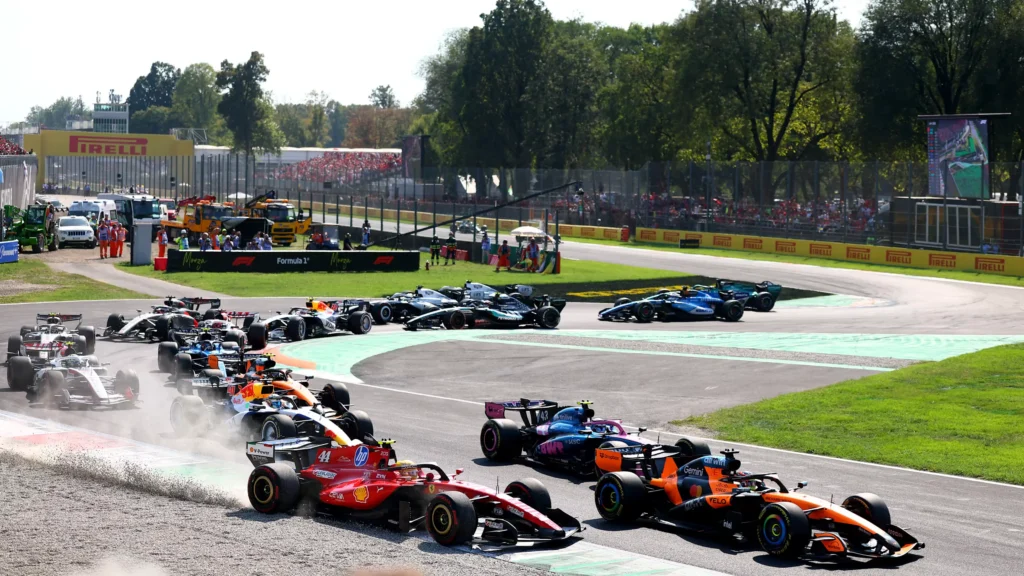
Ferrari arrived at Monza with both cars near the front and the weight of a nation’s expectation on their shoulders. With Charles Leclerc qualifying third and Lewis Hamilton right beside him in fourth, a podium at the Temple of Speed looked more than just realistic—it felt like a baseline requirement. Yet, by the time the chequered flag fell, the dream had violently unravelled. Leclerc was a DNF after a heavy shunt, and Hamilton was left to salvage a lonely sixth place while Mercedes celebrated an astonishing 1-2 finish.
How did Ferrari go from having its star-studded lineup in prime position at the Italian Grand Prix to suffering a home-race disaster?
The instinct in Formula 1 is always to look for a singular scapegoat: a botched pit stop, a driver error, or a catastrophic strategy call. But Ferrari did not lose the Monza podium because of one single mistake. Instead, this was a weekend that disintegrated through a chain of compounded problems—ranging from qualifying missteps to intra-team chaos and, ultimately, a fundamental aerodynamic deficit.
Here is how Ferrari’s Monza weekend actually fell apart, step by step.
1. Ferrari Already Left Performance on the Table in Qualifying
The unravelling began before the lights even went out on Sunday. Ferrari had a car capable of fighting at the absolute front over a single lap, but the team fundamentally failed to maximise the most crucial aerodynamic tool at Monza: the slipstream.
Monza’s unique layout means a perfectly timed tow can be worth two-to-three tenths of a second. Yet, during Q3, Ferrari’s execution was disjointed. Rather than orchestrating a clean, synchronised tow for both drivers, the team sent them out into awkward track positions. Formula 1’s official race-day team comments revealed that both Hamilton and Leclerc were highly critical of Ferrari’s qualifying strategy. Without the optimal slipstream, Leclerc could only manage P3, while Hamilton originally qualified P5 (before Oscar Piastri’s grid penalty promoted the Briton to P4).
They were close to the front, but at Monza, starting P4 instead of P1 or P2 leaves a driver highly vulnerable to the chaotic slipstream battles on the run down to Turn 1. Ferrari compromised its race before it began.
2. The Hamilton–Leclerc Clash That Started the Collapse
The vulnerability of those starting positions was immediately exposed on Sunday. As the pack roared down the long main straight toward the tight Rettifilo chicane, Hamilton got a strong launch and attempted to pass his teammate down the inside.

What followed was exactly what a team principal fears most. Leclerc held his line aggressively, squeezing Hamilton on the entry. The seven-time world champion was forced wide, plunging through the gravel trap and tumbling down the order to 11th place.
“Charles pushed me off,” Hamilton immediately fired over the team radio. While the stewards noted the incident but took no further action, the internal damage was done. Speaking to Motorsport.com, Fred Vasseur admitted the driver clash was “not good for the team.” More alarmingly, Hamilton’s post-race comments to Sky Sports revealed a deep frustration with Ferrari’s race management, explicitly claiming there are “no rules” when it comes to racing his teammate.
This was a classic racing incident born of two elite competitors refusing to yield, but it instantly derailed Ferrari’s tactical plan. Hamilton was now mired in the midfield, forcing the pit wall to pivot to a recovery strategy rather than a proactive offensive.
3. Then Leclerc Crashed
While Hamilton was picking his way through the midfield dust, Leclerc’s race ended in spectacular fashion.
On Lap 2, running in the podium positions but under intense pressure from McLaren’s Oscar Piastri, Leclerc pushed his SF-26 to the absolute limit. Exiting Parabolica—Monza’s fearsome final corner—Leclerc ran marginally wide. As confirmed by Reuters, his right rear tyre touched the dirty, dusty white-line surface on the edge of the track. The Monegasque suffered sudden wheelspin, violently lost the rear of the car, and skewed off at high speed into the tyre barriers.
Leclerc walked away unhurt, but the 60G impact brought out the red flag. Within four laps, Ferrari had lost its lead car, its strongest starting position, and its strategic optionality. The home-race dream had officially mutated into a nightmare.
4. Ferrari's Real Problem Was Hiding in Plain Sight
While the crashes and controversies generated the headlines, Ferrari’s biggest underlying weakness was quietly dictating its ceiling: straight-line speed.
Following the race, Vasseur explicitly stated that the team knew Monza would be a difficult weekend because of their top-speed deficit. Hamilton echoed this, acknowledging that the SF-26 was bleeding performance on the straights, making both overtaking and defending an uphill battle.
At a circuit like Monza, aerodynamic drag is everything. The track is defined by long straights interspersed with heavy braking zones. If a car is “draggy,” it cannot capitalise on the slipstream, its DRS advantage is blunted, and it is forced to deploy electrical energy sub-optimally just to keep up.
Because Ferrari was slow on the straights, Hamilton found it incredibly difficult to defend against faster cars in the DRS zones, and equally difficult to pass without taking massive risks under braking. Monza brutally exposed the SF-26’s aerodynamic inefficiency, stripping Ferrari of the very weapon you need to win in Italy.
5. Hamilton Actually Rescued Ferrari's Race
Given his eventual P6 finish, it is easy to assume Hamilton simply had a poor afternoon. The data tells a very different story. After being pushed down to 11th on Lap 1, Hamilton delivered a masterclass in damage limitation.
Following the red flag restart, Hamilton methodically picked his way through the midfield. Once he was finally in clean air, the inherent mechanical grip of the Ferrari SF-26 came alive. Free from the turbulent wake of slower cars, Hamilton was able to manage his tyre degradation beautifully, running highly consistent lap times to drag himself back into the fringes of the podium fight.
He didn’t just stumble into sixth place; he fought back through a pack of cars that boasted superior straight-line speed. For a fleeting period in the second stint, Hamilton actually gave Ferrari a legitimate chance to rescue their disastrous weekend.
6. The Strategy Question: Did Ferrari Make the Wrong Call?
As Hamilton closed in on the top four, the focus inevitably shifted to the pit wall. Did Ferrari make a strategic blunder that cost them a podium?

Following the race, Hamilton was audibly frustrated with the team’s tyre decisions, particularly surrounding the timing of their pit stops and their reaction to a mid-race Virtual Safety Car (VSC). However, an objective look at the data requires us to distinguish between what the driver felt in the cockpit and what was actually possible.
Ferrari’s strategy was inherently compromised by the car’s limitations. When the pit wall opted to extend Hamilton’s stint, hoping to create a tyre offset against the Red Bulls, they were gambling that fresh rubber would allow Hamilton to breeze past them late in the race. But as we have established, Ferrari lacked the straight-line speed to overtake efficiently.
Mercedes and Red Bull had the luxury of making conservative strategic calls because their raw pace protected them. Ferrari had to take risks. Did they react too slowly to the VSC? Perhaps. But the harsh reality is that no tyre strategy can magically generate 10 km/h on the main straight. Ferrari didn’t lose the podium solely in the pit lane; their strategy was simply unable to overcome the car’s inherent aerodynamic flaws.
7. Why Mercedes Could Do What Ferrari Couldn't
If you want to understand why Ferrari failed, you only need to look at the other side of the garage: Kimi Antonelli.
The 20-year-old Mercedes prodigy started P19 and drove to an astonishing victory. The contrast is devastating. Antonelli started at the back and won; Hamilton started P4 and finished P6.
Why? Because Mercedes possessed everything Ferrari lacked. Formula 1’s official race report specifically highlighted Mercedes’ superior straight-line performance. Antonelli was able to slice through the field because his car allowed him to deploy electrical energy aggressively on the straights and breeze past rivals in the DRS zones. Furthermore, Mercedes’ chassis was kinder to its tyres in dirty air, allowing Antonelli to maintain immense race pace without destroying his rubber. Ferrari, battling a draggy car, had to burn through its tyres just to maintain position.
8. Did Hamilton Really Lose the Podium?
This brings us to the central question of the weekend. Is Lewis Hamilton responsible for missing out on the podium?
The answer is nuanced. Hamilton is not entirely blameless. His positioning on the opening lap was aggressive, and while Leclerc squeezed him, Hamilton put his car in a high-risk wedge that ultimately cost him vital track position. When you are fighting your teammate, discretion is often the better part of valour.
However, looking at the full scope of the race, Hamilton was a victim of circumstances far beyond his control. He did not orchestrate the team’s poor qualifying execution. He did not ask for a car with a fundamental straight-line deficit. He did not cause Leclerc’s crash, nor did he make the borderline pit-wall decisions under the VSC.
Did Hamilton lose the podium, or did Ferrari fail to give him a car and strategy capable of defending one? The evidence points heavily toward the latter. The inherent difficulty of overtaking at Monza without sufficient top speed meant that once Hamilton dropped back on Lap 1, a podium was mathematically improbable, regardless of how well he drove.
9. What Monza Revealed About Ferrari
Zooming out from the immediate disappointment, Monza 2026 revealed deeply concerning traits about Ferrari’s current package.
This was a weekend where Ferrari had a massive emotional home advantage, two elite drivers starting near the front, and the deafening support of the tifosi. Yet, they were comprehensively outclassed by a Mercedes team that secured a dominant 1-2.
Was this an isolated failure? Monza is an outlier on the F1 calendar—a uniquely low-downforce circuit that punishes drag more than any other track. However, Vasseur’s admission that the team knew top speed would be an issue indicates a fundamental limitation baked into the SF-26’s DNA. If a car cannot shed drag efficiently, it will struggle at every power-sensitive circuit on the calendar. This was not just a bad Sunday; it was a glaring exposure of Ferrari’s aerodynamic ceiling.
Conclusion — Ferrari Didn't Lose Monza in One Moment
To view the 2026 Italian Grand Prix as a race decided by a single clash or a lone crash is to misunderstand how Formula 1 operates. The result was the product of a vicious chain reaction:
Qualifying execution problem
↓
Hamilton starts P4 instead of fighting for the front
↓
Hamilton–Leclerc clash at Turn 1
↓
Hamilton drops to P11
↓
Leclerc crashes on Lap 2
↓
Red flag
↓
Hamilton recovers
↓
Ferrari’s straight-line weakness becomes increasingly obvious
↓
Tyre/strategy decisions fail to create enough advantage
↓
Mercedes and Red Bull remain faster
↓
Hamilton finishes P6
↓
Ferrari leaves its home race without a podium
Ferrari’s Monza disaster was not authored by a single villain. It was a collective failure of operational execution, intra-team management, and aerodynamic engineering. Lewis Hamilton may have lost a podium at his first Italian Grand Prix in red, but he did not lose it alone. Ferrari simply did not bring a package—or a plan—capable of delivering the glory the tifosi demanded.


