
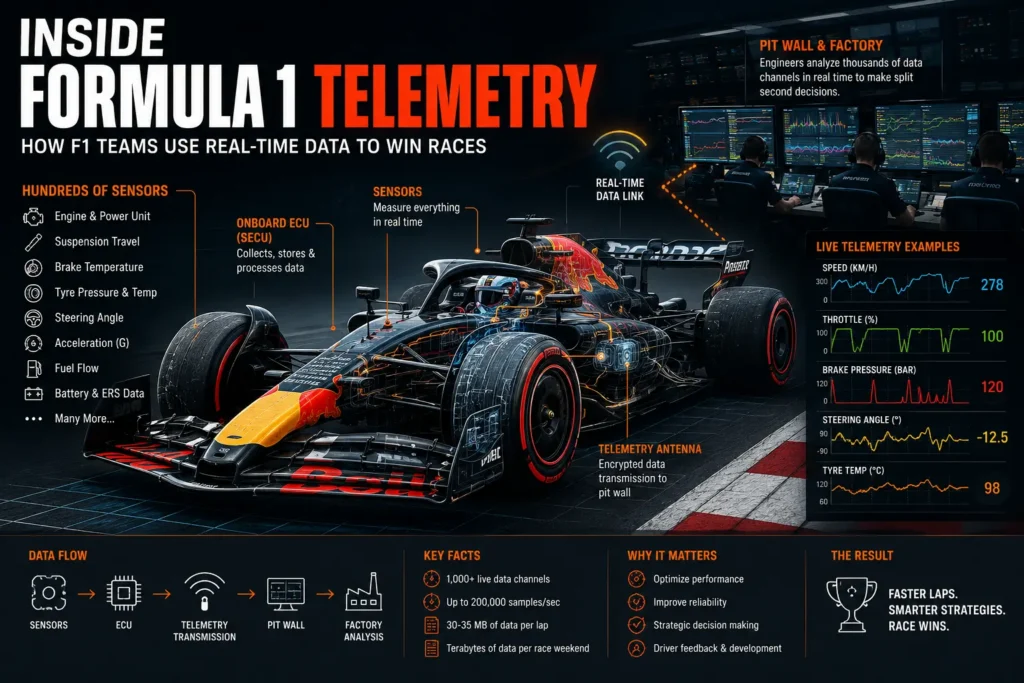
Running a contemporary Formula 1 car is widely considered one of the most sophisticated systems-engineering challenges on Earth. An F1 car is no longer merely a mechanical entity; it is a rolling data center generating over a terabyte of data per weekend.
This article explores the complete architectural framework of modern F1 telemetry, examining the physics, electronics, and data analysis methodologies used by race engineers to optimize lap time, ensure reliability, and dictate race strategy.
1. Telemetry vs. Alerting: The Engineering Philosophy
To understand F1 data systems, one must distinguish between “on-device alerting” and pure telemetry. From an engineering standpoint, configuring a sensor to trigger an alert only when a threshold is breached (e.g., “tyre pressure low”) is fundamentally flawed in a dynamic race environment.

The Problem Solved: Alerts lack context. If a tyre blows out or a power unit fails, an alert cannot tell an engineer how the failure occurred. Was it a rapid spike in temperature, or a slow build-up over several laps?
The Solution: Telemetry relies on “dumb” data collectors that continuously stream the absolute state of the car back to the garage. This continuous, high-resolution time-series data allows engineers to monitor the gradient of change, perform post-event forensics, and rapidly implement new predictive models without having to reprogram onboard sensor logic during a race.
2. ECU Architecture and CAN Bus Communication
Why it exists: Modern F1 cars utilise over 250 individual sensors, categorised into control,
instrumentation, and monitoring devices. Routing individual wires for each sensor to a central logger would result in a wiring loom too heavy and complex for an F1 car.
The Problem Solved: To manage this, F1 cars utilise a Controller Area Network (CAN) bus. The CAN bus is a deterministic network, meaning critical electronic signals are prioritized and never collide. This onboard backbone feeds directly into the Standard Electronic Control Unit (SECU).

SECU Architecture: Since 2008, the FIA has mandated a standardized ECU (currently supplied
by McLaren Applied). This SECU serves as the ultimate gateway for the car.
- Regulatory Policing: By mandating the SECU, the FIA ensures teams cannot implement illegal driver aids (like closed-loop traction control). The SECU physically and electrically isolates control sensors (used for engine and brake-by-wire operation) from purely instrumentation-based logging sensors.
- Data Gateway: The SECU acts as the central data logger. It records high-speed data to solid-state buffers (preventing data loss during radio dropouts) and simultaneously compresses and encrypts the live stream, generating roughly 30 megabytes of live data per lap.
3. Wireless RF Transmission and Telemetry Latency
Why it exists: Telemetry must be transmitted from a car moving at speeds exceeding 300 km/h to a static pit wall, without dropping packets.
The Engineering Problem: Traditional Wi-Fi cannot handle the extreme Doppler shifts and rapid physical displacement of an F1 car. Furthermore, broadcasting 1,200+ channels per car in a densely populated RF environment requires immense bandwidth and strict security.
The Solution: F1 utilizes a proprietary WiMAX 802.16 mesh network operating on the 3.5 GHz frequency band. Access points are distributed around the circuit. As the car travels, the onboard Picochip-based WiMAX transmitter seamlessly hands over the connection from one node to the next.
Latency and Factory Integration: The telemetry stream is received at the circuit and fed into the ATLAS (Advanced Telemetry Linked Acquisition System) server. However, the pit wall is only half the equation; the data must reach the factory operations room.
- European Races: Data routed via hardline fiber reaches the factory in 10 to 15 milliseconds.
- Fly-Away Races: For races in Australia or Japan, physics and satellite/undersea cable
routing increase latency to 300 to 400 milliseconds.
4. Aerodynamic Telemetry: Correlating CFD and the Track

Why it exists: Wind tunnels and Computational Fluid Dynamics (CFD) simulations are constrained environments. They cannot perfectly replicate track turbulence, crosswinds, or
the dynamic roll and pitch of the car over kerbs.
How Engineers Interpret the Data: Engineers measure aerodynamic performance on track using a combination of suspension displacement sensors and pressure taps.
- Ride Height and Displacement: Laser ride-height sensors directly measure the car’s proximity to the ground. Linear Variable Differential Transformers (LVDTs) mounted to the pushrods measure suspension stroke. By calculating the loads compressing the suspension at high speeds, engineers can mathematically derive the exact amount of aerodynamic downforce being generated.
- Surface Pressure: Teams use aero sensor blocks containing multiple low-pressure sensors (e.g., +/- 0.5psi) connected via pneumatic tubes to the surfaces of the front wing, sidepods, and underbody. By measuring the static pressure (p) against the remote free-stream dynamic pressure (q), engineers calculate the Pressure Coefficient (Cp). Impact on Strategy: If the Cp data shows the underbody diffuser is “stalling” (losing suction) at a specific rear ride height, engineers will stiffen the rear third-damper (heave damper) to artificially hold the car’s aerodynamic platform stable.
5. Hybrid ERS Telemetry: The 2026 Regulations
With the 2026 FIA Technical Regulations, the Energy Recovery System (ERS) becomes even
more heavily scrutinized and critical to lap time. The
Engineering Problem: The FIA must strictly police the flow of electrical energy to ensure no team exceeds the 8.5 MJ per lap harvesting limit or the 1000V maximum working voltage limit. Furthermore, electrical energy deployment must precisely match the driver’s throttle input with a maximum
permitted delay of 50 milliseconds.
Telemetry Interpretation:
- Energy Flow: The FIA mandates the installation of two highly calibrated DC sensors on the High Voltage DC Bus. One monitors the Energy Store (ES) negative pole, and the other monitors the positive pole of the MGU-K Control Unit (CU-K). This telemetry proves that all electrical energy propelling the car is legal.
- Torque Sensors: Regulatory torque sensors are mandated on both the MGU-K output shaft and the driveshafts. Engineers use this data to precisely map the hybrid deployment curve, ensuring the internal combustion engine (ICE) and MGU-K torque blend seamlessly without inducing wheelspin.
- Safety and Isolation: Telemetry monitors the Battery Management System (BMS), cell voltage dispersion, and Insulation Monitoring Devices (IMD). If telemetry detects an isolation failure (e.g., high voltage leaking to the chassis), the SECU will instantly open the main contactors and shut down the ERS to protect the driver and mechanics.
6. Tyre Degradation and Thermodynamics

The Problem Solved: Tyres are the only contact patch with the track, and their grip is governed by precise thermal operating windows.
Data Collection: Engineers use multi channel non-contact infrared thermal cameras aimed at the tyre carcass. A typical array reads at least three distinct temperature bands (inner, middle, outer) across the width of the tread. This is paired with FIA-mandated internal Tyre Pressure Monitoring Systems (TPMS).
The Problem Solved: Tyres are the only contact patch with the track, and their grip is governed by precise thermal operating windows.
Data Collection: Engineers use multi channel non-contact infrared thermal cameras aimed at the tyre carcass. A typical array reads at least three distinct temperature bands (inner, middle, outer) across the width of the tread. This is paired with FIA-mandated internal Tyre Pressure Monitoring Systems (TPMS).
7. Telemetry-Based Driver Coaching and Dynamics
Why it exists: Human perception is flawed; drivers often misinterpret vehicle dynamics or
cannot pinpoint exactly where they lost hundredths of a second. How it is used:
Performance engineers rely on ATLAS software to overlay the telemetry traces of two
drivers.

- The Speed Trace: The baseline metric. By looking at a distance-vs-speed graph,
engineers immediately identify who brakes later, who carries a higher minimum apex
speed, and who gets on the throttle earlier. - Throttle and Brake Pressure: A perfectly smooth, steep brake trace indicates
threshold braking (utilising maximum aerodynamic downforce), tapering off as
downforce bleeds away. A “saw-tooth” throttle trace reveals a driver hesitating,
fighting poor traction or a nervous rear end. - Steering Angle and G-Forces: High-frequency, jagged fluctuations in the steering
trace indicate the driver is constantly applying opposite lock to catch “snap
oversteer”. By combining steering angle with lateral G-force, engineers evaluate the
car’s steady-state balance. - Delta Time: The time difference graph highlights exact micro-sectors where a driver
gains or loses time compared to a benchmark lap, providing objective targets for the
next run.
8. Predictive Failure Analysis and The Factory Loop
The Engineering Problem: An F1 power unit costs millions; catastrophic failure results in
severe grid penalties.
The Solution: Rather than waiting for a mechanical failure, telemetry allows for predictive diagnosis. For instance, vibration data on engine components can be sampled at a staggering 200,000 times per second (200 kHz) and filtered via digital signal processing before being logged. If analysts at the factory observe a micro-fluctuation in gear shaft vibration, an anomalous drop in oil pressure, or a rise in water temperature, they instruct the race engineer to change the engine mode or retire the car before the engine destroys itself.
Conclusion
Formula 1 telemetry is the ultimate fusion of automotive engineering and IT infrastructure.
The data stream flows from 300+ sensors, over a deterministically timed CAN bus, through a
standardized ECU, and across an encrypted 3.5 GHz WiMAX mesh. By the time the driver has
completed a corner, the telemetry has already traveled via fiber optics to a factory simulator,
updated a digital twin, and generated a strategic recommendation. In modern F1, hardware
sets the baseline, but it is the rapid acquisition, interpretation, and application of telemetry
that ultimately finds the checkered flag.


