
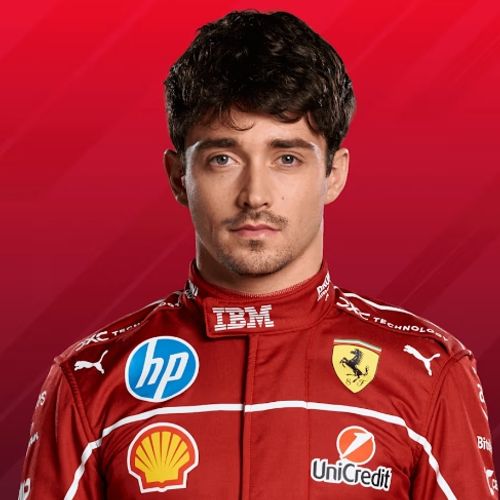
Full Name | Charles Leclerc |
Date of Birth / Place of Birth | 16 October 1997 / Monte Carlo, Monaco [1, 2] |
Nationality | Monegasque |
Race Number | 16 |
Current Team | |
Active Years in Formula 1 | 2018 – Present |
Total Races Entered | 167 |
Total Wins | 8 |
Total Podiums | 50 |
Total Poles | 27 (Indicates elite one-lap speed) |
Total Career Points | 1640 |
Championships | 0 |
Charles Leclerc stands as one of the most compelling and dynamic figures in modern Formula 1, embodying both the immense promise and the relentless pressure of leading the sport’s most historic team, Scuderia Ferrari. His journey from the karting tracks of Monte Carlo to the pinnacle of motorsport has been defined by precocious talent, statistical dominance in the junior categories, and a profound, historic link to the Maranello structure. This profile analyzes Leclerc’s background, his rapid career trajectory, his signature driving style, and the complex narrative that surrounds his quest to deliver a long-awaited World Championship title to the Tifosi.
Genesis of a Champion: The Formative Years and the Weight of Mentorship
The roots of Charles Leclerc’s motorsport career are intertwined with his upbringing in Monaco, a principality intrinsically linked to Grand Prix racing. Born on October 16, 1997, in Monte Carlo , Leclerc was supported intensely by his family, including his parents, Hervé and Pascale, and his brothers, Lorenzo and Arthur. The family made personal sacrifices to ensure he could pursue his ambitious dream. He began karting in 2005, swiftly asserting himself by winning several French championships.
Rivalry Forged in Miniature: Verstappen and the KZ Challenge
Leclerc’s early karting career was not merely a series of local victories; it was a proving ground where his talent collided repeatedly with that of a contemporary: Max Verstappen. The shared competitive path of these two drivers dates back to their teenage years, most notably culminating in the 2013 CIK-FIA World KZ Championship. In that high-stakes international competition, Leclerc finished second, often battling wheel-to-wheel with the Dutchman.
This decade-long competitive dialogue between the two drivers provides critical context for their high-profile battles in Formula 1. Their rivalry is not a sudden construct of a title fight but rather the continued escalation of two distinct, elite talents whose paths have been intertwined since adolescence. This competitive precedence established Leclerc’s pedigree early on, ensuring he arrived in Formula 1 having already mastered competition against the most aggressive and successful driver of his generation.
The Crucial Role of Jules Bianchi
Perhaps the most defining element of Leclerc’s early trajectory is his connection to the late French driver Jules Bianchi. Bianchi was not only a close friend and role model but also Leclerc’s godfather. Leclerc remembers him as a highly-rated Frenchman, describing him as “competitive, kind and an extremely talented driver”.
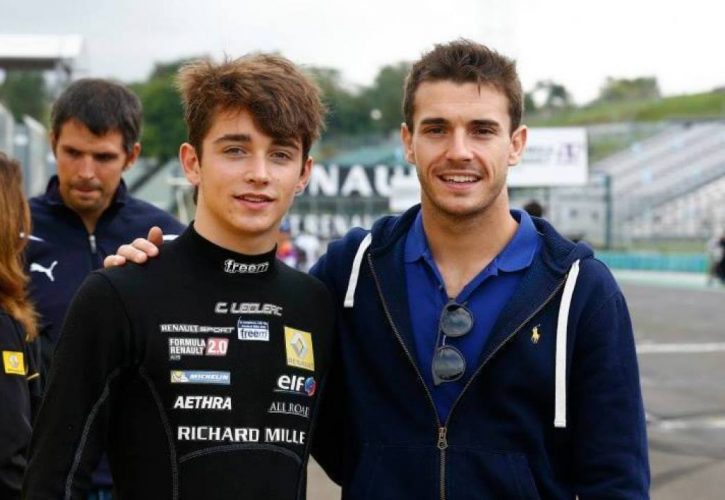
This relationship was essential in paving Leclerc’s path to Maranello. Bianchi, who was himself part of the Ferrari Drivers Academy (FDA), used his influence to introduce a 14-year-old Leclerc to Nicolas Todt. Todt, a powerful figure in motorsport management, remains Leclerc’s manager to this day. This connection secured Leclerc’s entry into the FDA in 2016. The emotional link to Bianchi, who tragically passed away after a crash, means Leclerc’s career success carries the profound weight of potential realized. His journey is inextricably linked to the Scuderia, not just professionally (joining the FDA) but personally, positioning him as the designated inheritor of a powerful, emotional, and historic link to Ferrari. Leclerc is thus viewed by many as the son of Ferrari, deeply invested in restoring the team’s former glory.
The Rapid Ascent: Junior Formula Dominance and FDA Accreditation
The speed of Leclerc’s ascent through the single-seater ranks was extraordinary, demonstrating a natural ability to adapt instantly to new machinery, a defining characteristic that secured his immediate leap to Formula 1.
Single-Seater Acclimation and Immediate Success
After success in karting, Leclerc transitioned to single-seaters in 2014, immediately proving his competitive pace by finishing second overall in Formula Renault 2.0 Alps, behind Nyck de Vries. He followed this with a move to the Formula 3 European Championship in 2015.
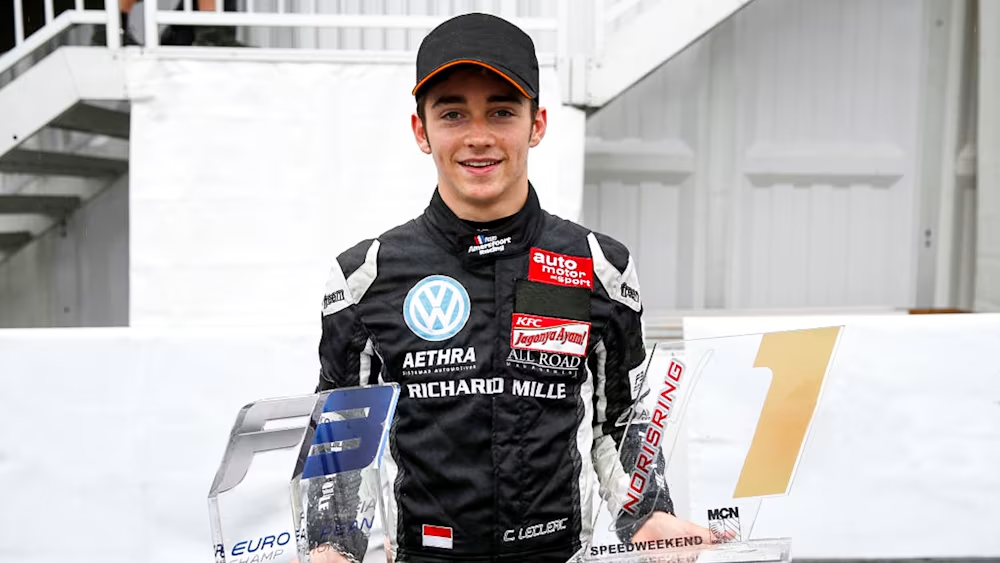
His career gathered explosive momentum in the primary support series. In 2016, he claimed the GP3 Series title, finishing ahead of future F1 driver Alexander Albon. This was merely a warm-up for his 2017 campaign in Formula 2 with Prema Racing, which proved to be a masterclass in single-season dominance.
Dominating the Feeder Series
Leclerc secured the 2017 Formula 2 title in his rookie year, recording a stunning seven wins, eight pole positions, and 10 podiums from 22 races, finishing 72 points ahead of Artem Markelov. This result solidified his reputation as a prodigious talent, setting several records in the process. He became the youngest-ever champion of the main F1 support series at 19 years and 356 days old, and the first rookie to achieve the title since Nico Hulkenberg in 2009.
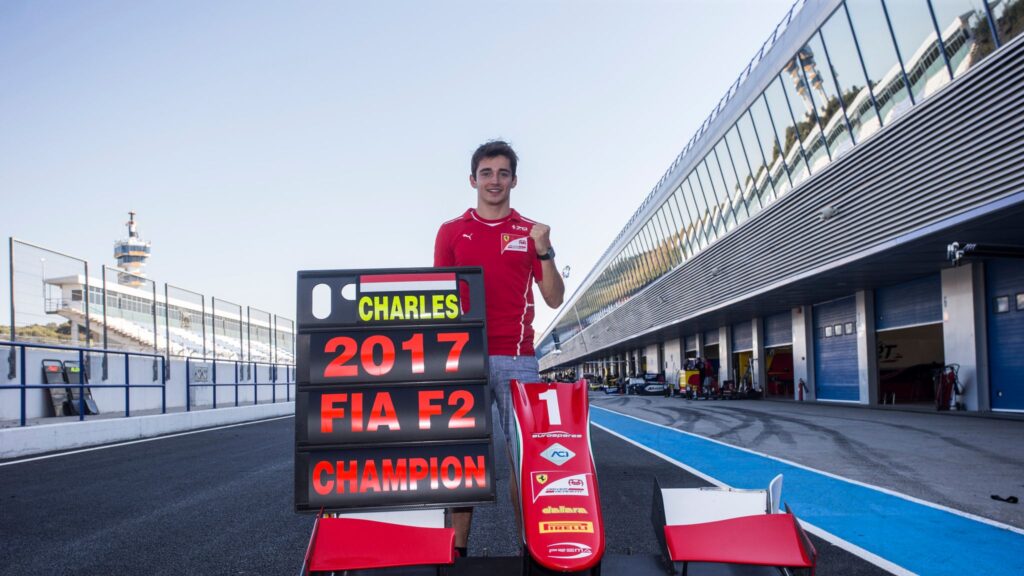
This achievement demonstrated unparalleled adaptability. Winning consecutive championships in GP3 and F2, often as a rookie, confirmed he possessed the rare ability to quickly understand and extract the maximum performance from constantly evolving aerodynamic and powertrain packages. This quality is fundamental for longevity and success in Formula 1. Furthermore, his eight pole positions in a single F2 season showcased an early proficiency for one-lap speed, a trait that would become his signature in F1. This statistic was the clear precursor to his impressive F1 qualifying record, signaling his readiness for the sport’s highest level.
Joining the Scuderia Pipeline
The link to Ferrari was formally cemented when Leclerc joined the Ferrari Driver Academy in 2016. His duties involved serving as a development driver for both Haas and Ferrari. His speed was evident even in these early roles; during mid-season testing for Ferrari at the Hungaroring in 2017, he finished fastest on the first day, completing 98 laps and validating the organization’s faith in his potential. This consistent display of peak performance convinced Ferrari that he was ready for an immediate F1 seat.
The Formula 1 Journey: Apprentice, Prodigy, and Scapegoat
Leclerc’s transition to Formula 1 was immediate and impactful, proving he could excel under pressure and outperform cars that lacked competitive pace.
The 2018 Debut: Outperforming the Machinery (Sauber)
Leclerc made his Formula 1 debut in 2018 with Sauber. Though Sauber was a midfield team, Leclerc delivered a “memorable debut campaign”. He quickly established a reputation for extracting performance beyond the car’s theoretical limits, often “getting more out of the car than should have been possible”. This singular season of impactful driving convinced Ferrari’s leadership to bypass conventional progression routes and sign him for the prestigious 2019 season, replacing the veteran World Champion Kimi Räikkönen.
The Leap to Maranello (2019)
Joining Ferrari in 2019 placed Leclerc instantly under intense global scrutiny. He handled this pressure by immediately delivering results. At the 2019 Bahrain Grand Prix, he secured his maiden F1 pole position, setting a new lap record at the Bahrain International Circuit in one minute and 27.866 seconds, beating the previous mark held by his four-time champion teammate, Sebastian Vettel.
At 21 years and 166 days old, Leclerc became the second-youngest polesitter in F1 history, only behind Sebastian Vettel’s 2008 Italian Grand Prix pole.
Youngest F1 Pole Position Holders (Top 3)
Rank | Driver | Age at Pole | Grand Prix |
1 | Sebastian Vettel | 21 years 72 days | |
2 | Charles Leclerc | 21 years 166 days | Bahrain 2019 |
3 | Fernando Alonso | 21 years 236 days | Malaysia 2003 |
Challenging the Established Order: The Vettel Rivalry
The 2019 season quickly became a crucible of internal competition. Leclerc, unfazed by his rookie status in a top team, immediately challenged Sebastian Vettel, who was the established number one driver and a four-time World Champion. Leclerc was “unafraid to go wheel-to-wheel” with the German.
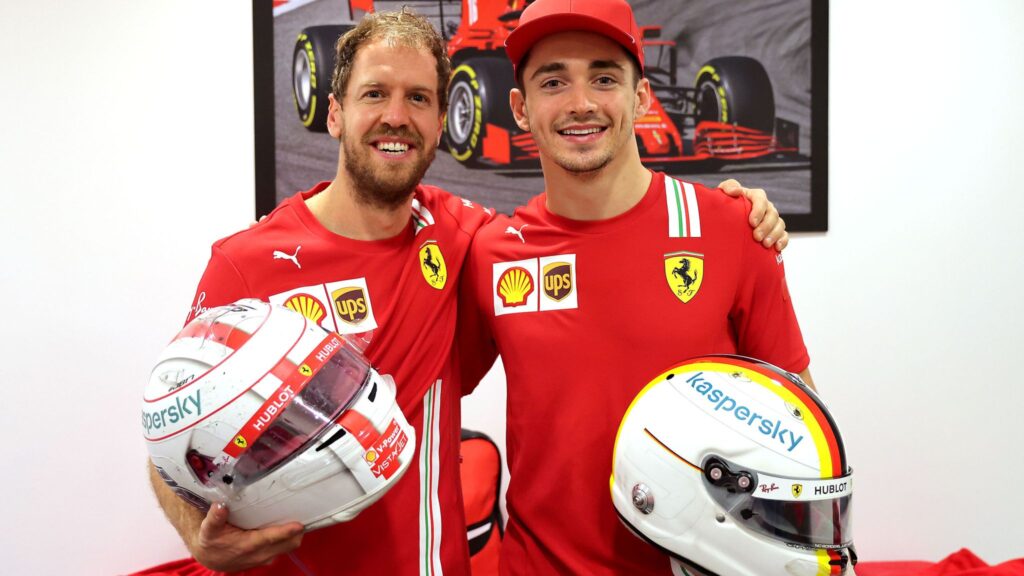
This period represented a significant internal power shift within the Scuderia. Leclerc became the first driver to out-score Vettel over a season with the team in 2019, a feat he repeated in 2020. For a young driver to immediately displace a reigning champion as the team’s points leader demonstrated immense mental fortitude and raw speed. Ferrari recognized this, consciously pivoting their long-term strategy and resources toward Leclerc. This boldness cemented his image as the designated “wunderkind” and the unequivocal future of the Scuderia.
Leclerc sealed his place in Ferrari lore that season by securing his maiden F1 victory at Spa, followed immediately by an emotionally charged second win at Ferrari’s home turf, Monza. Winning at Monza, the spiritual home of the Tifosi, in his debut season with the team provided him with immediate emotional credit and solidified his status as a legendary figure in the team’s history, reinforcing the public expectation that he would be the one to end Ferrari’s championship drought.
Definitive Seasons, Statistical Analysis, and Rivalries
Leclerc’s career has been marked by peaks of performance driven by immense individual talent, followed by troughs dictated by car performance and strategic consistency.
The Era of Resolve (2020–2021)
Following the competitive 2019 season, the subsequent years (2020 and 2021) proved challenging for Ferrari, bearing “little fruit” due to car limitations. Despite these difficulties, Leclerc “maintained his resolve”. His performances during these lean years confirmed his status as a high-caliber asset, consistently outperforming the machinery and maintaining focus even when lacking the competitive tools needed to challenge for victory. This psychological resilience in the face of failure is vital for a long-term star at a team with the scrutiny Ferrari faces.
The Title Contention Year (2022)
The 2022 season was Leclerc’s first true opportunity for a championship assault. He “emerged as a true title contender” , performing at a level that established him as a premier talent. In 2022, he was the “only man able to consistently take the fight to champion Max Verstappen”. This season represented his statistical zenith to date, concluding with three race victories, 11 podiums, and nine pole positions.
Current Context and Performance Outlook (2023–Present)
Unfortunately for the Scuderia and Leclerc, the high hopes established in 2022 were not sustained. Leclerc and Ferrari have been “unable to repeat the title contention feat of 2022 in subsequent campaigns” (2023 and 2024). Currently, Ferrari is reported as being “on the back foot compared to Red Bull and McLaren” , suggesting a renewed struggle to consistently challenge for race wins and championships.
Driving Style & Strengths
The Signature Driving Style: Qualifying Specialist
Leclerc has earned widespread recognition as perhaps the “fastest F1 driver over 1 lap” currently competing. His approach to qualifying is described as “insanely fast” and highly unique. This one-lap mastery is achieved through a high-risk, high-reward technique that maximizes peak grip and rotation, often involving exploiting a car setup that is inherently “pointy” or aggressive in turn-in. This characteristic ability to extract more speed than expected was first observed during his 2018 Sauber debut, where he was “often getting more out of the car than should have been possible”.
However, this specialized style offers a crucial explanation for the Pole Paradox discussed earlier. A setup that is perfect for qualifying, prioritizing peak single-lap performance, typically makes the car more sensitive to tire wear and less predictable over a full race distance. This trade-off links his elite, aggressive technique directly to the frequent challenges Ferrari faces in converting Saturday poles into Sunday race victories, requiring him and the team to manage tire degradation intensely during the race.
The Ferrari Wunderkind Persona
Leclerc arrived in Formula 1 with “big expectations” surrounding his name, yet the analysis indicates he “hasn’t had a problem handling the pressure”. His public image is intrinsically linked to his team, as he is universally regarded as the “wunderkind of Ferrari and the future of the Scuderia”. This role demands that he perpetually operates under the intense scrutiny of the global media and the fervent expectations of the Tifosi.
This public designation as the chosen successor to Ferrari’s champions means his ultimate legacy will be defined by one criterion: whether he can successfully deliver a World Championship while driving for the Maranello team. Unlike drivers who might change teams to find success, Leclerc’s historic connection via Jules Bianchi means that winning for any team other than Ferrari would fundamentally alter the narrative arc of his career, leaving the asterisk of unfulfilled potential at the team where he truly belongs.
Career Statistics Summary
Leclerc’s career statistics demonstrate a high volume of pole positions achieved despite being unable to secure the elusive World Championship title.
Statistic | Value |
Seasons Raced | 8 (2018 – Present) |
Teams | Sauber, Ferrari |
Races Started | 167 |
Wins / Podiums | 8 / 50 |
Poles / Fastest Laps | 27 / N/A |
Career Points | 1640 |
Highest Championship Finish | 2nd (2022) |
Championship Titles | 0 |
Personal Life & Off-Track
To fully understand the competitive intensity that defines Charles Leclerc on track, it is necessary to examine the pursuits he engages in away from the pressure cooker of Formula 1.
A Tonic to Speed: The Piano and Music
Away from the intense speed and noise of racing at 330 km/h , Leclerc finds essential balance and “solace” in playing the piano. This passion emerged significantly during the COVID-19 lockdown, when he had “too much free time” and decided to dedicate himself to music. He describes the piano as a way to “slow down,” providing a necessary contrast to the professional thrill of racing.
His proficiency has developed rapidly, transforming a personal hobby into a public interest, evidenced by his music garnering over 200,000 monthly listeners on Spotify. This artistic pursuit, alongside his sensitive nature, functions as a critical psychological counterbalance, providing an outlet for the immense emotional demands placed upon the leader of the Scuderia during periods of intense competition and struggle.
The Man Away From the Track
Off the track, Leclerc presents as a “curious, sensitive, thoughtful man with an innate elegance”. His personal life is centered on strong human relationships, particularly with his vital family ties. His “love for his parents,” Hervé and Pascale, and his relationships with his brothers, Lorenzo and Arthur, are central to his life. Driven by curiosity, his interests extend far beyond motorsport, embracing various worlds and new trends, which also guide his entrepreneurial ventures. This contrast between the ruthless competitor and the reflective, artistic individual provides the emotional equilibrium necessary to consistently handle the “big expectations” placed upon him.
Legacy & Public Image
Leclerc’s legacy remains one of immense potential, waiting for the final validation of a World Championship.
The Pole Paradox
The most statistically remarkable and narratively crucial data point in Leclerc’s career is the vast disparity between his 27 pole positions and his 8 career victories. This generates a pole-to-win conversion rate of only 29.6%, an uncharacteristically low figure for a driver consistently operating at the front of the grid. This statistic is the central dilemma of his career, highlighting that his brilliance is often undermined by strategic or operational issues within the team, rather than a failure of raw speed.
The Chosen Successor
His image is that of Ferrari’s designated future—a prodigy who arrived and immediately challenged the status quo, surpassing a four-time champion (Vettel) in his debut season with the team. The Tifosi view him as the rightful heir to the legendary drivers of Maranello, a sentiment strengthened by his emotional connection to Jules Bianchi and his early victory at Monza. His ultimate legacy, therefore, is tied not just to if he wins a title, but when he achieves it in the famous red car.
Fun Facts
Did You Know?
- The Number 16: Leclerc chose the number 16 because he originally wanted 7 or 10, but both were taken. He settled on 16 because he was born on October 16th, and the digits sum to seven (1 + 6 = 7).
- A Family of Racers: His younger brother, Arthur Leclerc, is also a professional racing driver and a former member of the Ferrari Driver Academy.
- The Rivalry Began Young: Leclerc’s fierce rivalry with Max Verstappen dates back to their teenage years in karting, where they often battled intensely for the CIK-FIA World KZ Championship.
- A Musician at Heart: Away from the track, Leclerc is a dedicated pianist, a hobby he took up during the COVID-19 lockdown, describing it as “solace” and a way to “slow down” from the speed of F1.
- The Monza Victory: His second F1 victory, achieved at the 2019 Italian Grand Prix (Monza), cemented his status as a Ferrari legend, becoming one of only a few drivers to win Ferrari’s home race in the modern era.

John Elkann Hits Out at Ferrari Drivers: “Less Talk, More Results”
Tension at Maranello? Ferrari Chief Elkann Slams Drivers Over Public...
Read MoreCharles Leclerc — Formula 1 Profile, Stats, and Career History
Charles Leclerc Full Name Charles Leclerc Date of Birth /...
Read More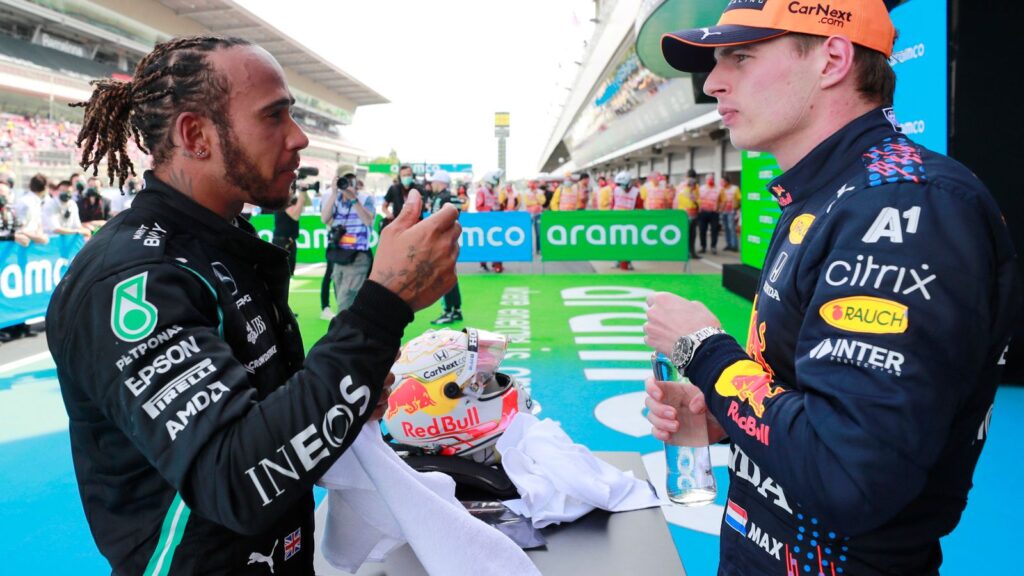
Leclerc Breaks Down the Rivalry: Hamilton vs. Verstappen
Having battled both Lewis Hamilton and Max Verstappen for race...
Read More


If some one wants expert view about running a blog afterward i recommend him/her to visit this webpage, Keep up
the good job.
Oh my goodness! an amazing article dude. Thanks Nonetheless I am experiencing concern with ur rss . Don’t know why Unable to subscribe to it. Is there anybody getting identical rss problem? Anybody who is aware of kindly respond. Thnkx