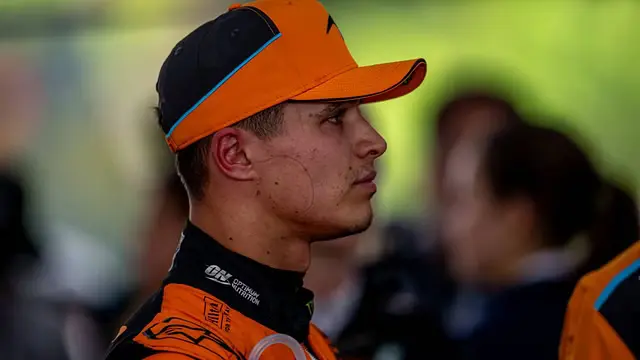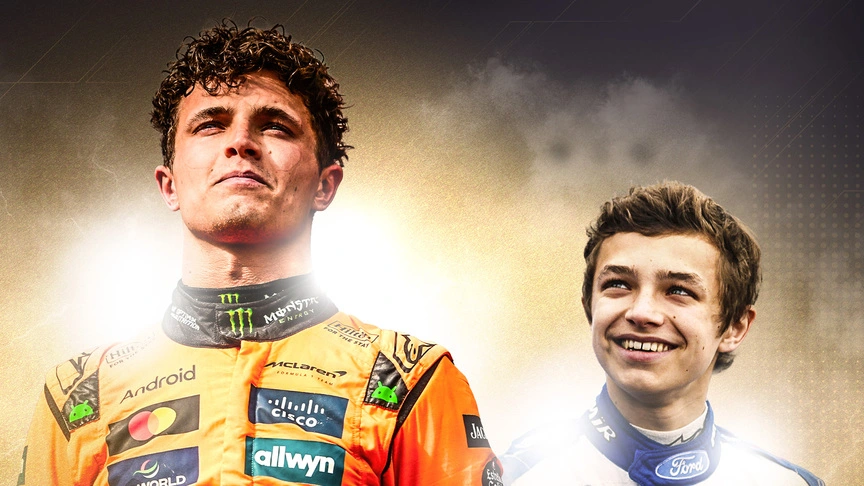
The air in Abu Dhabi hangs heavy, a humid blanket that descends as the sun dips below the horizon, painting the Yas Marina Circuit in hues of bruised purple and burnt orange. It is a setting that has hosted the resolution of championships before—Hamilton and Rosberg in the dusk of 2016, the seismic, controversial collision of titans in 2021—but the 2025 finale carried a different frequency of tension. It was not just a battle between two drivers; it was a collision of eras, a reckoning of legacies, and the potential end of a seventeen-year wilderness for one of Formula 1’s most storied dynasties.
When Lando Norris crossed the finish line on that Sunday evening, the timing screens registered a third-place finish. In isolation, a podium is a routine achievement for a driver of his caliber. But in the context of the 75th anniversary season of Formula 1, that P3 was the most significant result of his life. It secured him 15 points, bringing his season total to 423. Max Verstappen, the relentless juggernaut who had defined the previous half-decade of the sport, won the race, his 71st career victory, bringing his tally to 421.
Two points. The margin between immortality and heartbreak was smaller than the gap between a winning car and a barrier at Monaco.
“I’m not crying,” Norris choked over the radio, his voice betraying the lie immediately. In the garage, Zak Brown, the architect of McLaren’s modern resurrection, buried his head in his hands. The ghosts of Woking had finally been exorcised. For the first time since Lewis Hamilton overtook Timo Glock in the dying seconds of the 2008 Brazilian Grand Prix, a McLaren driver was the World Champion. Norris had become the 35th driver in history to wear the crown and the 11th British driver to conquer the world.
This is the story of how it happened. It is not merely a record of overtakes and pit stops, but a chronicle of psychological warfare, internal betrayal, strategic calamity, and the forging of a champion in the fiercest crucible motorsport has to offer.
The Ghost of 2008 and the Long Winter
To understand the magnitude of 2025, one must first measure the depth of the shadow McLaren lived under. The team is a titan of the sport, the outfit of Senna and Prost, of Hakkinen and Hunt. But since that rain-soaked afternoon at Interlagos in 2008, the trophy cabinet at the McLaren Technology Centre had gathered dust in the space reserved for Drivers’ Championships.
The Hamilton Shadow
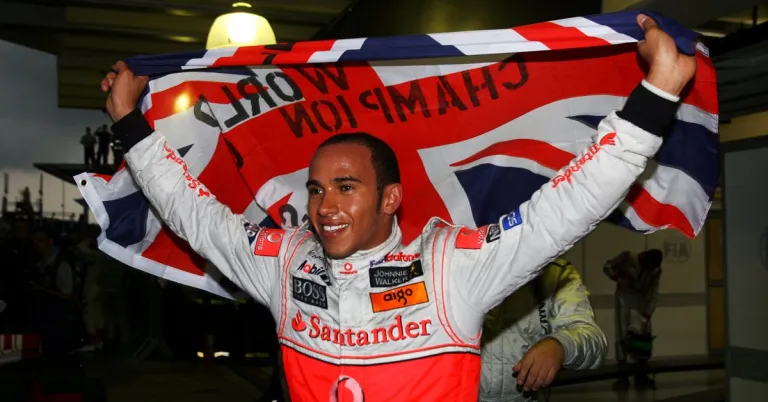
Lewis Hamilton’s 2008 triumph was a defining moment for British motorsport. In just his second season, he became the youngest champion at the time, winning in the most dramatic fashion imaginable. That victory set a standard that became a burden for every driver who followed him into the Woking seat. Jenson Button arrived as a champion but couldn’t replicate the feat in McLaren colors. Fernando Alonso returned, only to be consumed by the disastrous Honda partnership. The team fell from the podium to the back of the grid, a painful decline for an organization built on the ethos of absolute excellence.
Lando Norris arrived in this post-Hamilton landscape. He was the “boy who would be king,” a prodigy nurtured through the ranks, but he inherited a team in reconstruction. His early years were spent fighting for points, not wins. The 2021 Russian Grand Prix, where a maiden victory slipped through his fingers in the rain, became a scar on his psyche, a moment critics pointed to as evidence that he lacked the ruthlessness to close out a win.
The Brown & Stella Revolution
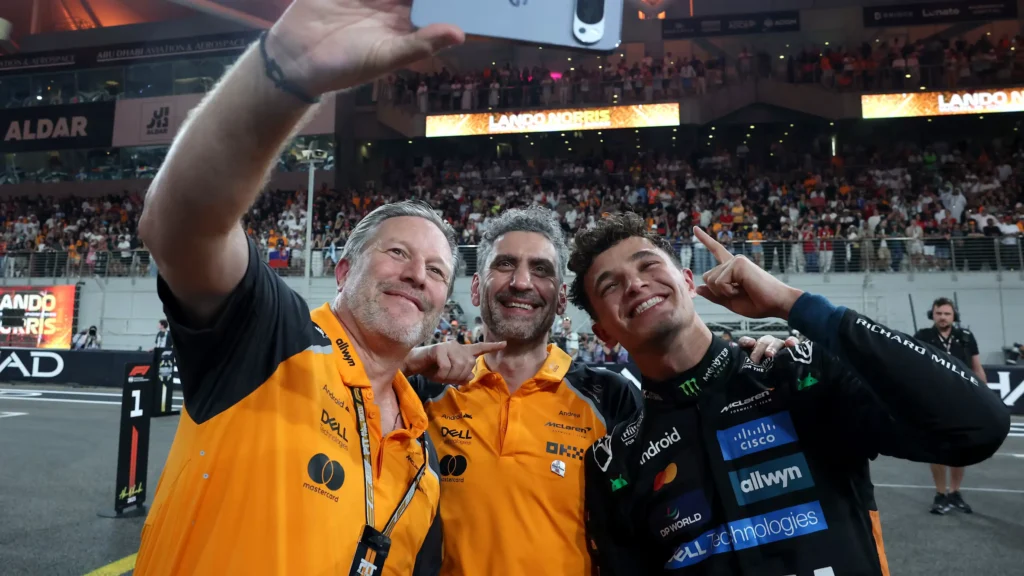
By 2025, however, the team was transformed. Zak Brown, the marketer-turned-racer CEO, had rebuilt the commercial viability of the team, painting the car in vibrant papaya to honor the roots of Bruce McLaren. Andrea Stella, the cerebral Team Principal, had instilled a culture of engineering purity and “scrupulous fairness”. The MCL39 was the culmination of this rebuild—a car capable of challenging the dominant Red Bull RB21 on every type of circuit.
Yet, a car is only as good as the driver in the cockpit. And in 2025, McLaren didn’t just have one contender; they had two. And that would nearly cost them everything.
The Protagonists: A Triumvirate of Power
The 2025 season was unique in the hybrid era because it featured a genuine three-way fight for much of the campaign. The dynamics between the three key players shifted the championship from a sporting contest to a psychological thriller.
Lando Norris: The Reluctant Ruthless
Norris entered 2025 facing questions about his “killer instinct.” He was popular, funny, and blazingly fast, but could he sustain a title fight? His admissions of self-doubt, once seen as refreshing honesty, were now scrutinized as weaknesses. To win, he had to evolve. He had to shed the “nice guy” persona on the track and find a steeliness that could withstand not just Verstappen, but his own teammate.
Max Verstappen: The Wounded Lion
After years of dominance, 2025 presented Verstappen with a new reality: a car that was not the fastest. The RB21 was temperamental in the first half of the season, suffering from balance issues that left the Dutchman exposed. But Verstappen is never more dangerous than when he is cornered. His ability to extract maximum points from a sub-optimal package kept him in the hunt long after he should have drifted away.
Oscar Piastri: The Enemy Within
Oscar Piastri, in his third season, had morphed into the perfect anti-Norris. Where Lando was emotional, Oscar was glacial. Where Lando wore his heart on his sleeve, Oscar offered nothing but a calm, monotone assessment of his speed. For the first two-thirds of the season, Piastri was not playing the role of a supportive number two; he was racing to win the title himself. This internal rivalry would define the strategic headaches that plagued McLaren.
Act I: The False Dawn and the Australian Miracle
The season opened with the usual sparring, but the narrative pivot came early, at the Australian Grand Prix.
Albert Park: Weathering the Storm
Australia is Piastri’s home race, but it was Norris who claimed the spotlight. In treacherous conditions—rain lashing the track, grip levels changing corner by corner—Norris displayed a mastery that silenced his doubters. The race was chaotic; cars were sliding off the tarmac, strategy calls were a gamble, and the pressure of the home crowd weighed heavily on the McLaren garage.
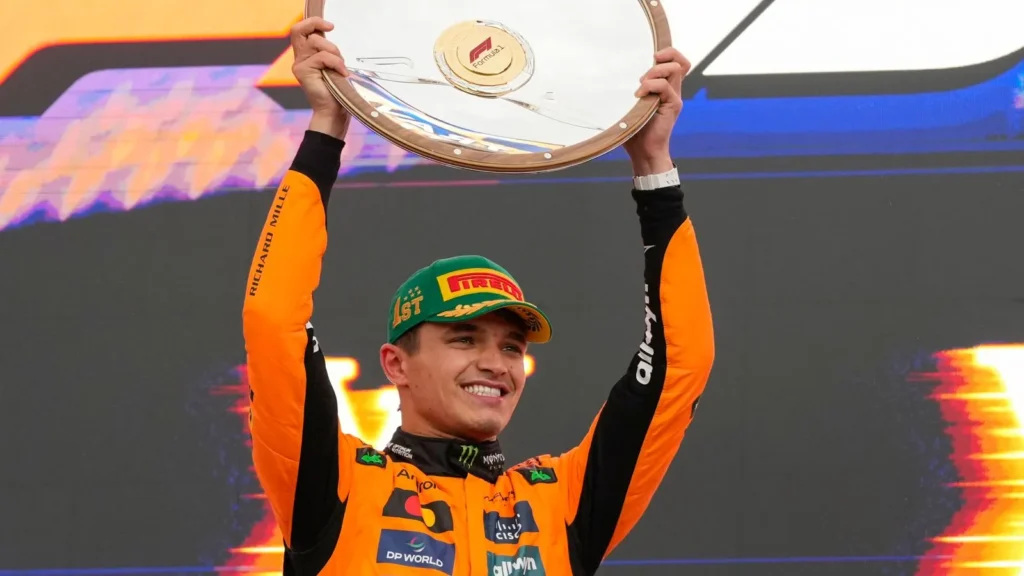
Norris, however, was “nerveless.” He managed his tires, read the conditions perfectly, and drove to a victory that was as much about survival as it was about speed. This win was critical. It proved that he could deliver when chaos reigned, exorcising the demons of Sochi 2021 where similar conditions had led to heartbreak. It was a statement: Lando Norris was ready to lead.
The Saudi Reality Check
But the high of Melbourne was short-lived. The very next round in Saudi Arabia provided a brutal reality check. In qualifying, pushing the limits of the MCL39 on the unforgiving Jeddah street circuit, Norris crashed. It was a rare unforced error, the kind that championships are lost on.
While Norris watched from the garage, Piastri capitalized. The Australian drove a flawless race to win, taking the championship lead for the first time in his career. The narrative shifted instantly. Was Piastri the true challenger? The press began to speculate. Norris had the experience, but Piastri had the momentum. The seed of doubt was planted, and it would grow into a forest of tension as the European leg began.
Act II: The Civil War of Summer
As the season moved into the European summer, McLaren’s dominance over the field became clear. The MCL39 was the class of the field, especially after a major front-suspension upgrade introduced in Austria gave Norris the front-end bite he craved. But with the fastest car came the hardest problem: two drivers who both believed they were the number one.
The Canadian Collision
The tension boiled over in Montreal. The Circuit Gilles Villeneuve is a track that punishes mistakes, and on lap 67, fighting over fourth place, the two McLarens found the same piece of tarmac. Norris, attempting to pass his teammate, misjudged the braking zone and clipped the back of Piastri’s car.
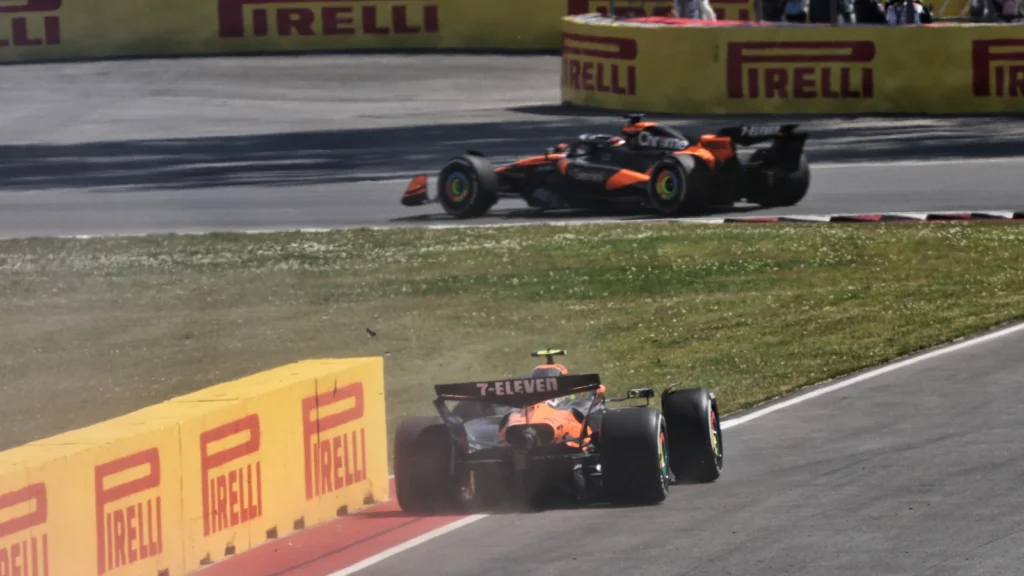
“All my bad, all my fault, stupid from me,” Norris said over the radio. It was a candid admission, but it didn’t repair the damage. Valuable points were lost. The collision was a physical manifestation of the strategic confusion within the team. Zak Brown had famously said that contact was a question of “when, not if” , but seeing carbon fiber fly between teammates is a team principal’s nightmare.
The Rise of Piastri and the Zandvoort Low
Through July and August, Piastri seemed to have the upper hand. He won at Silverstone—a bitter pill for Norris at his home race—and again at Spa. But the nadir for Norris came at the Dutch Grand Prix.
Zandvoort is Verstappen’s territory, a cauldron of orange smoke and noise. But in 2025, it was Piastri who silenced the Dutch crowd with a commanding win. Norris, meanwhile, suffered a mechanical failure with seven laps to go. The image of him standing alone in the dunes, head bowed, while his teammate celebrated victory, was the defining image of his mid-season slump.
Leaving the Netherlands, Norris trailed Piastri by 34 points. Verstappen, despite his car struggles, was still lurking. The championship seemed to be slipping away. The media wrote Norris off. He was the “nearly man” again. But it was in this valley of despair that the champion was forged.
Monza: The Implementation of "Papaya Rules"
The Italian Grand Prix was the turning point. McLaren realized that while they were busy fighting each other, Verstappen was beginning to find pace in the Red Bull. To secure the title, they needed to consolidate. They introduced “Papaya Rules”—a doctrine of engagement that prioritized the team result over individual glory.
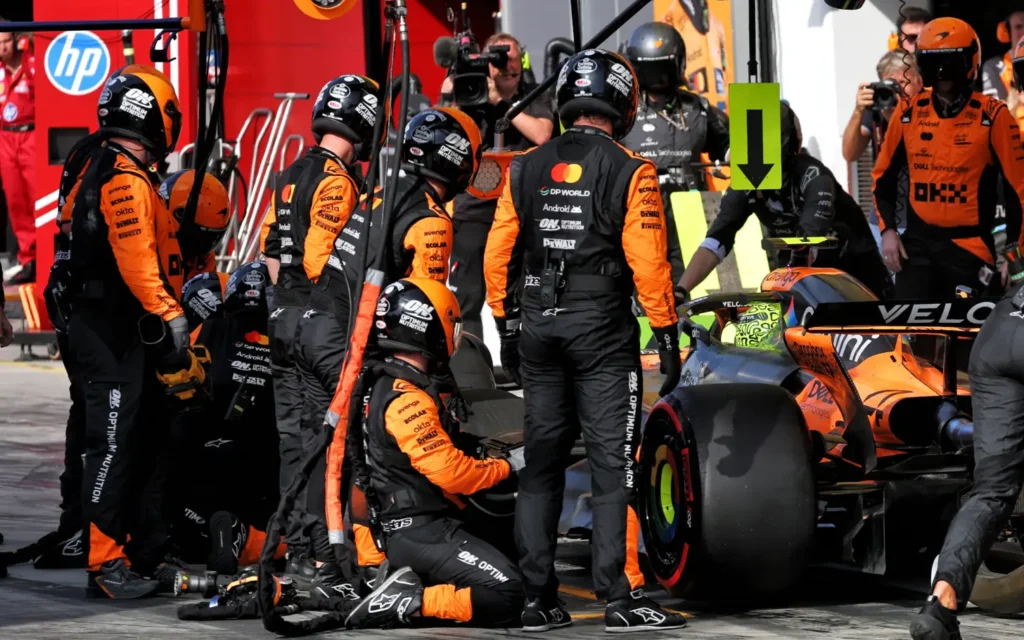
The implementation was messy. In the race, Piastri was ordered to cede second place to Norris after a strategy mishap. The order was given, and Piastri complied, but the crowd at Monza—the Tifosi, who respect racing purity above all else—booed Norris on the podium. They saw it as a gift. Norris hated it. He wanted to win on merit. But the points were crucial. It was a cold, pragmatic decision by Andrea Stella, and it signaled a shift in the team’s hierarchy: they were backing Norris for the title.
Act III: The Red Bull Resurgence
Just as McLaren got their house in order, the external threat materialized with terrifying speed. The Red Bull RB21, which had looked pedestrian in mid-summer, suddenly came alive.
The 104-Point Turnaround
Max Verstappen is not a driver who requires a dominant car to win; he only needs a competitive one. From September onwards, he was unstoppable. He reeled off victories in Baku, Singapore, and Austin. The gap, which had been over 100 points at the height of McLaren’s summer dominance, began to shrink.
Verstappen’s driving in this period was a masterclass. He took 8 wins in the season, more than any other driver. He was relentless, applying pressure every weekend. When McLaren stumbled, he was there to punish them. The championship fight, which had looked like an internal McLaren affair, transformed into a hunt. The predator was closing in.
Norris Strikes Back: Mexico and Brazil
Norris needed to stop the bleeding. He found his response in the Americas. In Mexico City, he delivered a commanding drive to win, proving he could go wheel-to-wheel with Verstappen and come out on top. Then came Brazil—the spiritual home of Senna, a place of immense significance for McLaren.
The São Paulo weekend was a Norris masterclass. He won the Sprint and the Grand Prix, taking maximum points. It was a critical buffer. He had “stemmed the rising tide” of Red Bull just in time. Heading into the final triple-header, he had a lead, but it was fragile. And then, disaster struck.
The Calamity in the Desert: Vegas and Qatar
The final chapter of the season began with two weekends that tested the sanity of every member of the McLaren team.
Las Vegas: The Double Disqualification
The spectacle of Las Vegas was matched only by the drama in the stewards’ room. On track, the McLarens were fast, finishing well inside the points. But in the post-race scrutineering, a technical infringing was found. The skid blocks—the wooden planks under the car—were worn beyond the legal limit.
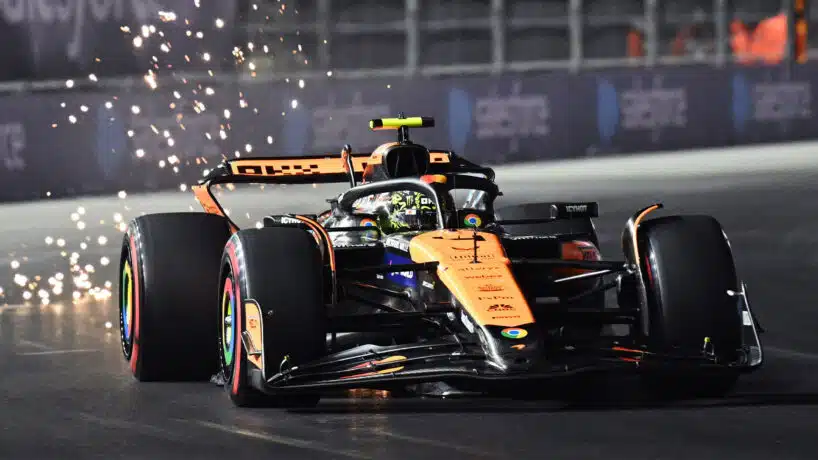
It was a setup error, a consequence of running the car too low on the bumpy Strip to gain aerodynamic performance. The result was catastrophic: disqualification for both Norris and Piastri. Verstappen, who had won the race, took the full 25 points while Norris took zero. The lead plummeted. Verstappen was now within 24 points. The momentum had swung violently.
Qatar: The Strategy Implosion
If Vegas was a technical error, Qatar was a strategic failure of the highest order. The race was under control. Norris and Piastri were running 1-3. Then, on Lap 6, the Safety Car was deployed for a crash involving Nico Hulkenberg.
It was the “golden moment” to pit. A cheap stop that would save time and secure track position. The entire field dove into the pits—except McLaren. They stayed out.
“Why didn’t we box?” Norris asked, confusion evident in his voice.
The answer was a miscalculation. The team feared traffic and believed the tires would hold. They were wrong. When the race restarted, the McLarens were sitting ducks on old rubber against a field of fresh tires. Verstappen cruised past to take the win. Norris fought back to finish fourth, but it was damage limitation rather than a victory.
The aftermath was toxic. Conspiracy theories erupted online. Was McLaren sabotaging Piastri? Was the team buckling under pressure?. Andrea Stella had to face the media and admit to a “mistake” in their interpretation of the safety car window.
Heading into Abu Dhabi, the gap was just 12 points.
The Finale: The Abu Dhabi Showdown
And so, it came down to this. One race. Fifty-eight laps. Two points.
The Qualifying Duel
Saturday in Abu Dhabi was electric. The floodlights hummed, matching the nervous energy in the paddock. Verstappen, knowing he had to win to have any chance, produced a lap of the gods in Q3. He took pole position, his 48th career pole, with a time that left the paddock gasping.
Norris lined up second. He didn’t buckle. He put the McLaren on the front row, right alongside his rival. Piastri was third. The three title protagonists filled the top three slots. It was the perfect setup.
The Race of a Lifetime
Lap 1: The lights went out. Verstappen launched perfectly, covering the inside line. Norris slotted into second. The order was set: Verstappen, Norris, Piastri.
The Strategy:
Red Bull had the pace in clean air. Verstappen began to pull away, managing the gap to Norris. McLaren’s hope lay in tire management or a mistake from the Dutchman. But Verstappen was a machine.
The Piastri Factor:
Midway through the race, the “Papaya Rules” were tested again. Piastri, on a different tire strategy, found himself with more pace than Norris. He overtook his teammate.1 It was a heart-stopping moment. If Piastri finished second and Norris third, Norris would still win the title—provided he stayed third.
The Closing Stages:
The final ten laps were torture for Lando Norris. Verstappen was gone, 8 seconds up the road, destined for victory. Piastri was secure in second. But behind Norris, the Ferrari of Charles Leclerc was charging. If Leclerc passed Norris, dropping him to fourth, the points swing would hand the title to Verstappen.
Norris was on older tires. His engineer, Will Joseph, was on the radio constantly: “Gap to Leclerc is 2.5… Gap is 1.8…”
“I just kept pushing,” Norris said later. “I was fighting to the end”.
He drove with a maturity that belied his years. He placed the car perfectly, managing the traction zones, not giving Leclerc a sniff of an opportunity.
The Checkered Flag:
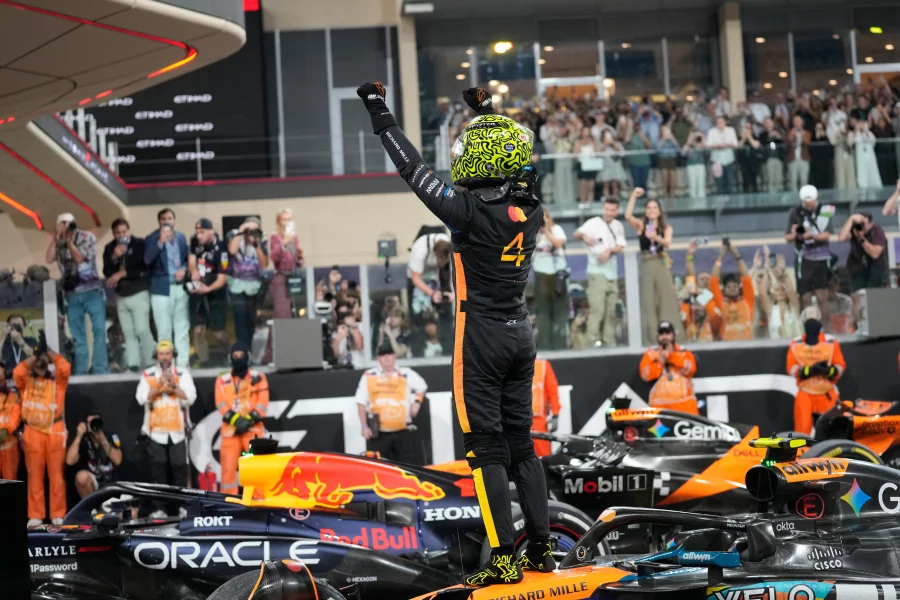
Max Verstappen crossed the line to win the Abu Dhabi Grand Prix. Fireworks erupted from the Yas Hotel.
Then Piastri crossed.
Then, finally, Lando Norris. P3.
The Math:
- Verstappen: 25 points for the win. Total: 421.
- Norris: 15 points for 3rd. Total: 423.
- Champion: Lando Norris.
The Release
The cool down lap was a mixture of screams and sobs.
“You are the World Champion! The World Champion!” Will Joseph yelled.
“We did it! We did it!” Norris screamed back, his voice breaking. “I love you guys. You made a kid’s dream come true.”
In the Red Bull cockpit, Verstappen was gracious in defeat. “I’m not disappointed,” he told his team. “We can be really proud of that comeback”.
Statistical Analysis: The Margins of Victory
The 2025 season will be studied by statisticians for decades. It was a season defined by the narrowest of margins.
The Championship Table
Position | Driver | Team | Points | Wins | Podiums |
1 | Lando Norris | McLaren | 423 | 7 | 18 |
2 | Max Verstappen | Red Bull Racing | 421 | 8 | 15 |
3 | Oscar Piastri | McLaren | 410 | 5 | 12 |
Key Metrics
- Most Wins: Max Verstappen (8). This makes him one of the few drivers in history to win the most races in a season but lose the title (joining Hamilton 2016, Massa 2008, Prost 1984, Moss 1958).
- Most Consistent: Lando Norris (18 Podiums). His ability to score heavily even on “bad days” (like the P4 in Qatar) was the difference.
- Closest Margin: 2 points. This is the closest finish since the 2010 season (Vettel vs Alonso) and echoes the 1-point margin of 2008.
Legacy: The 35th Champion
Lando Norris’s victory is significant not just for the numbers, but for what it represents to the sport.
The British Lineage
He becomes the 11th British Formula 1 World Champion, joining an elite club of legends.
- The Pioneers: Hawthorn (1958), G. Hill (1962, 68), Clark (1963, 65), Surtees (1964).
- The Golden Era: Stewart (1969, 71, 73), Hunt (1976).
- The Modern Era: Mansell (1992), D. Hill (1996), Hamilton (2008-2020), Button (2009).
- The New Guard: Norris (2025).
His victory ensures that the Union Jack continues to fly over the sport in the post-Hamilton era (though Hamilton was still racing for Ferrari in 2025, finishing 6th ).
McLaren’s Resurrection
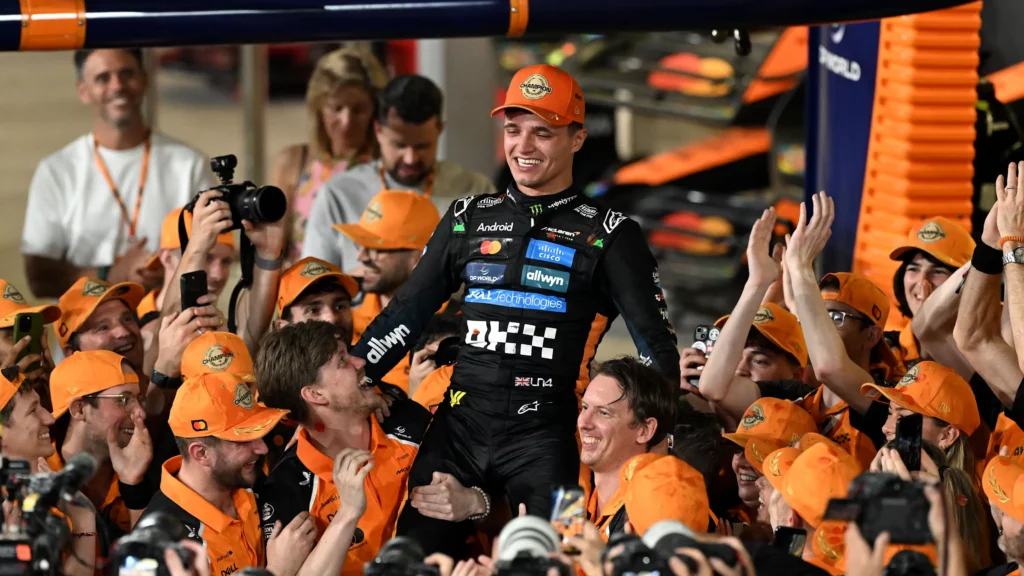
For McLaren, this is the completion of a long journey back from the abyss. The team that dominated the 1980s and 90s had lost its way. Zak Brown’s leadership—focusing on sponsorship, fan engagement, and hiring the right technical minds like Andrea Stella—has been vindicated. They defeated the Red Bull machine not by out-spending them, but by out-developing them and, crucial in the final race, holding their nerve.
The Future
The 2025 season established a new “Big Three” of drivers: Norris, Verstappen, and Piastri. With Piastri finishing just 13 points behind his teammate 1, the stage is set for an explosive intra-team rivalry in 2026. Norris has the crown, but he knows better than anyone how close he came to losing it.
As the fireworks faded over Yas Marina, Lando Norris stood on the top step of the sport, not just a driver, but a legend. The boy who grew up idolizing Lewis Hamilton had finally emulated him. The Papaya rules had prevailed.v
Race-by-Race Summary of Key Events
Round | Grand Prix | Winner | Key Narrative Event |
1 | Bahrain | Verstappen | Red Bull starts strong, McLaren podium. |
3 | Australia | Norris | Wins in rain; establishes title credentials. |
4 | Saudi Arabia | Piastri | Norris crashes in Quali; Piastri takes points lead. |
9 | Canada | Verstappen | Norris/Piastri collision; points lost. |
12 | Silverstone | Piastri | Norris loses home race to teammate. |
14 | Zandvoort | Piastri | Norris DNF (mechanical); 34 points behind. |
16 | Monza | Leclerc | “Papaya Rules” introduced; Piastri cedes P2 to Norris. |
20 | Mexico | Norris | Crucial win to stop Verstappen’s momentum. |
21 | Brazil | Norris | Double win (Sprint/GP) in rain. |
22 | Las Vegas | Verstappen | McLarens DQ’d for plank wear. |
23 | Qatar | Verstappen | McLaren strategy error (Safety Car). |
24 | Abu Dhabi | Verstappen | Norris P3 secures title by 2 points. |