The alliance between Lewis Hamilton and Scuderia Ferrari, announced in February 2024 as the “transfer of the century,” stands at a precarious precipice. What was architected as the romantic culmination of the sport’s most successful career and the resurgence of its most historic team has, by late 2025, devolved into a complex web of broken promises, technical divergence, and public acrimony.
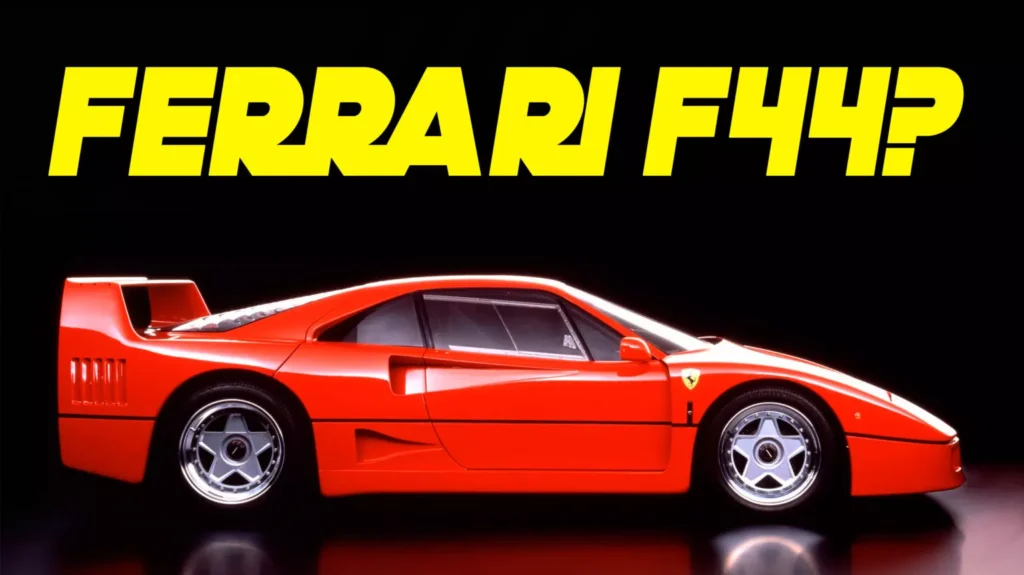
This investigative report provides an exhaustive analysis of the current crisis engulfing Maranello. Central to this breakdown is the revelation that the “F44” project—a bespoke, V12-powered, manual-transmission hypercar promised to Hamilton as a condition of his signing—has been “quietly abandoned”. This decision, reportedly taken by Ferrari leadership amidst a backdrop of deteriorating relations, serves as the symbolic death knell for the partnership’s honeymoon phase.
Furthermore, this report analyzes the extraordinary intervention of Ferrari Chairman John Elkann. His public ultimatum to his drivers to “talk less and focus on driving,” delivered in the wake of a disastrous Brazilian Grand Prix, marks a significant shift in the team’s governance strategy. It signals a move away from the driver-centric “superstar” model toward a corporate-authoritarian approach reminiscent of the Enzo Ferrari era, but applied within a modern, publicly traded context.
Through a forensic examination of internal developments, technical specifications of the rival SC40 project, contractual leverage regarding the 2027 option, and the operational collapse of the 2025 season, this document outlines the systemic failures threatening to turn the Hamilton-Ferrari union into Formula 1’s most expensive historical misstep.
PART I: THE F44 INVESTIGATION — ANATOMY OF A BETRAYAL
The Genesis of the F44 Concept
To comprehend the magnitude of the F44’s cancellation, one must first deconstruct what the project represented within the negotiation framework of Lewis Hamilton’s transfer from Mercedes. Hamilton did not merely join Ferrari for a salary; he joined for legacy and influence. Unlike his tenure at Mercedes, where corporate constraints limited his ability to shape road car product lines, Ferrari offered the allure of the “Special Projects” program—a division capable of birthing unique, one-off vehicles for the brand’s most exclusive clientele.
Hamilton, a known automotive purist with a reverence for historic machinery, pitched a concept that was poised to bridge the gap between Ferrari’s analog past and its future. Tentatively titled the “F44” (a nod to his permanent race number), the vehicle was conceptually defined by three non-negotiable pillars:
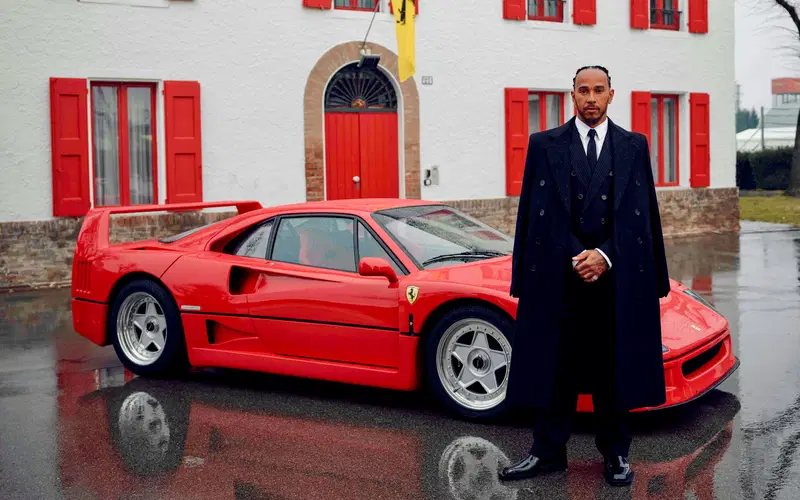
- The F40 Baseline: A spiritual and aesthetic successor to the 1987 F40, the last car approved by Enzo Ferrari.
- The V12 Heart: A rejection of modern downsizing, utilizing Ferrari’s naturally aspirated 6.5-liter V12 engine.
- The Gated Manual Transmission: A return to the tactile engagement of a stick shift, a feature absent from Ferrari’s flagship lineup since the early 2010s.
This project was more than a vanity asset; it was a commercial juggernaut in waiting. Market analysis suggests that a limited-run, Hamilton-designed V12 manual Ferrari would have sold out its allocation instantaneously, likely commanding valuations in excess of €4-5 million per unit. It was the tangible manifestation of Hamilton’s status as a “partner” rather than just an employee.
The Emergence of the SC40: The Corporate Rebuttal
The first indication that Hamilton’s vision was at odds with Maranello’s corporate strategy arrived not via a meeting, but through a product launch. In October 2025, Ferrari unveiled the SC40, a one-off commission from the Special Projects program.
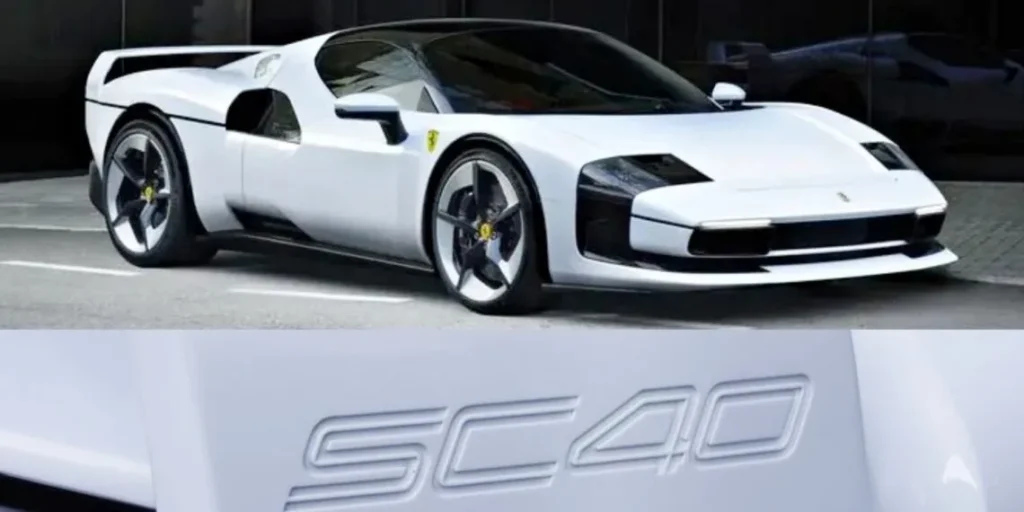
The SC40 was, in almost every superficial regard, the car Hamilton wanted to build. It featured the iconic F40 design cues: the fixed rear wing with “SC40” engraved in the uprights, the NACA-style ducts, the wedge profile, and the raw, carbon-Kevlar interior aesthetic. However, beneath the skin, it was the antithesis of the “F44” concept.
Feature | Project F44 (Hamilton Vision) | Ferrari SC40 (Realized Product) | Strategic Implication |
Engine Architecture | Naturally Aspirated V12 | Twin-Turbo V6 Hybrid | SC40 aligns with corporate push for V6 supremacy (F80/296). |
Transmission | Gated Manual (Stick Shift) | 8-Speed F1 Dual-Clutch | Rejection of “retro” mechanics; focus on lap time efficiency. |
Platform Base | Likely Icona / LaFerrari / SP3 | 296 GTB Architecture | Cost-efficiency vs. Bespoke Hypercar status. |
Philosophy | Analog, “Soul,” Driver Engagement | Digital, Hybrid, Performance Metrics | The clash between Hamilton’s purism and Ferrari’s modern tech roadmap. |
Status | CANCELLED | LAUNCHED (Oct 2025) | Ferrari prioritized a private client over their star driver. |
The existence of the SC40 was a strategic maneuver. By fulfilling the market demand for an “F40 Tribute” using the V6 hybrid platform of the 296 GTB, Ferrari effectively “burned” the concept. They utilized the aesthetic capital of the F40 to validate their modern V6 powertrain, directly undermining Hamilton’s argument that a true F40 successor required a V12. Sources suggest the SC40 was commissioned by a private client long before Hamilton’s arrival, yet the refusal to pivot or accommodate Hamilton’s F44 concept alongside it signals a profound lack of deference to his desires.
The Cancellation Order: "Quietly Abandoned"
In late November 2025, the internal friction manifested in a definitive decision. Reports from reliable Italian outlets, specifically via the Terruzzi Racconta podcast by journalist Giorgio Terruzzi, confirmed that the F44 project had been scrapped.
The phrasing used by insiders is “quietly abandoned” or “put on hold”. This terminological ambiguity is characteristic of Maranello’s internal politics—a soft kill designed to save face while removing the asset. The reaction from Hamilton was reportedly volatile; Terruzzi notes that the decision made the seven-time champion “furious” and that he “went berserk” upon realizing the promise had been broken.
The Rationale: Punitive Measures or Brand Protection?
Why would Ferrari walk away from a project with such immense commercial potential? The analysis points to three converging factors:
- The “Crying Driver” Narrative:
Pino Allievi, a veteran journalist with deep ties to the Ferrari old guard, offered a scathing assessment that likely reflects the sentiment of the board: “The F40 was a car that celebrated Ferrari’s 40th anniversary, as desired by Enzo Ferrari. And now they’re making an F44 just because a driver is crying? I would say Ferrari is doing the right thing”.
This narrative frames the F44 not as a collaboration, but as a concession to a demanding celebrity. Amidst a season where Hamilton has failed to score a win and trails his teammate significantly, the board appears unwilling to reward what they perceive as underperformance with a legacy-defining vehicle.
- The V6 Supremacy Doctrine:
Ferrari is currently engaged in a massive marketing effort to legitimize the V6 hybrid engine as the pinnacle of its engineering, evidenced by the F80 hypercar and the Le Mans-winning 499P. A Hamilton-endorsed V12 manual would inherently critique this direction. If the “greatest driver of all time” chooses a V12 stick-shift over the flagship V6 hybrid, it sends a message that the new technology lacks “soul”.11 Ferrari protected its product roadmap over its driver’s wishes.
3. The Elkann Power Play:
John Elkann is asserting his authority. By denying Hamilton this project, he reinforces the hierarchy: The Scuderia comes first, the brand comes second, and the driver is merely an employee. This aligns perfectly with his subsequent public comments demanding “less talk.”
PART II: THE ELKANN DOCTRINE — "TALK LESS, DRIVE MORE"
The NIAF Declaration
The cancellation of the F44 must be viewed in tandem with John Elkann’s extraordinary public intervention. Speaking at the National Italian American Foundation (NIAF) 50th Anniversary event in Washington, and later reiterating his stance in Rome, the Ferrari Chairman delivered a stinging rebuke that reverberated through the Formula 1 paddock.
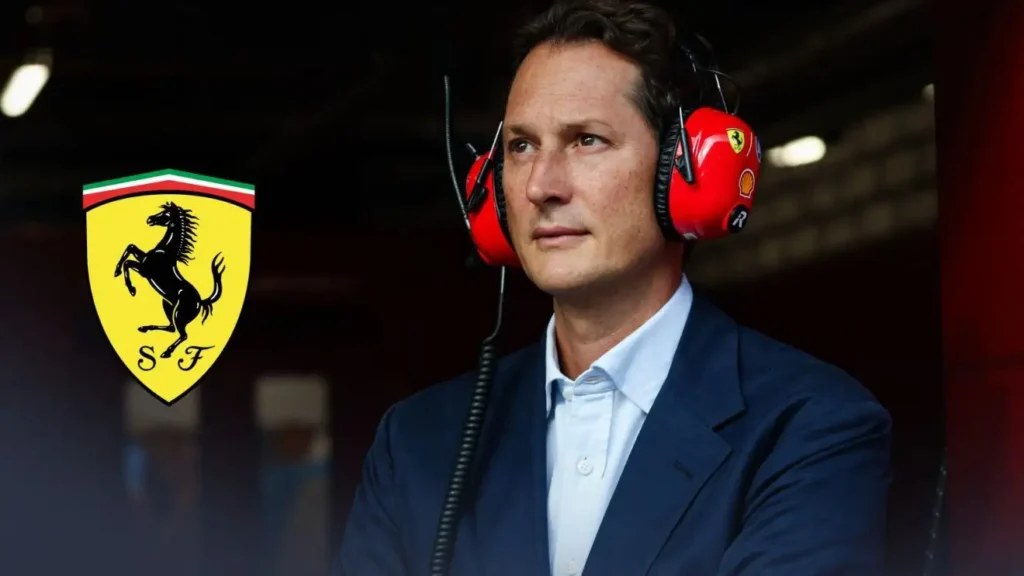
The Statement:
“In Formula 1, we have mechanics who are always first in performing pit stops. The engineers work to improve the car… If we look at the rest, it is not up to par. We have drivers who need to focus on driving and talk less, because we still have important races ahead of us”.
Deconstructing the Ultimatum
This statement is a deviation from the modern F1 standard of “protecting the talent.” Elkann’s words were calculated to isolate the drivers and shift the burden of the team’s failure onto their shoulders.
- The “Mechanics and Engineers” Shield: By explicitly praising the mechanics (who have indeed delivered sub-2-second pit stops consistently) and claiming the engineers have “improved the car,” Elkann constructs a reality where the machinery is competitive, and the deficit lies in the cockpit. This contradicts the data (analyzed in Part IV), which shows the SF-25 has suffered from fundamental development stalls.
- The Demand for Silence: The phrase “talk less” is a direct response to Hamilton’s and Leclerc’s vocal criticisms. throughout 2025.
- Hamilton: Has publicly called the season a “nightmare,” described his qualifying laps as “useless,” and expressed a desire to “unplug from the matrix”.
- Leclerc: Has voiced frustration over strategy and the physical limitations of the car, famously criticizing the “lift and coast” requirements in Singapore.
Elkann is enforcing a corporate discipline that views these “honest” assessments not as constructive feedback, but as brand damage. He is demanding the “corporate soldier” archetype—a role Hamilton famously outgrew at Mercedes.
The "Enzo" Precedent
Elkann’s behavior mimics the management style of Enzo Ferrari, who famously pitted drivers against one another to extract performance and believed the engine was the only critical component of the car. However, applying this 20th-century autocracy to a 21st-century superstar like Hamilton creates a volatile friction. The modern F1 driver is a brand, a stakeholder, and a media entity. Elkann’s attempt to silence them is a high-stakes gamble that risks alienating the very asset he spent hundreds of millions to acquire.
PART III: THE VASSEUR REGENCY — LEADERSHIP UNDER SIEGE
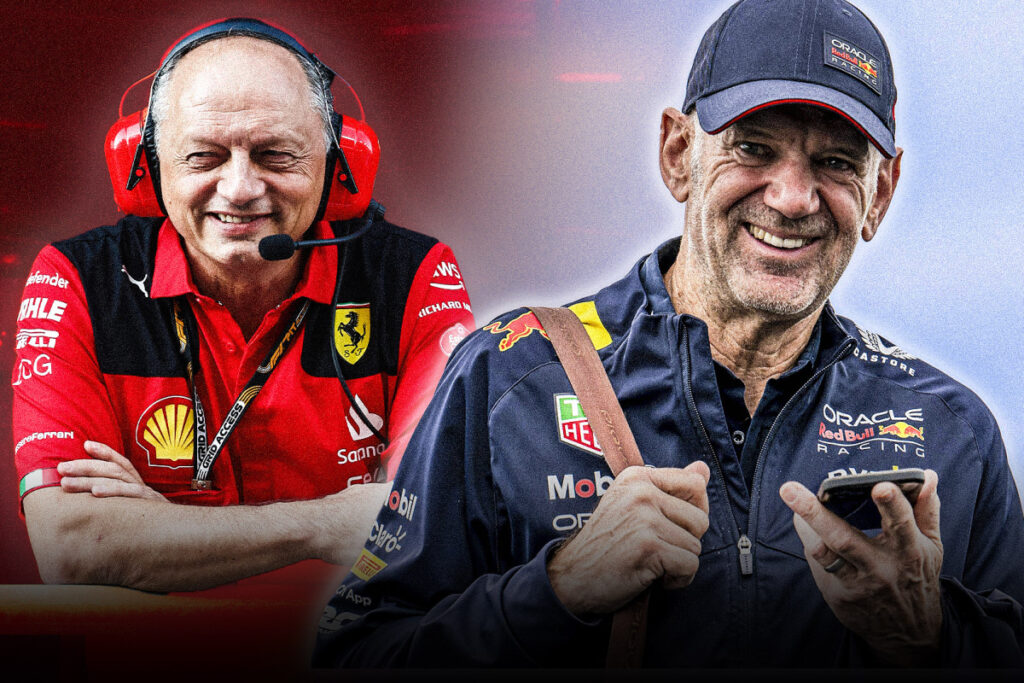
Frédéric Vasseur, the Team Principal who orchestrated Hamilton’s move, finds himself trapped between an unyielding Chairman and a disillusioned driver. While Elkann publicly stated, “I want to affirm our full confidence in Team Principal Fred Vasseur” , historical precedent at Ferrari suggests that such votes of confidence often precede a dismissal.
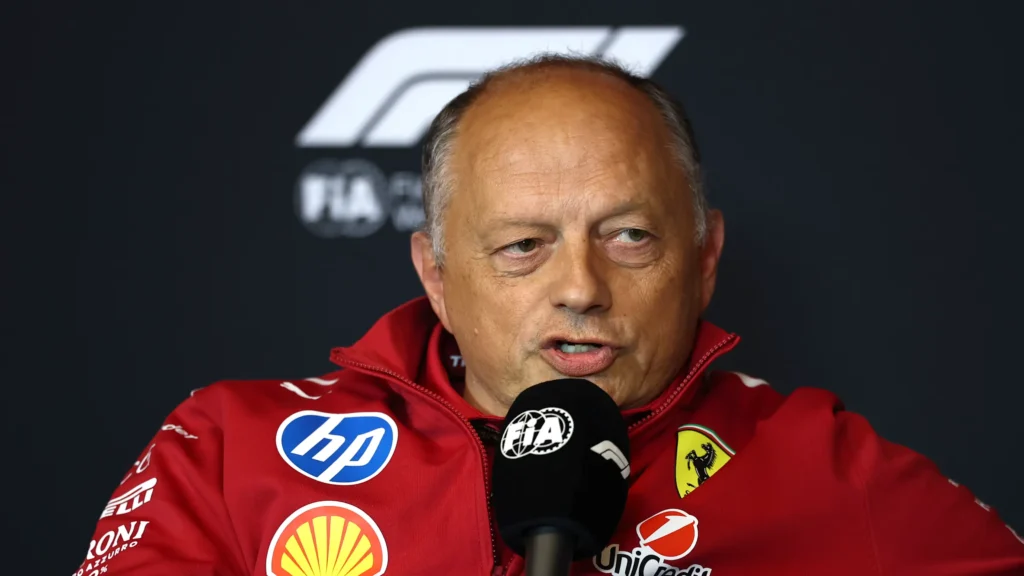
Rumors have persistently linked Christian Horner, the Red Bull Team Principal, to a potential move to Maranello. Reports suggest Elkann has personally “wooed” Horner in an attempt to bring a ruthless, winning culture to the team. While Vasseur has dismissed these rumors as “third party” noise created to destabilize the team , the persistence of the narrative suggests an active search for alternatives is underway in the corridors of Exor.
The Development Catastrophe
The root cause of the tension lies in a strategic error made by Vasseur in early 2025. In an admission that stunned the paddock, Vasseur revealed that Ferrari stopped development on the 2025 car (SF-25) as early as April to focus resources on the 2026 regulations.
- The Consequence: This decision effectively sacrificed Hamilton’s debut season. He joined to fight for wins; he was handed a car that was frozen in time while McLaren and Red Bull continued to evolve.
- The Psychological Blow: Vasseur admitted he “underestimated the psychological impact” of this decision on the team and drivers. For a driver of Hamilton’s caliber, being told in May that the car would not get faster is a devastating blow to motivation. Jean Alesi, a former Ferrari driver, labeled this excuse “embarrassing” and a “weak” attempt to cover up failure.
Operational Fracture: The Singapore Incident
The internal discord is not just strategic but operational. Reports of a “heated exchange” between Vasseur and a senior engineer following the Singapore Grand Prix illustrate the fraying tempers.
- The Incident: In Singapore, both drivers were forced into extreme “lift and coast” measures to manage brake temperatures, costing them massive lap time. Leclerc described himself as a “passenger”.
- The Implication: This was not a driver error but a fundamental failure of the car’s cooling architecture. For Elkann to claim the “engineers are improving the car” in the face of such basic operational failures suggests a disconnect between the boardroom and the pit wall.
PART IV: THE 2025 SEASON AUTOPSY — A CHRONOLOGY OF FAILURE
To evaluate the validity of Elkann’s criticism, one must examine the 2025 season data. Has Hamilton failed, or has the team failed him?
Statistical Disparity: Hamilton vs. Leclerc
Metric | Lewis Hamilton | Charles Leclerc | Analysis |
Championship Standing | ~8th Position | ~4th Position | Massive deficit for a 7-time champion. |
Points Gap | -86 Points vs. Teammate | +86 Points vs. Teammate | Leclerc has maximized the package; Hamilton has not. |
Qualifying Pace | Multiple Q1 Exits (Inc. Abu Dhabi, Vegas) | Consistent Q3 Appearances | Hamilton struggles to generate tire temp/confidence in the SF-25. |
Race Results | Zero Wins, Zero Podiums | Multiple Podiums (7+) | The car can reach the podium, but Hamilton hasn’t taken it there. |
Self-Assessment | “Useless,” “Nightmare” | “Not Happy,” “Slow” | Hamilton is internalized and defeated; Leclerc is frustrated but fighting. |
The "Washed" Narrative vs. Technical Reality
The paddock is rife with speculation that Hamilton, at 40, has lost his edge. Rene Arnoux bluntly stated, “He’s 40 years old and he can’t perform for the entire season like he could years ago”. Comparisons are being drawn to Michael Schumacher’s difficult return with Mercedes.
However, technical analysis offers a different perspective. The SF-25 is characterized by a “pointy” front end and an unstable rear axle—a trait Hamilton notoriously despises (similar to the Mercedes W13/W14 issues). Leclerc, conversely, prefers a car that rotates aggressively and can manage a loose rear. The “development freeze” in April meant the car’s fundamental handling characteristics were never corrected to suit Hamilton’s style. Thus, the performance gap may be less about reflexes and more about a car that fights its driver.
Key Race Flashpoints
- Brazil GP: A double DNF. Hamilton retired with car damage; Leclerc crashed out. Elkann used this specific race to launch his “talk less” tirade, despite the mechanical/incident nature of the exits.
- Las Vegas GP: Hamilton qualified “dead last” (or near the back) due to a complete lack of pace, admitting he was “not looking forward to 2026”.
- Abu Dhabi Finale: Hamilton finished P8, cementing a winless season. His radio message of gratitude was met with silence and a delayed, awkward response from the team—a “cold” farewell to a disastrous year.
PART V: CONTRACTUAL WARFARE — THE 2027 OPTION
Amidst the gloom, Hamilton holds a critical piece of leverage that protects him from immediate dismissal. Investigative reporting into his multi-million dollar contract has revealed a “secret” clause structure.
- The Structure: The deal is widely reported as a “2+1” or multi-year deal extending to the end of 2026. However, the option for the third year (2027) is held unilaterally by Lewis Hamilton, not Ferrari.
- The Implication: This gives Hamilton the power of determination. If the 2026 car is a failure, he can walk away without penalty. Conversely, if Ferrari wishes to replace him with a younger talent (such as Kimi Antonelli or Oliver Bearman) for 2027, they cannot do so if Hamilton chooses to exercise his option. He effectively holds the seat hostage based on his own desire.
- Commercial Protection: Reports indicate that Ferrari “will go with him no matter what” due to the immense commercial value he brings. Even a losing Hamilton drives stock prices, merchandise sales, and global attention. This commercial reality acts as a shield against his on-track underperformance.
Financial Entanglements
The cancellation of the F44 project also complicates the financial structure of the deal. A significant portion of Hamilton’s remuneration (totaling approx. $80-100M) was reportedly tied to business ventures and contributions to his Mission 44 foundation. The F44 car was likely a key vehicle for this revenue stream. Its cancellation potentially breaches the “spirit” of the agreement, if not the letter, and could lead to financial renegotiations or penalties.
PART VI: THE 2026 HORIZON — SALVATION OR RUIN?
The entire Hamilton-Ferrari partnership is now leveraged on the 2026 regulatory overhaul. Vasseur’s decision to sacrifice 2025 was a calculated gamble that the resources poured into the 2026 project would yield a championship-winning machine.
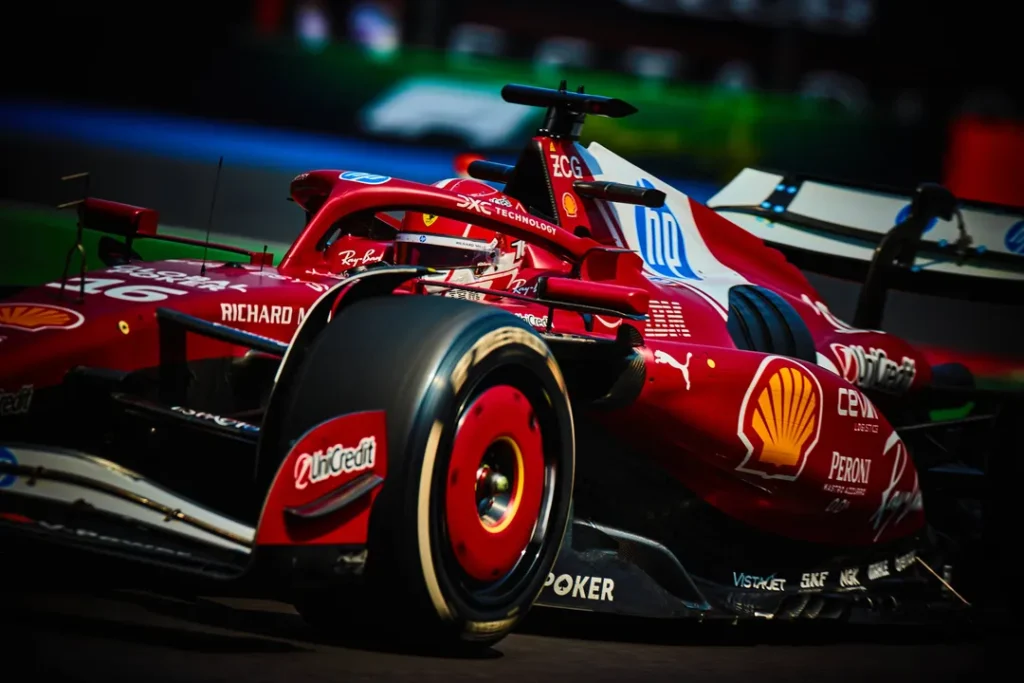
- The Engine Guarantee: Rumors persist that Hamilton’s contract contains performance clauses related to the 2026 Power Unit. If the Ferrari engine is not competitive under the new regulations, Hamilton may have exit grounds.
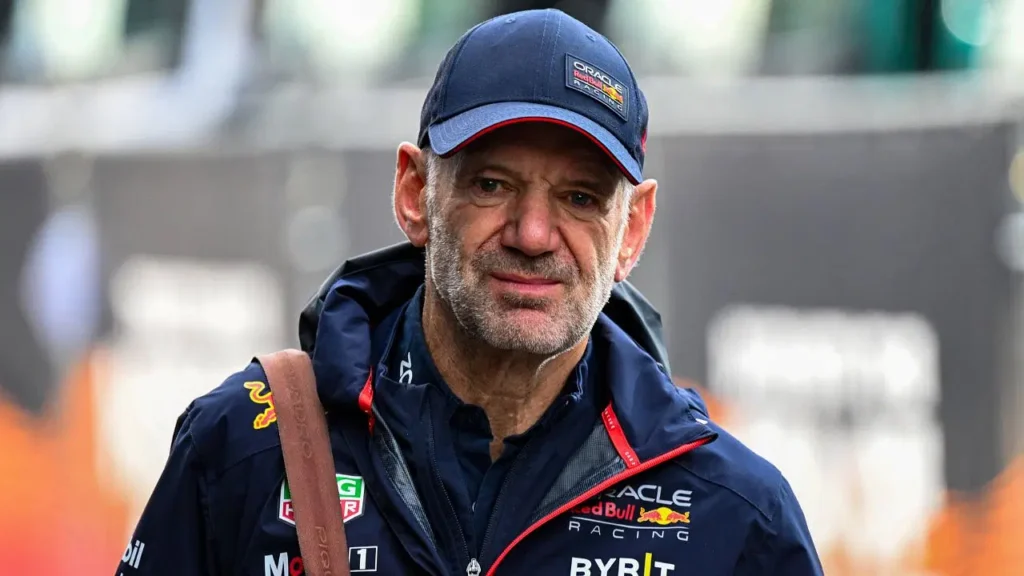
- The “Newey” Void: Ferrari failed to secure Adrian Newey, the sport’s preeminent designer, who joined Aston Martin. This failure leaves Ferrari relying on its internal technical committee—the same group Elkann claims is “improving” the current flawed car.
- The stakes: If the 2026 car is not an immediate contender, the F44 cancellation will be viewed by historians as the moment the partnership effectively died. Hamilton will likely exercise his exit clause, and Ferrari will be left with the bill for the most expensive failed experiment in F1 history.
The cancellation of Project F44 is not merely a decision about a road car; it is a symptom of a profound misalignment between Lewis Hamilton and the institution of Ferrari.
Hamilton arrived in Maranello seeking a partnership—a role where his voice, his legacy, and his creative vision would be integrated into the fabric of the Prancing Horse. He found instead a rigid corporate hierarchy, led by a Chairman in John Elkann who views the driver as a subservient component of the machine. The replacement of Hamilton’s V12 manual dream with the corporate-aligned V6 hybrid SC40 is the ultimate rejection of his philosophy.
Coupled with the “talk less” ultimatum and the operational abandonment of the 2025 season, the message from Maranello is clear: Conform or leave.
As the team enters the critical winter development phase for 2026, the atmosphere is toxic. Vasseur is fighting for his survival against the shadow of Christian Horner; Hamilton is fighting against a car and a management structure that has turned against him; and Elkann is fighting to prove that the “Ferrari way” can still win in the modern era. Unless the 2026 car is a masterpiece, the “Transfer of the Century” is destined to be remembered as a monumental collision of egos, ending in wreckage for both parties.