

Aston Martin AMR25
The Rear Wing: A Balancing Act of Downforce and Drag
The rear wing is one of the most substantial aerodynamic components on a Formula 1 car. As air flows over and around it, the wing generates downforce, effectively pushing the car firmly onto the racetrack. This downforce is vital for mechanical grip, which is absolutely crucial for optimal cornering performance. A stable rear end also significantly improves a car’s turn-in capability by minimizing unwanted sliding, and the AMR25’s rear wing has been specifically designed with this in mind.
However, rear wings inherently create a turbulent airflow, known as a wake, which increases air resistance, or drag. It’s a fundamental trade-off: a smaller rear wing results in less drag and consequently higher straight-line speeds. Conversely, a larger rear wing will produce more downforce, but at the cost of increased drag and reduced straight-line velocity.
The Drag Reduction System (DRS)
Integrated into the rear wing is the Drag Reduction System (DRS). At designated points on the circuit, drivers can activate DRS using a button on their steering wheel, which opens a flap on the rear wing. This action significantly reduces drag as air flows through the newly created gap, providing a substantial boost to straight-line speed and enhancing overtaking opportunities. During a race, drivers are permitted to use DRS when they are within one second of the car ahead at the DRS detection point.
For this season, the regulations governing the rear wing’s minimum gap when DRS is closed have been adjusted. This gap has been reduced from the previous 10-15mm range to 9.4-13mm. When DRS is open, the maximum allowable gap remains 85mm.


Bodywork: A Visual and Aerodynamic Evolution
The most noticeable visual alteration from its predecessor is the reprofiled sidepods of the AMR25. These feature a deep undercut and a flowing channel along their upper surface, meticulously designed to optimize airflow guidance.
To accommodate this new sidepod design, the radiator layout has been reconfigured and tightly packaged. These radiators are crucial for regulating the powertrain’s temperature.
The engine cover now boasts a jagged, razor-sharp spine extending from the airbox towards the rear wing. This distinctive feature serves to direct airflow precisely to the rear of the car. Large louvres are integrated to efficiently draw hot air away from the turbocharged 1.6-litre V6 hybrid power unit and its cooling systems, which are nestled beneath the tightly fitted bodywork. Further enhancing cooling, a cooling cannon at the rear channels air from the radiators.
Front Wing: Enhancing Stability and Downforce
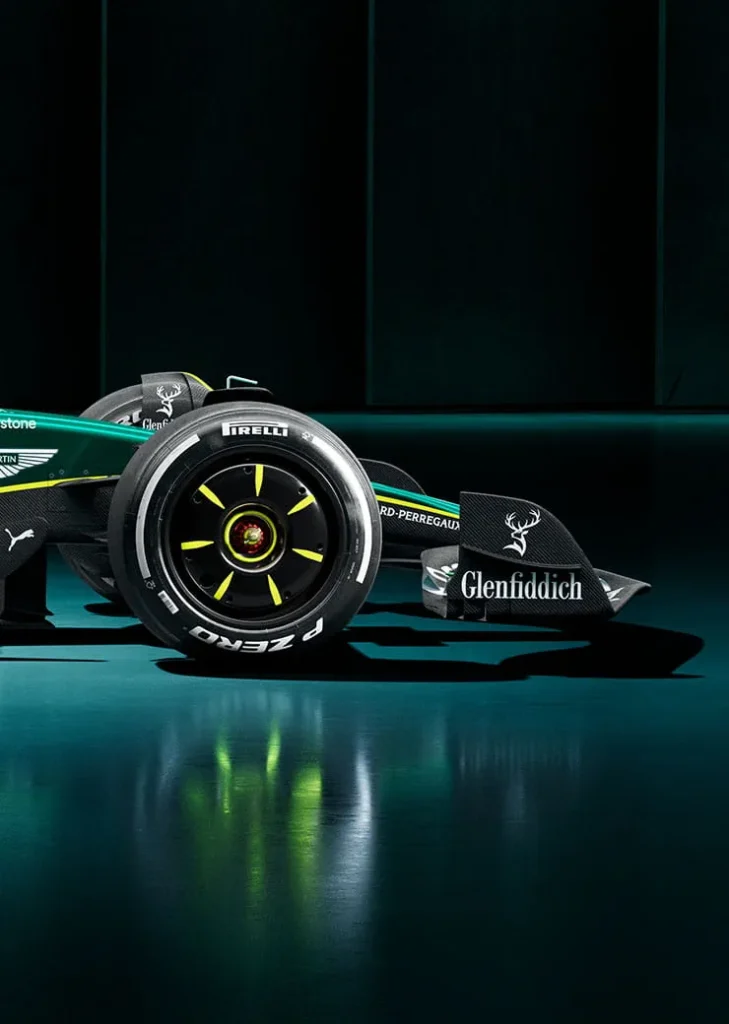
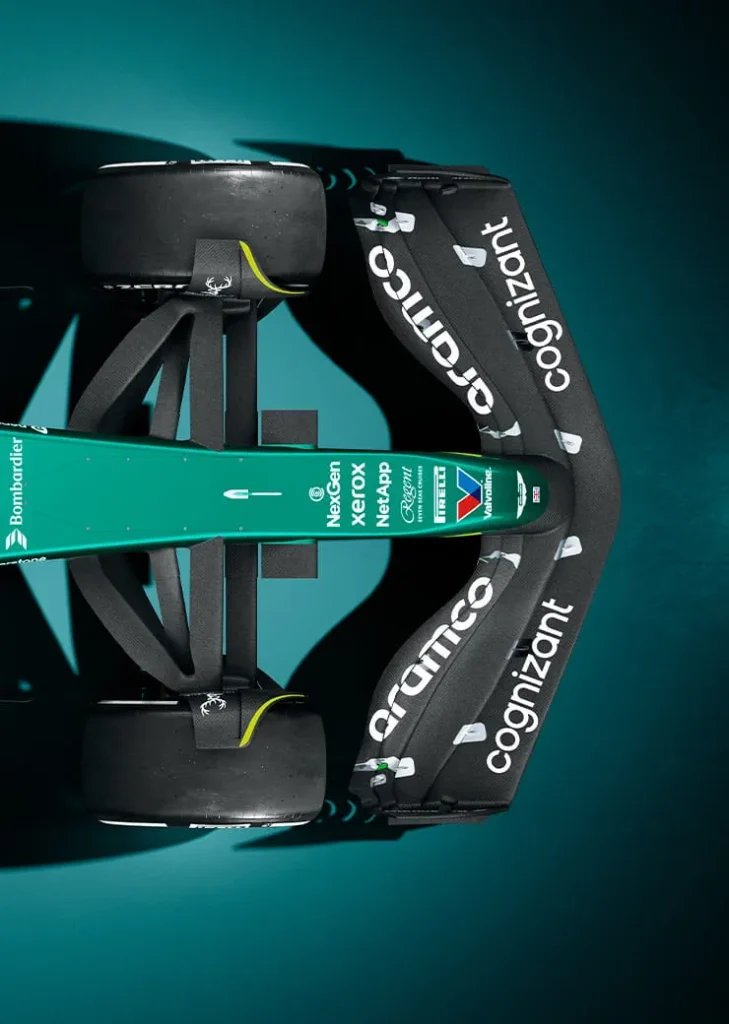
The front wing on the AMR25 represents a considerable advancement from the version introduced late last year. The modifications primarily aim to boost low-speed downforce, refine the car’s balance, and provide drivers with greater stability throughout every stage of cornering.
Operating at speeds exceeding 350 km/h, the front wing plays a critical role in the car’s overall performance by meticulously directing airflow across all aerodynamic surfaces.
Working in unison, the front wing and nose, alongside the over-wheel winglets, effectively manage the front-wheel wake. They direct this turbulent air away from the car’s bodywork, which in turn helps to increase downforce at the rear.
Brakes: Optimized for Performance and Endurance
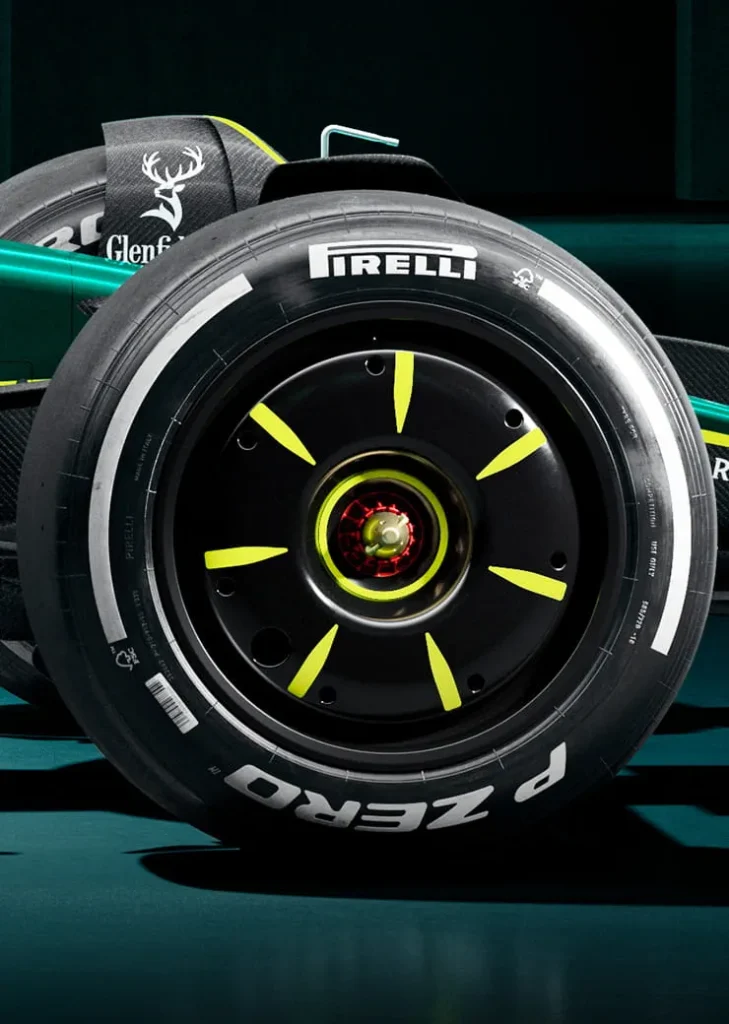
The AMR25 features new brake ducts at both the front and rear, specifically engineered to enhance brake cooling and airflow management. These ducts efficiently channel air into and out of the brake assembly, which on the AMR25 comprises Brembo brake calipers and Carbon Industrie carbon fiber discs and pads.
These powerful brakes can decelerate the car at an astonishing rate of up to 6G, generating over four times the braking power of the hybrid power unit itself. This allows the car to come to a complete stop from 320 km/h in less than five seconds. They are also built to endure extreme temperatures, withstanding up to 1,000°C.
A critical balance must be achieved between aerodynamic cooling and overall aerodynamic efficiency. Larger brake ducts provide superior cooling, but this comes at the cost of reduced aerodynamic efficiency. The severity of a circuit’s braking demands will ultimately dictate the optimal design choice.
Power Unit: The Heart of the AMR25
The AMR25’s power unit is a marvel of engineering, generating approximately 1,000bhp. It’s a complex system made up of several key components: the internal combustion engine, the motor generator unit-heat (MGU-H), the motor generator unit-kinetic (MGU-K), a turbocharger, the energy store, control electronics, and the exhaust system.
The MGU-H plays a crucial role by harnessing energy from the engine’s exhaust gases to generate electricity. This power is then used to keep the turbocharger spinning at optimal speeds, effectively eliminating turbo-lag. Meanwhile, the MGU-K recovers kinetic energy during deceleration, converting it into additional power that can be deployed when the throttle is applied.
Behind this powerful unit sits the eight-speed, semi-automatic Mercedes F1 gearbox. This marks the final season the team will utilize an externally sourced gearbox, as from 2026, Aston Martin will transition to transmission and hydraulics developed entirely in-house at our cutting-edge AMR Technology Campus.
Central Systems and Safety Innovations
Deep within the car’s core are essential components like the fuel cell, which has a capacity of 110kg, and the electronic control unit (ECU). The ECU acts as the car’s brain, processing data from hundreds of sensors to fine-tune performance and ensure peak efficiency throughout races. It’s responsible for managing and controlling various critical systems, including engine performance, transmission, and energy recovery.
This central area also houses vital safety features. The roll hoop, positioned directly behind the driver’s head, is engineered to withstand an incredible 15G of vertical impact. Furthermore, the halo, a protective structure fixed above the cockpit, is crafted from a super-light, super-strong aerospace-grade titanium alloy and can withstand a force of 12,500kg.


Floor: The Ground-Effect Powerhouse
The AMR25 features a revised floor design, specifically crafted to enhance airflow beneath the car. This new floor works in harmony with the updated sidepod and bodywork designs, enabling superior airflow management both under the car and over the rear wing.
A significant portion of a Formula 1 car’s downforce is generated by its floor. Maximizing performance from this area is crucial for unlocking overall speed, which is why the floors of F1 cars have been a primary battleground for development since the current technical regulations were introduced in 2022.
An F1 car’s floor incorporates a complex series of channels and tunnels that work synergistically to create downforce and minimize drag. These channels guide air through a section that narrows under the car before widening again towards the rear. This strategic narrowing and widening accelerates the airflow, creating a low-pressure area that generates additional downforce and effectively pulls the car closer to the racetrack—a phenomenon known as ground effect.
Remarkably, at speeds of approximately 150 km/h, the car can generate downforce equivalent to its own weight.
Suspension: Balancing Grip and Aerodynamics
The suspension system in a Formula 1 car plays a multifaceted role, often requiring a delicate balance between seemingly contradictory demands. It needs to be compliant enough to ensure consistent tire grip as the car navigates track undulations, yet simultaneously stiff enough to maintain the optimum ride height for aerodynamic performance.
A finely tuned suspension setup is critical for controlling weight transfer distribution, which significantly improves the car’s cornering ability. Furthermore, the suspension geometry must guarantee that as much of the tire’s surface as possible remains in contact with the track, maximizing grip and allowing for earlier throttle application out of corners.
Suspension Layout and Its Aerodynamic Impact
The layout of the suspension profoundly influences a car’s aerodynamics, as the suspension arms are exposed and located in highly sensitive airflow regions. The AMR25 utilizes a push-rod suspension layout at both the front and rear. In this configuration, the wheel assembly connects to the chassis via a diagonal structure, with the push-rod’s higher attachment point on the car’s body. A pull-rod suspension, conversely, uses the opposite arrangement.
A push-rod setup offers several advantages: it provides cleaner airflow around the suspension arms, is generally lighter, and offers easier access for mechanics should repairs be needed. While pull-rod suspension can offer benefits in terms of a lower center of gravity due to heavier components like springs and dampers being mounted lower in the chassis, the push-rod’s aerodynamic and maintenance advantages are favored here.
Constructed with aluminum uprights and carbon fiber composite wishbones, the suspension components must withstand immense forces while remaining light enough to avoid negatively impacting car performance. Springs and anti-roll bars are responsible for controlling the movement of the wheels relative to the chassis, while dampers dissipate energy and reduce unwanted oscillations, ensuring a stable and controlled ride.
- Technical Specifications
Chassis
Carbon fibre composite monocoque with Zylon legality side anti-intrusion panels.
Suspension
Aluminium uprights with carbon fibre composite wishbones, track rod and push-rod. Inboard chassis mounted torsion springs, dampers and anti-roll bar assembly.
Wheels
BBS Front: 18” x 13.2”, Rear: 18” x 16.9”
Clutch
AP Racing
Tyres
Pirelli P Zero
Brake system
Brembo brake calipers and in-house designed brake-by-wire system with Carbon Industrie carbon fibre discs and pads.
Electronics
McLaren Applied TAG single ECU with in-house designed electrical harness
Overall width
2000mm
Wheelbase
3600mm max
Overall weight
Overall vehicle weight 798kg (including driver, excluding fuel). Weight distribution between 44.5% and 46.0%.
Engine PU supplier
Mercedes HPP
Engine PU spec
Mercedes-AMG F1 M16 E Performance. 1.6l V6 turbocharged and energy recovery system.
Transmission
Mercedes F1 eight-speed, semi-automatic